
Graphene Thermal Film Manufacturing: From Ink to Scalable Production
As demand for high-performance thermal management continues to grow, graphene thermal films have emerged as a promising solution for efficient heat dissipation.
However, transitioning from laboratory materials to reliable industrial production requires more than just high-quality graphene—it demands a well-integrated manufacturing pathway from formulation to scalable coating.
Understanding Graphene Thermal Films
Graphene thermal films are engineered to deliver:
- High in-plane thermal conductivity
- Lightweight and flexible structure
- Compatibility with electronic and energy systems
Their performance depends on two equally critical factors:
👉 material formulation and 👉 manufacturing process control
From Graphene Ink to Functional Films
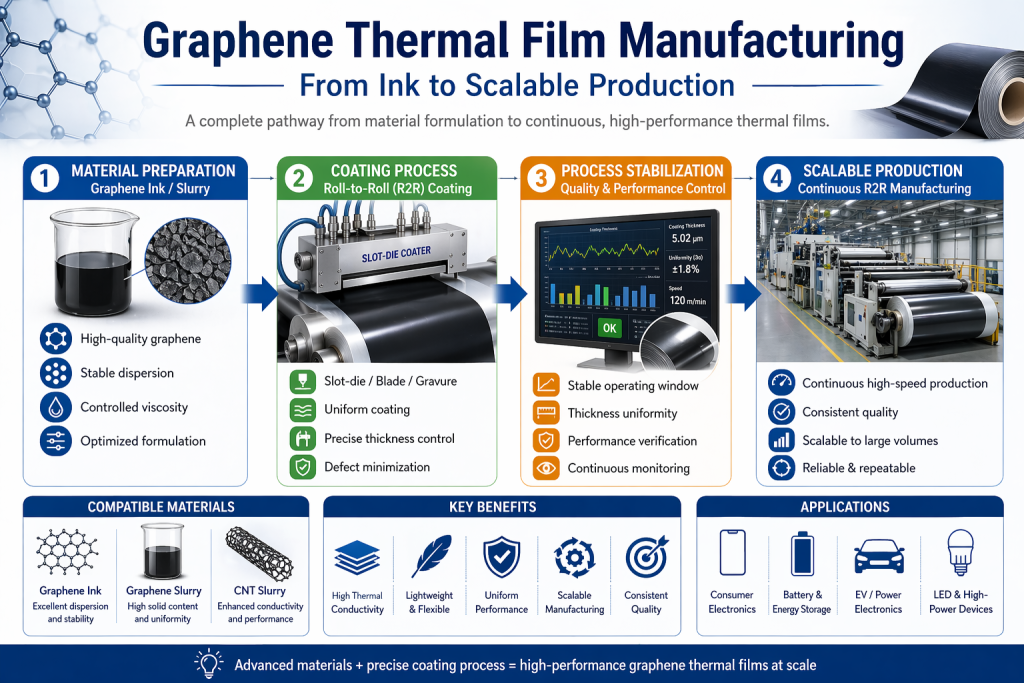
The production of graphene thermal films begins with graphene ink or graphene slurry, which serves as the foundation of the coating process.
Graphene Ink / Slurry Characteristics
Key parameters include:
- Solid content – affects final film thickness
- Viscosity – determines coating behavior
- Dispersion stability – ensures uniform film formation
- Flake size distribution – influences thermal and electrical performance
A well-formulated graphene ink enables consistent coating and minimizes defects during production.
Coating Technologies for Graphene Films
Once the material is prepared, the next step is selecting the appropriate coating method. Among various technologies, roll-to-roll (R2R) coating systems are widely used for graphene thermal film manufacturing.
Slot-Die Coating
- High precision and uniform thickness control
- Suitable for continuous large-area coating
- Ideal for scalable production
Blade / Knife Coating
- Flexible and widely used in early-stage development
- Suitable for higher viscosity materials
- Easier to adapt for certain formulations
Gravure Coating
- Enables patterned or intermittent coating
- High throughput for specific applications
Each method has its advantages, but the choice depends on material properties and final product requirements.
Process Stability: The Key to Film Quality
In industrial production, coating performance is not defined at the start, but during continuous operation.
To achieve consistent graphene thermal films:
- The coating process must reach a stable operating window
- Flow behavior, thickness, and uniformity must stabilize over time
- Defects such as streaks or edge effects must be minimized
This is why small-scale batch testing is often insufficient for evaluating real production performance.
From Process Validation to Scalable Manufacturing
A successful graphene thermal film manufacturing process follows a structured pathway:
1. Material Validation
- Ink formulation optimization
- Compatibility with coating method
- Initial film formation tests
2. Process Stabilization
- Continuous coating trials
- Equipment parameter tuning
- Uniformity and defect control
3. Performance Verification
- Thermal conductivity consistency
- Mechanical flexibility
- Adhesion and substrate compatibility
4. Scalable Production
- Continuous R2R manufacturing
- Repeatable process conditions
- Reduced variability and improved yield
This approach ensures a direct transition from laboratory development to industrial-scale production.
Integration with Functional Requirements
Graphene thermal films are often part of a broader system. Depending on the application, additional processes may include:
- Surface treatment (e.g., corona treatment)
- Lamination or multilayer structures
- Electrical integration or patterning
- Controlled drying and curing
These steps must be aligned with the coating process to maintain overall performance.
Applications of Graphene Thermal Films
Graphene-based thermal films are widely used in:
- Consumer electronics cooling
- Battery and energy storage systems
- Power modules and EV components
- LED and high-power devices
Their combination of thermal performance and flexibility makes them suitable for next-generation thermal management solutions.
Building a Scalable Manufacturing Strategy
The key to successful graphene thermal film production is not just material innovation, but process integration and scalability.
By aligning:
- Graphene ink formulation
- Coating technology selection
- Continuous process optimization
manufacturers can create a reliable pathway from concept to large-scale production.
Graphene thermal film manufacturing is a process-driven journey, where each step—from ink formulation to continuous coating—plays a critical role in final performance.
With the right combination of materials and scalable coating technologies, it is possible to achieve consistent, high-quality graphene films suitable for industrial applications.
Contact us to explore how graphene ink formulation and advanced coating processes can support your thermal film development and scalable production needs.