
CNT and Graphene Coatings: Enhancing Thermal and Electrical Performance
As industries move toward higher power density, lightweight systems, and advanced electronics, conventional coatings are no longer sufficient to meet modern performance demands.
CNT coatings and graphene coatings are emerging as next-generation functional materials capable of significantly improving:
- Electrical conductivity
- Thermal conductivity
- EMI shielding performance
- Mechanical durability
These advanced conductive coatings are increasingly used in applications ranging from battery systems and AI servers to industrial electronics and thermal management solutions.
What Are CNT and Graphene Coatings?
CNT Coatings
Carbon nanotube (CNT) coatings use interconnected 1D nanotube networks to create:
- Efficient electron pathways
- Flexible conductive structures
- Stable percolation networks
CNT coatings are particularly effective for:
- Conductive coatings
- Flexible electronics
- Antistatic applications
Graphene Coatings
Graphene coatings utilize 2D carbon sheets with exceptional:
- In-plane conductivity
- Thermal transport capability
- Barrier properties
Graphene-based coatings are widely used for:
- Thermal management
- Corrosion resistance
- EMI shielding
Why Conductive and Thermal Coatings Matter
Modern systems generate increasing:
- Heat
- Electrical interference
- Current density
This creates demand for coatings that can provide:
- Efficient heat dissipation
- Stable conductivity
- Lightweight multifunctionality
Traditional metal coatings often face limitations such as:
- Weight
- Corrosion
- Processing complexity
CNT and graphene coatings offer a lightweight alternative.
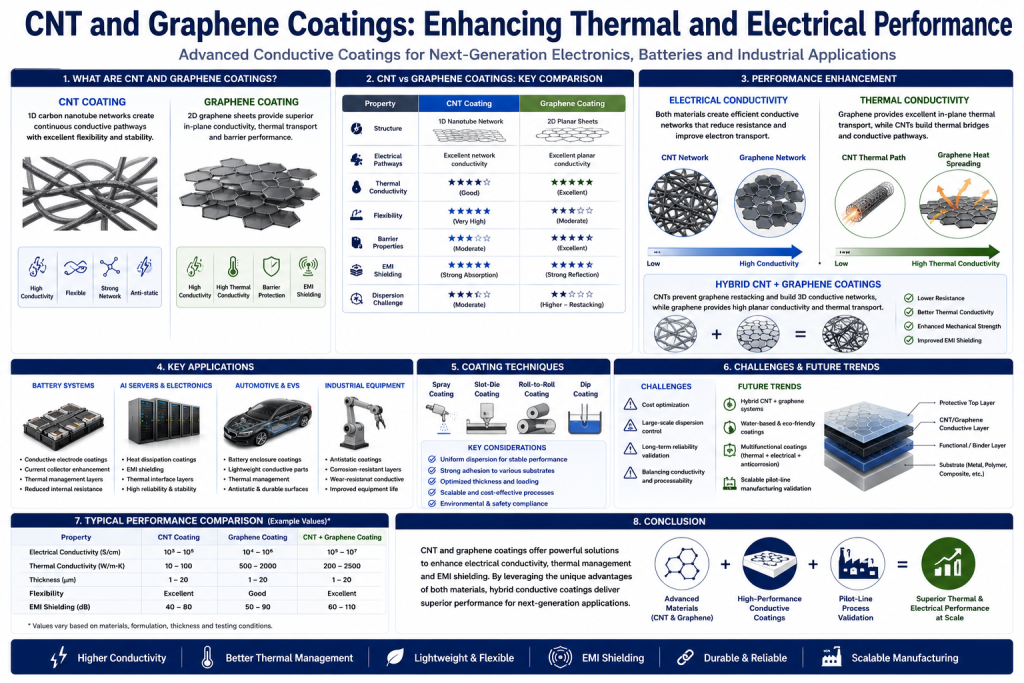
CNT vs Graphene Coatings: Key Differences
| Property | CNT Coating | Graphene Coating |
|---|---|---|
| Structure | 1D nanotube network | 2D planar sheets |
| Electrical Pathways | Excellent network conductivity | Excellent planar conductivity |
| Thermal Conductivity | Good | Excellent |
| Flexibility | Very high | Moderate |
| Barrier Properties | Moderate | Excellent |
| EMI Shielding | Strong absorption | Strong reflection/barrier |
| Dispersion Challenge | Moderate | Higher tendency to restack |
Electrical Conductivity Enhancement
CNT Coatings
CNTs form interconnected conductive networks with:
- Low percolation threshold
- Stable electron transport pathways
- Excellent flexibility under mechanical stress
This makes CNT coatings highly suitable for:
- Flexible conductive films
- Printed electronics
- Battery current collection enhancement
Graphene Coatings
Graphene provides:
- High surface conductivity
- Large-area conductive pathways
Applications include:
- Conductive structural coatings
- EMI shielding layers
- Smart surfaces
Thermal Conductivity Enhancement
Why Thermal Performance Matters
High-performance systems such as:
- AI servers
- EV batteries
- Power electronics
generate significant heat loads.
Efficient thermal coatings help:
- Reduce hotspots
- Improve reliability
- Extend component lifespan
Graphene for Thermal Management
Graphene is particularly effective due to its:
- Extremely high in-plane thermal conductivity
- Thin and lightweight structure
Applications include:
- Heat spreaders
- Thermal interface enhancement
- Cooling coatings
CNT Thermal Networks
CNTs improve heat transfer by:
- Bridging thermal gaps
- Creating conductive pathways inside composite systems
Especially useful in:
- Flexible thermal coatings
- Polymer-based thermal systems
Hybrid CNT + Graphene Coatings
Combining CNTs and graphene creates synergistic effects:
- CNTs prevent graphene restacking
- Graphene enhances planar conductivity
- Hybrid structures improve both thermal and electrical transport
Result:
👉 Multi-dimensional conductive networks with enhanced overall performance.
Key Industrial Applications
Battery Systems
- Conductive electrode coatings
- Current collector enhancement
- Thermal management layers
AI Servers & Electronics
- Heat dissipation coatings
- EMI shielding systems
- Conductive thermal interfaces
Industrial Equipment
- Antistatic coatings
- Corrosion-resistant conductive surfaces
Automotive & EVs
- Battery enclosure coatings
- Lightweight conductive components
Processing and Manufacturing Considerations
Dispersion Stability
Uniform dispersion is critical for:
- Stable conductivity
- Coating consistency
Coating Techniques
Common methods include:
- Spray coating
- Slot-die coating
- Roll-to-roll processing
- Dip coating
Functionalization
Surface treatment may improve:
- Adhesion
- Compatibility with polymers and resins
Challenges
- Cost optimization
- Large-scale dispersion control
- Long-term reliability validation
- Balancing conductivity with processability
Future Trends
The future of conductive coatings is moving toward:
- Hybrid CNT + graphene systems
- Water-based environmentally friendly coatings
- Multifunctional coatings (thermal + electrical + anticorrosion)
- Scalable pilot-line manufacturing validation
CNT coatings and graphene coatings are transforming the future of thermal and electrical performance materials.
While CNTs excel in forming flexible conductive networks, graphene provides exceptional planar conductivity and thermal transport. Together, they create advanced multifunctional coating systems suitable for next-generation industrial applications.
As industries continue pushing toward higher power density and lightweight system design, conductive carbon coatings will become increasingly important in scalable industrial manufacturing.