
How Pilot Lines Reduce Risk in Advanced Material Projects
Developing a new material is exciting.
Whether it is graphene, carbon nanotubes (CNTs), silicon-based anodes, thermal management materials, or next-generation battery components, laboratory results often demonstrate impressive performance improvements.
However, many advanced material projects fail long before reaching commercial success.
The reason is rarely the material itself.
Instead, failure often occurs during the transition from laboratory development to industrial production.
This stage is where technical, operational, and financial risks become most visible.
Pilot lines are designed specifically to address these challenges.
By providing a controlled environment between research and mass production, pilot manufacturing helps companies identify risks early, optimize processes, and increase the probability of successful commercialization.
The Hidden Risks of Scale-Up
A common misconception is that scaling up simply means producing more material.
In reality, increasing production volume introduces entirely new variables.
Factors that often change during scale-up include:
- Mixing dynamics
- Heat transfer
- Residence time
- Material dispersion
- Drying behavior
- Equipment performance
As a result, a process that performs perfectly in the laboratory may behave very differently at larger scales.
Without validation, these issues often remain hidden until significant investments have already been made.
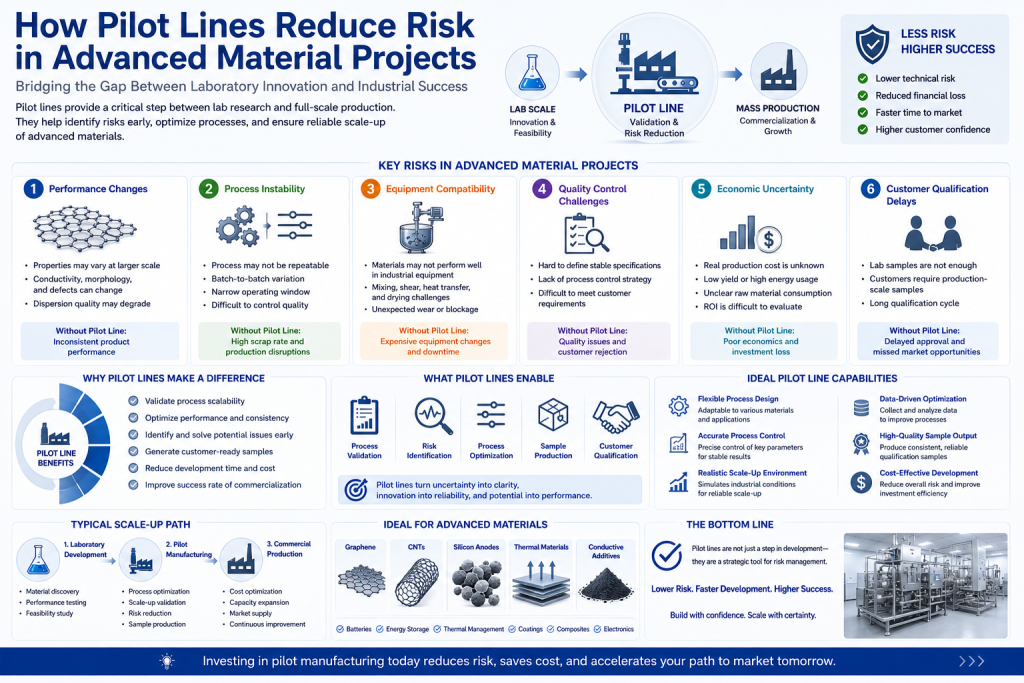
Risk 1: Product Performance Changes
One of the most common risks in advanced material projects is performance inconsistency.
Laboratory samples are typically produced under highly controlled conditions.
When production volume increases, manufacturers may observe:
- Reduced conductivity
- Lower thermal performance
- Increased defect levels
- Changes in particle morphology
- Loss of dispersion quality
Pilot lines help identify these changes before commercial production begins.
This allows engineers to optimize processing parameters while minimizing risk.
Risk 2: Process Instability
A successful laboratory experiment does not necessarily translate into a stable manufacturing process.
Industrial production requires:
- Repeatability
- Consistency
- Predictable quality
Pilot-scale validation evaluates:
- Batch-to-batch variation
- Process robustness
- Equipment reliability
- Operating windows
By identifying instability early, companies can avoid costly production disruptions later.
Risk 3: Equipment Compatibility Issues
Many advanced materials place unique demands on manufacturing equipment.
Examples include:
Graphene
- Agglomeration control
- High-shear dispersion
- Drying sensitivity
CNTs
- Entanglement
- Rheology challenges
- Conductive network formation
Silicon-Based Materials
- Particle stability
- Volume expansion management
Pilot lines help determine whether existing equipment can successfully process these materials before large-scale investments are made.
Risk 4: Quality Control Challenges
Customers expect consistent material specifications.
Even small variations may affect:
- Battery performance
- Thermal conductivity
- Mechanical properties
- Product reliability
Pilot manufacturing enables companies to establish:
- Process control strategies
- Quality specifications
- Inspection protocols
- Statistical process control methods
This foundation becomes critical during commercial production.
Risk 5: Economic Uncertainty
Technical success alone does not guarantee commercial success.
A material must also be economically viable.
Pilot production helps evaluate:
- Manufacturing yield
- Raw material consumption
- Energy requirements
- Labor efficiency
- Production throughput
These data provide a realistic picture of production economics before major capital commitments are made.
Risk 6: Customer Qualification Delays
Many customers require production-scale samples before approving a new material.
Laboratory samples are often insufficient for:
- Battery manufacturers
- Automotive suppliers
- Electronics companies
- Industrial OEMs
Pilot lines enable the production of:
- Representative samples
- Qualification batches
- Process validation lots
This significantly accelerates customer approval and market entry.
Why Pilot Lines Matter for Advanced Carbon Materials
Advanced carbon materials present unique scale-up challenges.
Graphene
Pilot validation helps optimize:
- Exfoliation processes
- Dispersion stability
- Thermal performance consistency
- Manufacturing repeatability
Carbon Nanotubes (CNTs)
Pilot testing supports:
- Conductive network formation
- Slurry rheology optimization
- Coating compatibility
- Electrode manufacturing performance
Thermal Management Materials
Pilot production verifies:
- Thermal conductivity consistency
- Interface performance
- Long-term reliability
- Manufacturing scalability
The Pilot Line as a Risk Management Tool
Rather than viewing pilot manufacturing as an additional development step, successful companies increasingly treat it as a strategic risk management tool.
A pilot line helps answer critical questions:
- Can the material be manufactured consistently?
- Will quality remain stable during scale-up?
- Can existing equipment support production?
- What is the real production cost?
- Will customers accept the product?
Answering these questions before industrial investment dramatically reduces project uncertainty.
The Typical Scale-Up Path
Most successful advanced material projects follow a structured pathway:
Stage 1: Laboratory Development
Focus on:
- Material innovation
- Performance validation
- Feasibility studies
Stage 2: Pilot Manufacturing
Focus on:
- Process optimization
- Scale-up validation
- Risk reduction
- Sample production
Stage 3: Commercial Production
Focus on:
- Cost optimization
- Capacity expansion
- Customer qualification
- Market growth
Skipping the pilot stage often increases both technical and financial risk.
The transition from laboratory innovation to commercial production is one of the most challenging stages in any advanced material project.
While laboratory testing demonstrates potential, pilot manufacturing demonstrates reality.
By validating processes, identifying scale-up challenges, reducing uncertainty, and generating customer-ready samples, pilot lines provide a critical bridge between innovation and commercialization.
For companies developing graphene, CNTs, battery materials, thermal management solutions, and other advanced technologies, pilot manufacturing is not simply a development step—it is one of the most effective tools for reducing risk and improving the likelihood of long-term commercial success.