
Graphene Is Not the Product — Integration Is
For more than a decade, graphene has been promoted as a revolutionary material.
Researchers have highlighted its:
- Exceptional electrical conductivity
- Outstanding thermal conductivity
- High mechanical strength
- Large surface area
- Lightweight structure
Thousands of scientific papers have demonstrated graphene’s potential across industries ranging from batteries and electronics to coatings and composites.
Yet despite this excitement, graphene adoption has often progressed more slowly than expected.
The reason is surprisingly simple:
Graphene is not the product.
The real challenge is integrating graphene into a product that delivers measurable value.
In most successful commercial applications, customers are not buying graphene itself.
They are buying improved performance, lower costs, enhanced reliability, or new functionality.
Graphene is simply one part of the solution.
The Difference Between Material Innovation and Product Innovation
Many graphene projects begin by focusing on material properties.
Questions often include:
- How conductive is the graphene?
- How many layers does it have?
- What is its surface area?
- What is the defect density?
These metrics are important.
However, customers rarely purchase materials based solely on laboratory specifications.
Instead, they ask:
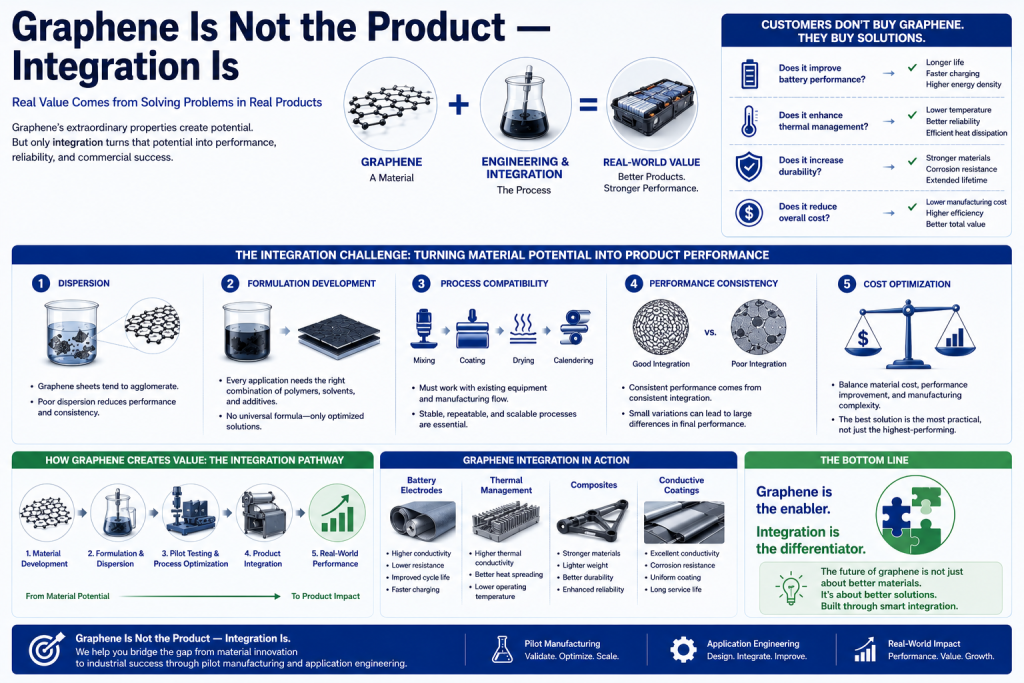
- Does it improve battery performance?
- Does it enhance thermal management?
- Does it extend product lifetime?
- Does it reduce manufacturing costs?
In other words, customers care about product outcomes rather than material characteristics.
Why Great Materials Often Fail Commercially
History is filled with examples of technically impressive materials that failed to achieve widespread adoption.
The reason is not poor performance.
The reason is poor integration.
A material may offer excellent properties in isolation but still face challenges such as:
- Difficult processing
- High cost
- Poor compatibility
- Manufacturing complexity
- Reliability concerns
Graphene is no exception.
Commercial success requires solving these practical challenges.
Graphene Creates Value Only When It Enters a System
Graphene rarely functions as a standalone product.
Instead, it becomes part of a larger system.
Examples include:
Battery Electrodes
Customers do not purchase graphene because of its conductivity.
They purchase batteries with:
- Faster charging
- Longer cycle life
- Higher energy density
Graphene’s value is realized only when it improves electrode performance.
Thermal Management Materials
Customers are not interested in graphene films alone.
They want:
- Lower operating temperatures
- Improved reliability
- Better heat dissipation
Graphene becomes valuable when integrated into thermal interface materials, cooling plates, or heat spreaders.
Conductive Coatings
The goal is not to add graphene.
The goal is to create coatings with:
- Enhanced conductivity
- Improved corrosion resistance
- Greater durability
Again, integration creates the commercial value.
The Integration Challenge
Integrating graphene into a product is often far more difficult than producing graphene itself.
Common challenges include:
Dispersion
Graphene sheets tend to agglomerate.
Poor dispersion can eliminate many of graphene’s advantages.
Formulation Development
Each application requires unique formulations involving:
- Polymers
- Solvents
- Additives
- Processing conditions
There is no universal graphene recipe.
Process Compatibility
Graphene must work within existing manufacturing systems.
Questions include:
- Can it be coated?
- Can it be mixed?
- Can it be dried?
- Can it be processed consistently?
Industrial compatibility is often more important than laboratory performance.
Cost Optimization
Even when technical performance improves, economics remain critical.
Successful integration requires balancing:
- Material cost
- Performance gains
- Manufacturing complexity
- Production yield
The best solution is not always the highest-performing material.
It is often the most practical one.
Why Pilot Manufacturing Matters
The gap between graphene development and graphene commercialization is often an integration problem.
Pilot manufacturing helps bridge this gap.
Pilot-scale validation allows engineers to evaluate:
- Material behavior in real processes
- Dispersion quality
- Coating performance
- Manufacturing repeatability
- Production economics
Most importantly, pilot lines reveal whether graphene can create value within a complete product system.
Moving From Graphene Suppliers to Solution Providers
The graphene industry is evolving.
Early-stage companies often focused on selling graphene powder, graphene oxide, or graphene dispersions.
Today, the most successful companies increasingly focus on delivering solutions.
Rather than asking:
“How much graphene can we sell?”
The more important question becomes:
“How much customer value can graphene create?”
This shift transforms graphene from a material business into an application business.
The Future of Graphene Commercialization
As the industry matures, successful graphene projects will increasingly be defined by integration rather than material performance alone.
Future winners are likely to excel in:
- Application engineering
- Process development
- Pilot-scale validation
- Product design
- Manufacturing integration
The companies that master these capabilities will be better positioned to convert graphene’s extraordinary properties into real commercial success.
Conclusion
Graphene remains one of the most exciting advanced materials of the modern era.
However, commercial success depends on much more than producing high-quality graphene.
Customers do not purchase graphene for its own sake.
They purchase products that perform better, last longer, charge faster, dissipate heat more effectively, or reduce operating costs.
Graphene becomes valuable only when it is successfully integrated into those products.
In that sense, graphene is not the product.