
Why Dry Electrode Technology Is Gaining Attention
As global demand for lithium-ion batteries continues to grow, manufacturers face increasing pressure to improve production efficiency, reduce costs, and minimize environmental impact.
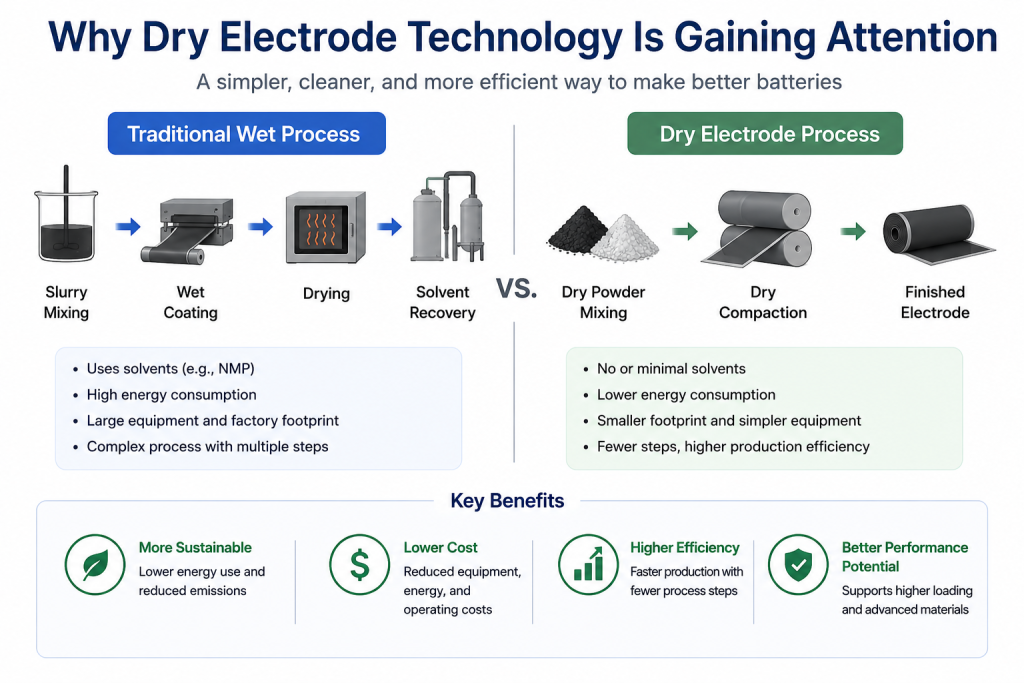
Traditional battery manufacturing relies heavily on wet processing methods involving:
- Slurry preparation
- Solvent usage
- Electrode coating
- Drying
- Solvent recovery
While these processes are well established, they also contribute significantly to manufacturing costs, energy consumption, and factory complexity.
As a result, the battery industry is increasingly exploring an alternative approach:
Dry Electrode Technology.
By reducing or eliminating the need for solvents and large drying systems, dry electrode processing has attracted attention as a potentially transformative manufacturing method for next-generation batteries.
What Is Dry Electrode Technology?
Dry electrode technology refers to manufacturing methods that produce battery electrodes without relying on traditional solvent-based slurry coating.
Instead of creating a liquid slurry, active materials, conductive additives, and binders are processed in a dry state and formed directly into electrode structures.
The process generally eliminates several conventional steps, including:
- Solvent preparation
- Wet coating
- Long drying stages
- Solvent recovery operations
The goal is to simplify manufacturing while maintaining or improving electrode performance.
Why Traditional Wet Processing Is Challenging
Wet electrode manufacturing has proven highly effective, but it introduces several limitations.
High Energy Consumption
Large drying ovens consume substantial amounts of energy.
For many battery factories, drying represents one of the most energy-intensive production stages.
Solvent Recovery Requirements
Cathode production often uses NMP (N-Methyl-2-pyrrolidone).
This solvent requires:
- Recovery systems
- Environmental controls
- Additional operating costs
Factory Footprint
Drying ovens and solvent recovery systems occupy significant factory space.
Large battery plants often dedicate substantial areas to these operations.
Process Complexity
Wet processing requires control of:
- Slurry rheology
- Coating behavior
- Drying profiles
- Binder migration
- Solvent removal
Each stage introduces potential sources of variability.
The Key Advantages of Dry Electrode Manufacturing
Dry electrode technology aims to address many of these challenges.
Lower Energy Consumption
Without large drying ovens, energy requirements can be significantly reduced.
This can improve both economics and sustainability.
Reduced Capital Investment
Eliminating solvent recovery and drying equipment may reduce factory infrastructure requirements.
Potential benefits include:
- Lower equipment costs
- Simpler production layouts
- Faster facility deployment
Smaller Manufacturing Footprint
Dry electrode production lines may occupy less space than conventional wet processing systems.
This could improve factory utilization and scalability.
Faster Production
Removing lengthy drying stages may increase overall manufacturing throughput.
Higher productivity can help reduce battery production costs.
Potential Performance Benefits
In addition to manufacturing advantages, dry electrode processes may offer technical benefits.
Higher Electrode Loading
Dry processing may support thicker electrodes while maintaining structural integrity.
This can contribute to higher energy density.
Improved Electrode Architecture
Some dry manufacturing methods enable unique particle arrangements and conductive networks.
This may improve:
- Electron transport
- Mechanical stability
- Energy utilization
Reduced Binder Migration
Because solvents are absent, issues related to drying-induced binder migration can be minimized.
This may improve electrode uniformity.
Applications in Advanced Battery Technologies
Dry electrode manufacturing is attracting attention across several battery sectors.
Electric Vehicles
Manufacturers are seeking lower-cost, high-volume production methods.
Energy Storage Systems
Large-scale battery production benefits from reduced manufacturing expenses.
High-Energy-Density Batteries
Thicker electrode structures may support improved energy density.
Next-Generation Chemistries
Emerging battery systems may benefit from alternative electrode fabrication approaches.
The Role of Carbon Materials
Advanced carbon materials remain important in dry electrode systems.
Examples include:
Carbon Nanotubes (CNTs)
CNTs can help form conductive networks throughout the electrode.
Their high aspect ratio is particularly valuable in dry processing.
Graphene
Graphene may contribute to:
- Conductivity enhancement
- Mechanical reinforcement
- Electrode stability
Conductive Carbon Additives
Optimized conductive architectures remain essential for high-performance battery operation.
As dry electrode technology evolves, carbon material engineering is expected to play an increasingly important role.
Challenges Facing Dry Electrode Technology
Despite growing interest, several technical challenges remain.
Material Distribution
Achieving uniform particle distribution without solvents can be difficult.
Binder Selection
Dry processes require specialized binder systems capable of forming strong electrode structures.
Electrode Uniformity
Maintaining consistent thickness and density across large production widths remains challenging.
Scale-Up Complexity
Laboratory success must still be validated under industrial production conditions.
Many dry electrode concepts remain in various stages of commercialization.
Why Pilot Validation Is Essential
As with any emerging manufacturing technology, pilot-scale validation is critical.
Pilot production allows engineers to evaluate:
- Material handling
- Electrode formation
- Process stability
- Product consistency
- Manufacturing economics
Pilot trials help identify scale-up risks before full commercial deployment.
For many companies, pilot validation is the key step between innovation and industrialization.
Dry vs Wet Electrode Manufacturing
| Factor | Wet Process | Dry Process |
|---|---|---|
| Solvent Use | Required | Minimal or None |
| Drying Ovens | Required | Reduced or Eliminated |
| Energy Consumption | Higher | Lower Potential |
| Factory Footprint | Larger | Smaller Potential |
| Process Maturity | Highly Mature | Emerging |
| Scale-Up Experience | Extensive | Developing |
Both technologies have advantages, and future manufacturing may involve a combination of approaches depending on application requirements.
Future Outlook
Interest in dry electrode technology continues to grow due to several industry trends.
Battery Cost Reduction
Manufacturers seek more efficient production methods.
Sustainability Goals
Lower energy consumption supports environmental objectives.
Gigafactory Expansion
Simplified manufacturing may accelerate capacity growth.
Advanced Materials Integration
CNTs, graphene, and next-generation conductive architectures may further enhance dry electrode performance.
While wet processing will remain important for many years, dry electrode technology is increasingly viewed as a promising pathway toward future battery manufacturing.
Dry electrode technology is gaining attention because it addresses some of the most expensive and energy-intensive aspects of conventional battery manufacturing.
By reducing dependence on solvents, drying systems, and recovery equipment, dry processing has the potential to simplify production, lower costs, and improve sustainability.
At the same time, challenges involving material distribution, electrode formation, and large-scale manufacturing remain active areas of development.
As battery demand continues to expand worldwide, the combination of advanced carbon materials, innovative processing methods, and pilot-scale validation will play a crucial role in determining how rapidly dry electrode technology moves from promising concept to industrial reality.