

Co-Development Models in Next-Generation Battery Projects
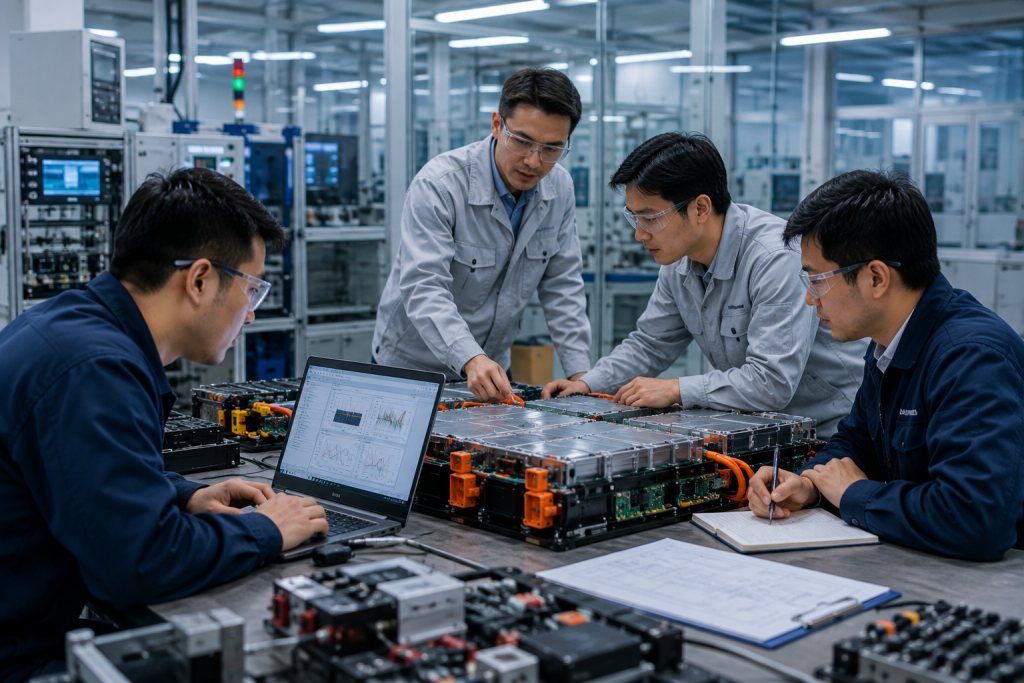
The battery industry is entering a new phase of development. As lithium-ion batteries continue to evolve and technologies such as sodium-ion batteries, solid-state batteries, silicon-based anodes, lithium-metal batteries, and advanced battery materials move toward commercialization, the traditional supplier-customer relationship is becoming increasingly insufficient.
Next-generation battery projects often involve complex technical requirements, uncertain scale-up pathways, specialized equipment, new materials, and application-specific performance targets. In many cases, no single company possesses all the capabilities required to move a technology from laboratory validation to commercial production.
This is where co-development models become increasingly important.
Instead of simply purchasing materials, equipment, or engineering services, battery manufacturers, material suppliers, technology companies, research institutions, and system integrators can work together to develop a solution around a clearly defined technical and commercial objective.
A well-designed co-development model can reduce development time, improve technology validation, accelerate pilot production, and create a more reliable path toward commercialization.
What Is a Co-Development Model?
A co-development model is a structured collaboration in which two or more organizations jointly contribute resources, technical expertise, equipment, materials, testing capabilities, or market knowledge to develop a new battery product, process, material, or manufacturing solution.
The collaboration can take many forms.
For example:
- Battery manufacturers working with material suppliers
- Cell developers working with electrode technology companies
- Equipment manufacturers working with battery R&D teams
- Universities working with industrial partners
- Material companies working with downstream application companies
- Pilot-line operators supporting emerging battery technologies
- System integrators collaborating with battery technology developers
The key difference from conventional procurement is that the parties are not simply exchanging a finished product for a purchase order.
Instead, they jointly address a development problem.
The objective may be to achieve a specific energy density, improve cycle life, reduce manufacturing cost, validate a new material, develop a production process, or establish a pilot-scale manufacturing route.
Why Co-Development Is Becoming More Important
Next-generation battery technologies typically have higher technical uncertainty than mature lithium-ion products.
A company developing a new battery chemistry may have excellent laboratory data but still face major challenges when moving toward pilot production.
These challenges can include:
- Raw material consistency
- Electrode processing
- Slurry formulation
- Coating behavior
- Drying conditions
- Cell assembly
- Formation protocols
- Electrolyte compatibility
- Moisture control
- Thermal management
- Equipment compatibility
- Production yield
- Quality control
- Scale-up economics
A technology that performs well in a coin cell or small laboratory pouch cell does not automatically become commercially viable.
Co-development allows these issues to be addressed earlier by bringing multiple technical capabilities into the development process.
Model 1: Material Supplier and Battery Manufacturer Co-Development
One of the most common models involves a material supplier and battery manufacturer working together to optimize a new material for a specific cell design.
The supplier may provide:
- Active materials
- Conductive additives
- Binders
- Electrolyte components
- Separators
- Functional coatings
- Graphene or carbon-based additives
The battery manufacturer contributes practical knowledge of electrode formulation, cell manufacturing, formation, testing, and application requirements.
This model is particularly useful when the material’s performance depends strongly on processing conditions.
For example, a conductive additive may demonstrate excellent electrical properties in laboratory characterization but require a specific dispersion process or loading level to achieve the desired performance in a commercial electrode.
The co-development process can therefore optimize not only the material itself but also its integration into the battery manufacturing process.
Model 2: Equipment and Process Co-Development
Equipment selection becomes particularly important when a new battery chemistry requires processing conditions that differ from conventional lithium-ion manufacturing.
A standard production machine may not be directly suitable for a new material or cell architecture.
Equipment suppliers can work with battery developers to establish:
- Coating parameters
- Drying conditions
- Calendering pressure
- Cutting parameters
- Stacking or winding conditions
- Electrolyte filling procedures
- Sealing parameters
- Formation protocols
- Environmental requirements
Instead of purchasing a standard machine immediately, the customer and equipment supplier can first conduct joint process trials.
This reduces the risk of investing in production equipment before the manufacturing process has been adequately validated.
Model 3: Pilot-Line Co-Development
Pilot lines play a particularly important role in next-generation battery development.
A pilot line provides a bridge between laboratory experiments and mass production.
Under a co-development model, the technology developer may provide the cell design and materials while the pilot-line partner provides:
- Manufacturing equipment
- Controlled production environment
- Process engineering
- Operators
- Quality control
- Cell assembly
- Formation and testing
- Data collection
The parties can then jointly optimize the manufacturing process.
This approach can be especially valuable for startups and research institutions that possess strong battery technology but do not have access to a complete pilot manufacturing infrastructure.
Model 4: Joint Development Agreement
For longer-term projects, companies may establish a formal Joint Development Agreement (JDA).
A JDA normally defines:
- Development objectives
- Technical responsibilities
- Project milestones
- Testing requirements
- Cost-sharing arrangements
- Intellectual property ownership
- Confidentiality
- Data ownership
- Commercialization rights
- Termination conditions
The agreement is particularly useful when the development project involves significant investment from both sides.
For example, a material company may invest in developing a customized graphene-based conductive system for a battery manufacturer. In return, the battery manufacturer may provide application data, testing resources, and long-term commercial opportunities.
Clear ownership rules are essential because successful co-development can generate new intellectual property that did not previously exist.
Model 5: Application-Driven Co-Development
Another increasingly important model begins with the final application rather than the battery material.
For example, an energy storage company may require a battery with:
- Long cycle life
- High safety
- Low-temperature performance
- Fast charging capability
- Low cost
- High energy density
Instead of selecting an existing battery first and adapting the application around it, the application company can work directly with battery developers to define the required technical specifications.
This creates an application-driven development process.
The battery chemistry, electrode materials, cell format, thermal management, and manufacturing process can then be optimized around the actual application.
This model can reduce the gap between laboratory performance and commercial customer requirements.
Model 6: Research Institution and Industry Co-Development
Universities and research institutions often have access to advanced analytical equipment, specialized researchers, and emerging battery technologies.
However, they may not have the manufacturing infrastructure required for industrial validation.
Industrial companies, on the other hand, may possess pilot production capabilities, supply chains, quality systems, and market knowledge.
Combining these strengths can accelerate technology transfer.
A typical cooperation structure may involve:
Research institution → material or cell concept → industrial pilot validation → customer testing → commercialization
The key is to establish practical development milestones rather than relying solely on academic performance indicators.
For example, instead of evaluating a new cathode only by laboratory capacity, the project can also evaluate electrode loading, coating compatibility, cycle performance, manufacturing yield, and cost at pilot scale.
Defining the Development Scope
A successful co-development project should have a clearly defined scope.
The project should answer several questions at the beginning:
What are we developing?
Is the target a material, electrode, cell, process, equipment package, or complete manufacturing solution?
What performance must be achieved?
Examples include energy density, cycle life, power capability, safety, charging speed, or operating temperature.
At what scale must the technology be demonstrated?
A laboratory sample, 100-cell pilot batch, 1,000-cell validation batch, or larger production trial can have very different requirements.
What constitutes success?
Performance targets should be measurable and agreed upon before the project begins.
Development Milestones
Co-development projects benefit from clearly defined stages.
Stage 1: Technical Feasibility
The parties confirm that the proposed technology can potentially satisfy the target requirements.
Stage 2: Laboratory Validation
Materials and processes are tested under controlled laboratory conditions.
Stage 3: Pilot Validation
The technology is transferred to pilot-scale equipment to evaluate manufacturing compatibility.
Stage 4: Engineering Optimization
Critical process parameters are optimized and production repeatability is evaluated.
Stage 5: Customer Validation
Representative cells or products are evaluated under real application conditions.
Stage 6: Commercialization
The parties establish production capacity, quality standards, supply arrangements, and commercial responsibilities.
This staged approach prevents excessive investment before technical risks have been reduced.
Intellectual Property Management
Intellectual property is one of the most sensitive areas in battery co-development.
There may be three different categories of intellectual property:
Background IP: technology that each party already owns before the project.
Foreground IP: technology created during the co-development project.
Application-specific IP: modifications developed specifically for a particular customer’s application.
These categories should be clearly separated.
A project should also establish whether the resulting technology will be:
- Jointly owned
- Exclusively licensed
- Non-exclusively licensed
- Restricted to a specific application
- Restricted to a geographic market
- Available for broader commercial use
Without clear IP arrangements, technical success can create commercial disputes later.
Data Sharing and Technical Transparency
Battery development generates large quantities of data.
This may include:
- Electrode data
- Cell capacity
- Coulombic efficiency
- Impedance
- Cycle life
- Formation data
- Thermal behavior
- Failure analysis
- Material characterization
- Manufacturing yield
The co-development partners should agree in advance on how data will be collected, formatted, stored, and shared.
It is also important to distinguish between raw data and interpreted results.
A material supplier may need access to performance data to improve its product, while the battery manufacturer may need to protect confidential cell design information.
A well-designed data-sharing framework can protect both sides while still allowing meaningful technical optimization.
Commercial Models
Co-development does not necessarily require equal financial investment.
Several commercial structures are possible.
Cost-Sharing Model
Both parties share development expenses according to an agreed ratio.
Customer-Funded Development
The customer funds development because the resulting technology is primarily intended for its own application.
Supplier-Invested Development
The supplier invests its own resources in development in exchange for future commercial opportunities.
Development Fee Plus Product Supply
The customer pays a development fee while the supplier provides materials or equipment under a later supply agreement.
Milestone-Based Payment
Payments are linked to technical achievements such as laboratory validation, pilot production, or customer qualification.
The most suitable model depends on technology maturity, development risk, expected market size, and the strategic importance of the project.
Managing Risk During Co-Development
The purpose of co-development is not to eliminate technical uncertainty. It is to manage uncertainty systematically.
A useful project framework should identify:
- Technical risks
- Manufacturing risks
- Supply-chain risks
- Regulatory risks
- IP risks
- Cost risks
- Schedule risks
- Customer qualification risks
Each major risk should have an owner and a mitigation plan.
For example, if a new electrode material has uncertain scale-up behavior, the project may establish an early pilot trial before purchasing large quantities of production equipment.
This can prevent a relatively small technical uncertainty from becoming a major capital investment risk.
From Technology Demonstration to Commercial Production
One of the biggest challenges in battery development is the “commercialization gap.”
A technology may demonstrate excellent laboratory performance but fail to achieve competitive economics at scale.
Co-development helps address this gap by introducing manufacturing considerations earlier.
The project should therefore evaluate not only technical performance but also:
- Material utilization
- Production yield
- Cycle time
- Equipment throughput
- Energy consumption
- Scrap rate
- Labor requirements
- Environmental requirements
- Quality-control cost
- Raw material availability
A battery technology becomes commercially attractive only when technical performance and manufacturing economics can work together.
What Makes a Successful Co-Development Project?
Successful projects usually share several characteristics.
First, the partners have complementary capabilities rather than simply overlapping resources.
Second, the project has clearly defined technical targets.
Third, responsibilities are assigned before development begins.
Fourth, milestones are measurable.
Fifth, data is shared efficiently while confidential information remains protected.
Sixth, the parties recognize that pilot-scale problems are part of the development process rather than evidence that the technology has failed.
Finally, the project has a clear path from technical validation to commercial supply.
Co-development is becoming an increasingly important strategy for next-generation battery projects.
As battery technologies become more specialized, the distance between laboratory innovation and commercial manufacturing continues to increase. Materials companies, battery manufacturers, equipment suppliers, research institutions, pilot-line operators, and application companies each possess different capabilities that can contribute to closing this gap.
A successful co-development model does more than combine resources. It creates a structured pathway for converting technical knowledge into a manufacturable product.
The most effective projects typically begin with clearly defined performance requirements, establish measurable development milestones, validate materials and processes at pilot scale, manage intellectual property carefully, and evaluate commercial economics before full-scale investment.
For next-generation batteries—including advanced lithium-ion systems, sodium-ion batteries, solid-state batteries, silicon-based anodes, lithium-metal technologies, and other emerging chemistries—co-development can provide a practical framework for reducing development risk and accelerating commercialization.
Ultimately, the goal is not simply to develop a better battery in the laboratory. The goal is to build a repeatable, scalable, economically viable, and application-ready battery technology.
That is where strategic co-development becomes a competitive advantage.