Outsourcing Pilot Production for Graphene: What to Consider
Graphene has attracted interest across conductive coatings, battery materials, thermal management, anticorrosion systems, polymer composites, and functional films. However, moving a graphene-based formulation from laboratory research to industrial production often requires more than a promising material sample and a successful experiment.
Companies may need larger batches, specialized mixing or dispersion equipment, pilot coating facilities, process optimization, and application-level validation. Building these capabilities internally can require significant capital investment, technical expertise, and time.
For this reason, outsourcing pilot production has become a practical option for companies developing graphene-based products.
An external pilot production partner may provide access to equipment, process engineering, technical personnel, and manufacturing environments without requiring the customer to establish a complete pilot line.
However, outsourcing does not automatically reduce development risk. The wrong partner, an unclear scope of work, or inadequate process documentation can result in wasted material, inconsistent results, intellectual property disputes, and delays in commercialization.
Successful outsourced pilot production depends on matching the partner’s capabilities to the actual development objective—not simply finding a facility with larger equipment.
1. Why Outsource Graphene Pilot Production?
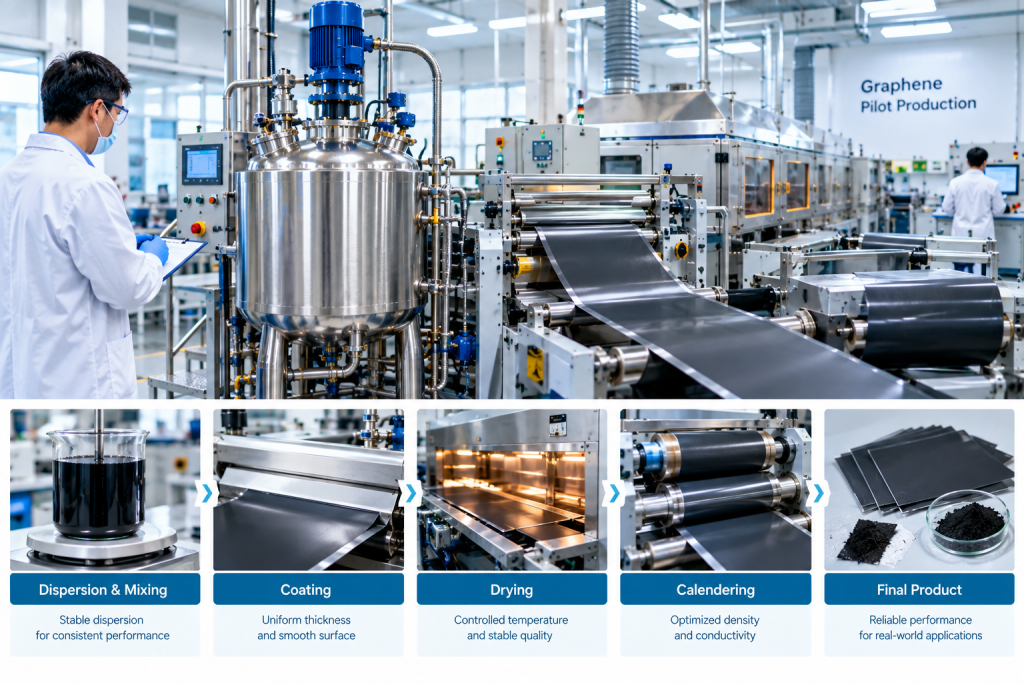
Graphene projects can require several different types of scale-up activity. A company developing a conductive coating may need dispersion optimization and roll-to-roll coating trials, while a battery-material developer may need slurry preparation, electrode coating, drying, calendering, and subsequent cell evaluation.
These projects do not necessarily require the same equipment or expertise.
Outsourcing can provide several advantages.
1.1 Lower Initial Capital Investment
Establishing an internal pilot line may involve equipment purchases, facility preparation, utilities, maintenance, safety systems, and specialized personnel.
An external facility can allow a company to evaluate a process before committing to those investments.
This is particularly useful when the formulation, production route, or target market has not yet been fully validated.
1.2 Access to Specialized Equipment
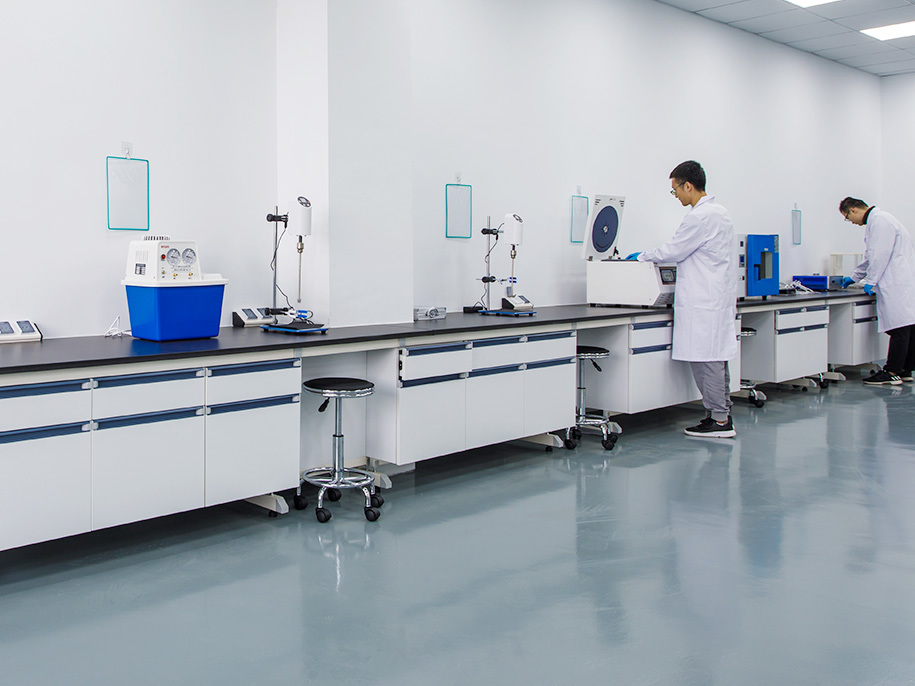
Some graphene applications require equipment that is not commonly available in a standard laboratory.
Examples include:
- High-shear or specialized dispersion systems
- Controlled mixing and formulation equipment
- Pilot-scale coating and drying lines
- Roll-to-roll processing equipment
- Electrode calendering and slitting systems
- Electrical, thermal, mechanical, and environmental testing equipment
The relevant question is not how much equipment a facility owns, but whether its equipment can reproduce the important conditions of the intended manufacturing process.
1.3 Faster Technical Evaluation
An experienced pilot partner may help identify process limitations, evaluate alternative formulations, and establish an initial operating window.
This can reduce the time required to move from laboratory experimentation to a more representative manufacturing trial.
However, outsourcing accelerates development only when the project objectives, responsibilities, and decision criteria are clearly defined.
1.4 Flexible Access to Technical Resources
Not every company needs a permanent pilot facility.
A project may require only a small number of trials to assess dispersion stability, coating quality, process compatibility, or batch repeatability. Outsourcing allows companies to access specialized resources according to project needs.
2. Define the Pilot Production Objective Before Selecting a Partner
One of the most common mistakes is approaching a pilot production facility before defining what the project needs to demonstrate.
“Scale up graphene production” is too broad to serve as a reliable technical scope.
The project may involve scaling up the production of graphene itself, preparing a graphene dispersion, manufacturing a graphene-containing formulation, or producing a finished component using graphene as an additive.
These activities require different capabilities.
| Project objective | Typical requirements |
|---|---|
| Graphene material production | Synthesis or exfoliation equipment, purification, drying, material characterization |
| Graphene dispersion | Mixing and dispersion equipment, formulation control, stability testing |
| Conductive coating development | Formulation, coating, drying or curing, electrical testing |
| Battery electrode production | Slurry preparation, electrode coating, drying, calendering, electrode testing |
| Graphene composite development | Matrix compatibility, compounding or mixing, forming, mechanical and functional testing |
| Application validation | Representative components, application-specific testing, documented acceptance criteria |
Before contacting a partner, establish:
- The starting material and its current specifications
- The intended formulation or product
- The required batch size
- The target process and equipment
- The performance indicators to be evaluated
- The expected outputs of the trial
- The criteria for deciding whether to proceed
A clearly defined objective helps prevent a technically capable facility from delivering results that do not answer the customer’s actual question.
3. Evaluate the Partner’s Technical Capabilities
A facility may describe itself as capable of graphene processing without having experience in the customer’s specific application.
Technical qualification should therefore examine the actual process rather than relying on general claims about advanced materials.
3.1 Experience With the Relevant Graphene Form
Graphene powder, graphene nanoplatelets, graphene oxide, reduced graphene oxide, and graphene dispersions have different characteristics and processing requirements.
A partner experienced in one material form may not automatically be qualified to process another.
For example, a facility specializing in aqueous graphene oxide dispersion may not have the appropriate process knowledge for a high-solids conductive coating based on graphene nanoplatelets.
Ask whether the partner has worked with a comparable material form, formulation, substrate, or application.
3.2 Equipment Suitability
Equipment capacity is important, but equipment specifications alone are not sufficient.
A larger mixing vessel does not guarantee that the dispersion quality achieved in the laboratory can be reproduced at a higher volume. Differences in shear distribution, heat generation, mixing time, and circulation can change the outcome.
For coating applications, the coating method, web width, line speed, drying capacity, and substrate handling may all influence the trial.
For battery electrodes, the availability of appropriate coating, drying, calendering, and sample-preparation equipment may be essential.
The equipment should be selected according to the process that needs to be validated.
3.3 Application and Testing Experience
A pilot partner should understand how process conditions affect the performance of the finished product.
For a conductive coating, relevant experience may include sheet resistance, coating uniformity, adhesion, and durability.
For a battery electrode, relevant experience may include slurry rheology, loading uniformity, electrode density, porosity, and downstream cell evaluation.
If the facility can manufacture a sample but cannot measure the properties that determine success, additional testing resources may be required.
4. Confirm What the Pilot Trial Will Actually Deliver
Before production begins, both parties should agree on the deliverables.
A pilot production project should produce useful technical evidence, not simply a quantity of material.
Depending on the project, deliverables may include:
- A specified quantity of processed material or finished samples
- A documented formulation and processing sequence
- Equipment settings and relevant process parameters
- Material and batch identification
- Test results using agreed methods
- Observations about defects, instability, or processing limitations
- A preliminary process window
- Recommendations for the next development stage
It is also important to distinguish between production deliverables and development deliverables.
A facility hired only to process a supplied formulation may not be responsible for optimizing that formulation or guaranteeing application performance.
If the project requires process development, troubleshooting, or formulation optimization, those activities should be included explicitly in the scope of work.
The same principle applies to testing. A supplier may be able to provide basic material characterization but may not have the capability to perform advanced electrochemical, environmental, or reliability testing.
Additional services should be identified and agreed upon before the trial starts.
5. Address Process Repeatability and Batch Consistency
A single successful pilot batch does not establish that a process is ready for industrial production.
The value of pilot testing lies partly in understanding whether the result can be reproduced.
For graphene-based systems, repeatability can be affected by raw-material characteristics, dispersion conditions, solids content, mixing energy, temperature, drying conditions, and post-processing.
A practical trial should therefore define which parameters need to remain controlled and which results will be compared across batches.
Relevant evaluation criteria may include:
- Dispersion stability and agglomeration
- Viscosity and processability
- Particle or flake characteristics where relevant
- Coating thickness and uniformity
- Electrical or thermal performance
- Adhesion and mechanical integrity
- Yield and defect rate
- Variation between representative batches
The required level of repeatability depends on the development stage. Early feasibility trials may focus on identifying a workable process, while later qualification trials require stronger evidence of reproducibility.
Customers should avoid treating an isolated best-case result as representative of normal production.
6. Protect Intellectual Property and Confidential Information
Graphene pilot production often involves commercially sensitive information.
This may include formulation ratios, dispersion methods, surface-treatment conditions, process parameters, customer specifications, and application designs.
Before sharing such information, determine what the external partner needs to know and how the information will be protected.
6.1 Use an Appropriate Confidentiality Agreement
A non-disclosure agreement (NDA) can establish obligations for handling confidential information, subject to its specific terms and applicable law.
The agreement should identify the relevant parties, permitted use of the information, confidentiality obligations, and any agreed exceptions or disclosure requirements.
For projects involving multiple organizations, consider whether the agreement adequately covers all parties that will access the information.
6.2 Define Ownership of Existing and Newly Developed IP
The customer may bring an existing formulation or process, while the pilot partner contributes equipment expertise or develops process improvements during the trial.
These contributions should not be left ambiguous.
The parties should clarify:
- Ownership of pre-existing intellectual property
- Ownership of newly developed formulations or process improvements
- Rights to use the resulting data and reports
- Rights to manufacture or transfer the process
- Restrictions on disclosure or use for other customers
An NDA alone does not automatically resolve ownership of newly developed intellectual property. That issue should be addressed separately in the project agreement where necessary.
6.3 Control Information Access
Not every participant needs access to the complete formulation or the customer’s full application details.
Where practical, information can be shared according to project responsibilities. However, any confidentiality or access-control arrangement should still allow the partner to perform the agreed work effectively.
7. Understand the Full Cost of Outsourced Pilot Production
The quoted processing fee is only one part of the project cost.
A low initial quotation may exclude formulation development, material preparation, analytical testing, equipment cleaning, trial setup, repeat runs, sample shipping, or detailed reporting.
A realistic budget should identify the complete cost structure.
| Cost category | Questions to clarify |
|---|---|
| Initial setup | Are equipment preparation and line setup included? |
| Materials | Who supplies graphene, binders, solvents, substrates, and consumables? |
| Processing | Is pricing based on time, batch size, material quantity, or a fixed project fee? |
| Technical development | Are formulation adjustments and process optimization included? |
| Testing | Which tests are included, and which require external laboratories? |
| Repeat trials | What happens if the first run fails or requires adjustment? |
| Waste and yield | Who pays for rejected material, process losses, and cleaning? |
| Reporting | Are process records, test data, and a final technical report included? |
| Logistics | Who handles packaging, transportation, storage, and sample return? |
The parties should also establish how changes in scope will be approved and charged.
A pilot project may uncover unexpected technical problems. A clear change-control process helps prevent disagreements when additional experiments become necessary.
8. Assess Scale-Up Transferability
One of the most important questions is whether the results can be transferred to the intended manufacturing environment.
A pilot facility may produce acceptable samples using equipment that differs significantly from the customer’s future production line.
This does not make the pilot trial useless, but it changes what can reasonably be concluded from the results.
Transferability depends on several factors:
- Similarity between pilot and production equipment
- Relevance of mixing, shear, heat-transfer, and residence-time conditions
- Compatibility of the formulation with target manufacturing processes
- Availability of documented operating parameters
- Stability of material supply and critical ingredients
- Ability to reproduce product specifications at larger scale
For roll-to-roll coating, a successful trial on a narrow web may not establish performance on a much wider production line.
For battery electrodes, acceptable small-batch slurry behavior does not automatically establish uniform coating, drying, and calendering at commercial throughput.
The pilot plan should therefore identify which questions the trial can answer and which will require further validation.
9. Choose the Right Type of External Partner
Not all pilot production providers serve the same role.
Depending on the project, the most appropriate partner may be a research laboratory, a university-linked technical platform, a contract manufacturer, an application development center, or an established industrial production facility.
Each has potential advantages and limitations.
Research laboratory or university-linked platform: May be suitable for exploratory work, specialized characterization, or early process development. Commercial throughput and production documentation should be assessed carefully.
Contract pilot manufacturer: May be suitable for repeatable processing, equipment access, and structured manufacturing trials. Confirm experience with the relevant material and application.
Application development center: May be suitable when formulation, processing, and performance evaluation need to be considered together.
Industrial manufacturer: May be appropriate when the objective is to evaluate compatibility with a production-oriented process, although smaller exploratory projects may be less attractive to some facilities.
The right choice depends on the stage of development, required technical support, confidentiality needs, budget, and expected deliverables.
A well-equipped partner is not necessarily the best partner if its core capabilities do not match the project’s immediate objective.
10. Common Mistakes to Avoid
Several mistakes can undermine outsourced graphene pilot production.
Selecting a partner based only on equipment capacity. Equipment must be suitable for the process and material, not merely large enough to handle the target batch.
Providing an incomplete technical brief. Vague objectives make it difficult to design useful trials or assess whether the outcome was successful.
Assuming the partner will optimize everything. Processing, formulation development, testing, and application validation are different services and should be defined separately.
Failing to agree on data ownership. Unclear ownership can restrict the customer’s ability to reuse results or transfer the process to another manufacturer.
Ignoring raw-material consistency. Changes in the graphene grade or other ingredients may make it difficult to interpret the results of a pilot trial.
Skipping repeatability checks. One successful batch may not reflect the normal operating range of the process.
Overlooking commercial transferability. A technically successful pilot may still be uneconomical or difficult to reproduce on the intended production line.
Expecting guaranteed application results from material processing alone. Final performance depends on the formulation, process, substrate, component design, and operating conditions. Responsibilities for validation should be clearly allocated.
Outsource the Right Process, Not Just the Production Volume
Outsourcing pilot production can be an effective way to advance graphene-based products without immediately investing in a dedicated manufacturing facility.
However, the value of outsourcing depends on the quality of the technical definition, the suitability of the partner, the clarity of the agreement, and the usefulness of the results.
Companies should evaluate equipment and process capabilities, establish application-relevant acceptance criteria, protect confidential information, define project costs, and ensure that the resulting data can support the next development stage.
For graphene projects, pilot production should connect material selection, formulation development, process optimization, repeatability, and application validation.
The objective is not simply to produce a larger batch of graphene-based material. It is to generate reliable evidence that the material and process can move toward practical, repeatable, and economically viable manufacturing.
When outsourced pilot production is planned around that objective, it can help companies reduce uncertainty, make better investment decisions, and move promising advanced materials closer to industrial adoption.
Frequently Asked Questions
What is outsourced pilot production for graphene?
It is the use of an external laboratory, pilot facility, contract manufacturer, or application development center to process graphene or graphene-based formulations at an intermediate scale before commercial manufacturing.
When should a company outsource graphene pilot production?
Outsourcing may be appropriate when the company lacks suitable equipment, needs specialized technical expertise, wants to evaluate manufacturing feasibility before investing in a pilot line, or requires temporary access to application-specific processing capabilities.
What information should be provided to a pilot production partner?
Typically, the project brief should describe the starting material, target application, formulation status, required batch size, relevant processing conditions, performance targets, testing requirements, and expected deliverables. Confidential details should be shared under appropriate agreements.
Does successful pilot production guarantee commercial-scale performance?
No. Pilot production provides evidence about process feasibility and performance under the tested conditions. Differences in equipment, throughput, heat transfer, mixing, coating width, and other variables may require additional validation at a larger scale.
How can a company protect its graphene formulation during outsourcing?
Appropriate measures may include an NDA, defined permitted uses of confidential information, controlled information access, clear intellectual property provisions, and written agreements covering project data and newly developed process improvements.
How much does outsourced graphene pilot production cost?
Costs vary according to the material, batch size, equipment, technical development required, testing scope, number of trials, and reporting requirements. A useful quotation should separate processing charges from development, testing, materials, repeat runs, and other project costs.