

Conductive Coatings for Renewable Power Infrastructure
Enhancing Reliability, Monitoring, and Protection with Advanced Materials
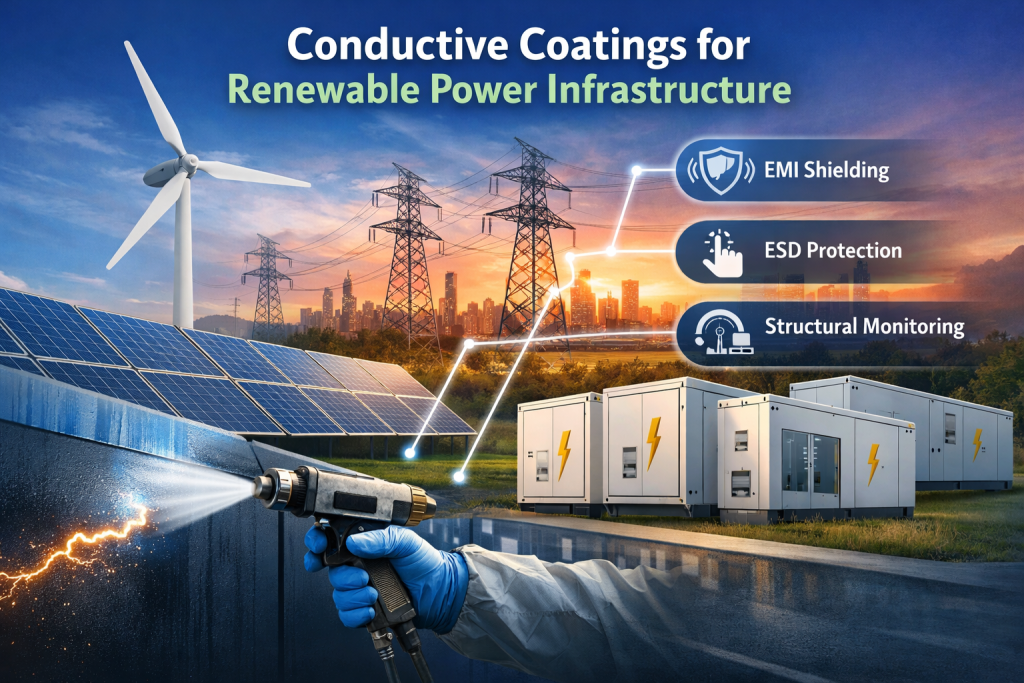
Why Conductive Coatings Matter in Renewable Energy
Renewable power infrastructure—such as solar farms, wind turbines, battery storage systems, and grid-connected equipment—operates in harsh environments while demanding long-term reliability.
Beyond corrosion protection, modern infrastructure increasingly requires coatings that can:
-
Dissipate static electricity
-
Enable condition monitoring
-
Reduce electromagnetic interference (EMI)
-
Support smart and connected systems
Conductive coatings are becoming a functional layer, not just a protective one.
Key Challenges in Renewable Power Environments
Renewable energy assets face unique challenges:
-
Outdoor exposure (UV, humidity, salt spray, dust)
-
Thermal cycling and vibration
-
High-voltage electrical environments
-
Increasing sensor integration and data monitoring
Traditional insulating coatings often limit functionality and fail to support these evolving needs.
Functional Roles of Conductive Coatings
1. Static Dissipation and Grounding
Wind turbine blades, inverter housings, and battery enclosures can accumulate static charge.
Conductive coatings:
-
Provide controlled surface resistivity
-
Reduce electrostatic discharge (ESD) risk
-
Protect sensitive electronics
Typical target surface resistivity:
-
10⁵–10⁹ Ω/sq (static dissipative range)
2. EMI Shielding for Power Electronics
Inverters, converters, and control cabinets generate and are affected by EMI.
Conductive coatings:
-
Form continuous shielding layers
-
Reduce signal interference
-
Improve system stability and compliance
Nanocarbon-based coatings enable EMI performance without heavy metal layers.
3. Enabling Structural Health Monitoring
Conductive coatings can function as:
-
Strain-sensing layers
-
Damage-detection networks
-
Embedded diagnostic surfaces
Changes in resistance can indicate:
-
Cracks
-
Delamination
-
Mechanical fatigue
This supports predictive maintenance strategies.
Material Choices for Conductive Energy Coatings
Carbon Black: Traditional but Limited
-
High loading required
-
Limited durability under weathering
-
Reduced mechanical performance
Best for:
-
Cost-driven, low-performance applications
CNT-Based Coatings: Network Efficiency
-
Low percolation threshold
-
Stable conductivity under strain
-
Excellent EMI and ESD performance
Ideal for:
-
Inverter housings
-
Battery enclosures
-
Smart power equipment
Graphene and Graphene Oxide: Barrier + Function
-
Excellent corrosion resistance
-
Strong barrier properties
-
Improved adhesion and durability
Graphene-based systems are well-suited for:
-
Outdoor steel structures
-
Marine and offshore renewable assets
-
Hybrid conductive–protective coatings
Hybrid CNT–Graphene Systems for Infrastructure
Hybrid systems combine:
-
CNTs for conductive pathways
-
Graphene for barrier and mechanical reinforcement
Benefits include:
-
Reduced total filler loading
-
Improved weathering resistance
-
Long-term conductivity stability
These systems are increasingly adopted in high-value renewable installations.
Coating System Compatibility
Conductive coatings can be formulated in:
-
Epoxy systems
-
Polyurethane topcoats
-
Waterborne acrylics
-
Zinc-rich primers (hybrid systems)
Key formulation considerations:
-
Dispersion stability
-
Adhesion to substrates
-
Environmental durability
Application Examples
| Infrastructure Component | Coating Function |
|---|---|
| Wind turbine towers | ESD + corrosion protection |
| Solar panel frames | Grounding + EMI reduction |
| Battery enclosures | EMI shielding + sensing |
| Power cabinets | Static dissipation |
| Offshore platforms | Corrosion + conductivity |
Standards and Performance Targets
Typical evaluation methods:
-
Surface resistivity (ASTM D257)
-
Salt spray and humidity resistance
-
Thermal cycling tests
-
EMI shielding effectiveness
Meeting both electrical and environmental standards is critical.
Sustainability and Lifecycle Benefits
Conductive coatings contribute to sustainability by:
-
Extending asset lifetime
-
Reducing maintenance frequency
-
Enabling condition-based maintenance
-
Lowering material usage via nanocarbon efficiency
This aligns with the long-term economics of renewable energy projects.
Renewable power infrastructure demands coatings that do more than protect.
By integrating conductivity into protective layers, nanocarbon-based coatings enable:
-
Safer operation
-
Smarter monitoring
-
Higher system reliability
As renewable energy systems become more complex and connected, conductive coatings are evolving into a critical infrastructure technology.