
Dispersion Stability: The Real Bottleneck
Why performance gains often disappear before the product even leaves the mixer.
The uncomfortable truth
In advanced materials projects, teams often focus on:
-
Higher intrinsic conductivity
-
Larger sheet size
-
Higher aspect ratio
-
Better purity
But in real products, the biggest failure point is usually much simpler:
Dispersion stability.
If the conductive network collapses, re-aggregates, or sediments over time, the theoretical advantages of graphene or CNTs never translate into real-world performance.
What “dispersion stability” really means
Dispersion is not just about making the material “look uniform” during mixing.
True stability means:
-
No significant re-aggregation
-
No rapid sedimentation
-
Stable rheology over time
-
Stable electrical/thermal performance
-
Process reproducibility
And importantly:
Stable under real processing conditions — not just in a beaker.
Why dispersion becomes the bottleneck
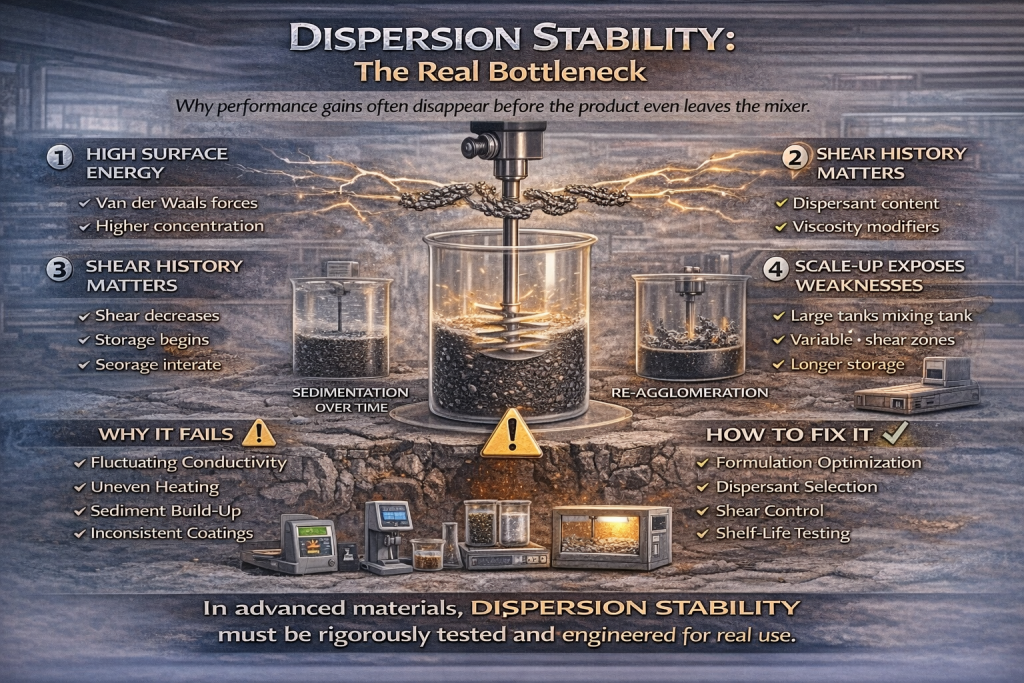
1️⃣ High surface energy
Graphene and CNTs naturally attract each other through van der Waals forces.
The higher the surface area, the stronger the tendency to re-stack.
Better materials often mean stronger aggregation risk.
2️⃣ Shear history matters
Many dispersions look good immediately after high-shear mixing.
But once:
-
Shear decreases
-
Storage begins
-
Temperature changes
Particles start to re-organize.
What works at Day 0 may fail at Week 2.
3️⃣ Rheology vs performance trade-off
To improve stability, formulators often increase:
-
Dispersant content
-
Viscosity modifiers
-
Binder concentration
But excessive stabilizers can:
-
Reduce conductivity
-
Lower thermal pathways
-
Increase contact resistance
-
Affect curing
Stability and performance must be balanced—not maximized independently.
4️⃣ Scale-up exposes weaknesses
Lab-scale dispersion:
-
Small volume
-
High control
-
Immediate testing
Production-scale dispersion:
-
Larger tanks
-
Variable shear zones
-
Longer storage
-
Batch-to-batch variability
What works at 500 mL often behaves differently at 500 L.
The hidden consequences of unstable dispersion
When stability fails, the symptoms may appear as:
-
Fluctuating sheet resistance
-
Uneven heating
-
Thermal hotspots
-
Inconsistent coating thickness
-
Sediment buildup in storage tanks
-
Nozzle clogging in printing systems
And often, teams mistakenly blame:
-
Raw material quality
-
Equipment inconsistency
-
Environmental factors
When the root cause is dispersion collapse.
Powder vs slurry: stability shifts location
In projects comparing graphene slurry and powder, the key difference is:
Where stability responsibility lies.
With powder:
-
Customer controls dispersion
-
Stability depends on local processing
With slurry:
-
Supplier controls initial dispersion
-
Customer must manage storage stability
Stability never disappears — it just moves.
How professionals evaluate stability
Instead of visual inspection alone, advanced teams test:
-
Zeta potential
-
Sedimentation rate
-
Accelerated aging
-
Viscosity drift
-
Electrical stability over time
-
Thermal performance after storage
Performance stability is more important than initial peak performance.
Strategies to improve dispersion stability
✔ Surface functionalization
✔ Optimized dispersant selection
✔ Controlled shear profiles
✔ Solid content balance
✔ pH management
✔ Solvent compatibility validation
✔ Shelf-life testing before commercialization
Most failures occur when stability testing is skipped under time pressure.
The real bottleneck is not conductivity
High intrinsic conductivity is easy to advertise.
Stable dispersion across:
-
Mixing
-
Storage
-
Transportation
-
Application
-
Curing
That is much harder.
And in many advanced materials projects, dispersion stability—not material spec—is what determines whether a product succeeds or quietly fails.
Practical takeaway
If a formulation works beautifully on Day 1 but drifts by Day 10,
the material is not the breakthrough.
Stability is.
And in real manufacturing environments, stability is often the true competitive advantage.