
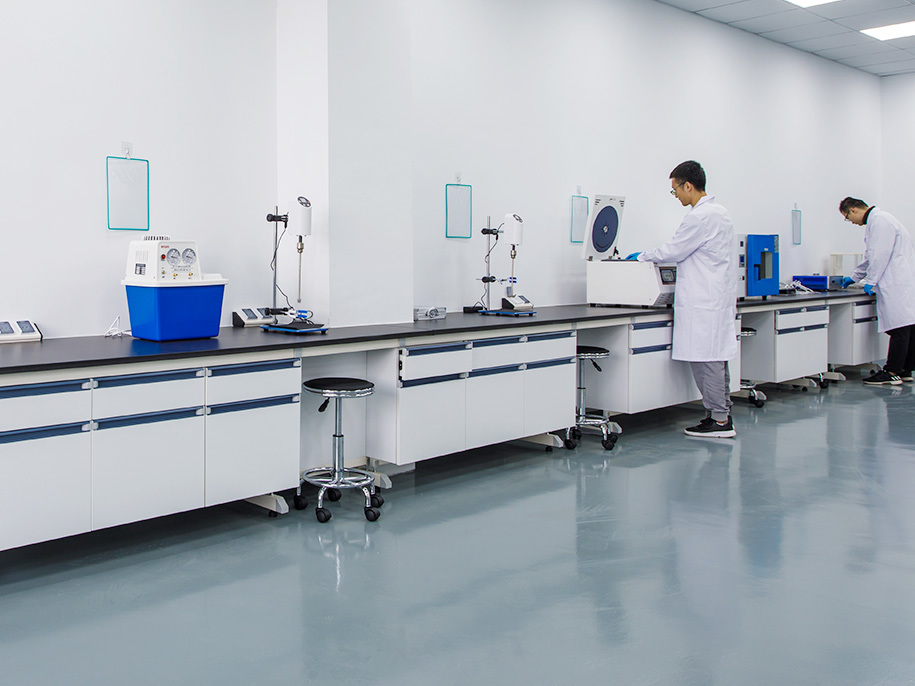
Pilot Production for Advanced Coatings
Bridging Lab Innovation and Industrial Reality
In advanced material industries, many promising coating technologies stop at laboratory validation. The real challenge begins when a formulation must transition from gram-scale experiments to pilot-scale production.
Pilot production is not simply “scaling up.” It is a systematic engineering phase where materials, processes, and application methods are aligned with industrial requirements.
For graphene-enhanced and other advanced carbon coatings, pilot production determines whether a concept becomes a reliable commercial solution.
1️⃣ Why Pilot Production Matters
1. Process Stability
Lab formulations often rely on ideal mixing, small-batch dispersion, and controlled curing environments.
In pilot production, we validate:
-
Dispersion uniformity at larger volumes
-
Shear stability during mixing
-
Storage stability and sedimentation behavior
-
Compatibility with industrial equipment
This stage eliminates risks before full-scale manufacturing.
2. Performance Consistency
Advanced coatings must deliver consistent performance across:
-
Corrosion resistance
-
Thermal conductivity
-
Electrical conductivity
-
Mechanical durability
-
Adhesion to substrates
Pilot runs verify that these properties remain stable from batch to batch.
3. Application Method Validation
A coating system is not just material — it includes:
-
Spray parameters
-
Coating thickness control
-
Curing profile
-
Substrate preparation
-
Environmental tolerance
Pilot production simulates real industrial application scenarios.
2️⃣ Key Steps in Pilot Production
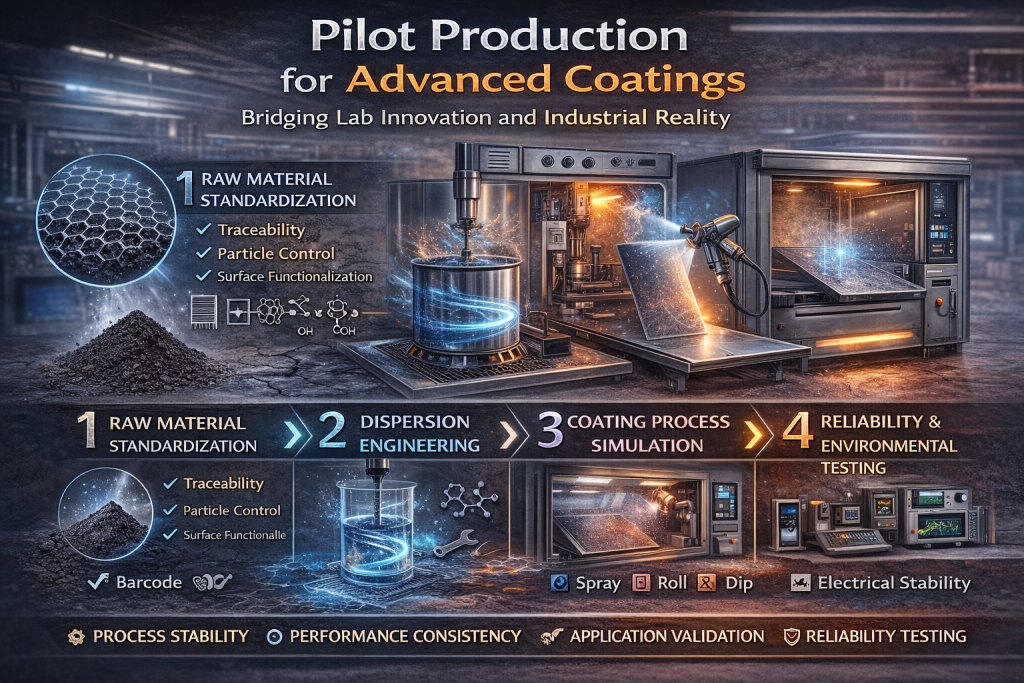
Step 1: Raw Material Standardization
Graphene or carbon nanomaterials must be:
-
Batch-traceable
-
Particle-size controlled
-
Surface-functionalization consistent
-
Moisture content monitored
Without material stability, no pilot validation can succeed.
Step 2: Dispersion Engineering
Uniform dispersion is the heart of advanced coating systems.
Pilot-scale dispersion focuses on:
-
Shear energy optimization
-
Agglomeration control
-
Surfactant compatibility
-
Rheology tuning
This determines electrical and barrier network formation inside the coating matrix.
Step 3: Coating Process Simulation
We simulate:
-
Industrial spray lines
-
Roll coating
-
Dip coating
-
Large-surface application
This reveals practical issues that do not appear in lab-scale samples.
Step 4: Reliability & Environmental Testing
Pilot batches undergo:
-
Salt spray testing
-
Thermal cycling
-
Humidity aging
-
Mechanical abrasion
-
Electrical stability testing
This transforms “good data” into engineering confidence.
3️⃣ From Material Supplier to System Partner
Pilot production changes the role of a material company.
Instead of only supplying graphene powder or dispersion, the company becomes:
-
A formulation partner
-
A process engineering collaborator
-
A risk-control consultant
-
A long-term reliability supporter
This is the true transition from material innovation to system-level solution.
4️⃣ Strategic Value in Advanced Coatings
For companies entering high-performance markets — such as:
-
Energy storage systems
-
Industrial anti-corrosion
-
Thermal management structures
-
Electrically conductive coatings
Pilot production serves as the filter between experimental curiosity and scalable business.
It protects both supplier and client from premature scale-up risks.
Advanced coatings do not succeed because the material is innovative.
They succeed because:
-
The formulation is engineered
-
The dispersion is controlled
-
The application is validated
-
The performance is repeatable
Pilot production is where innovation becomes industry.