

Percolation Threshold in CNT Systems Explained
Why conductivity doesn’t increase gradually — it jumps.
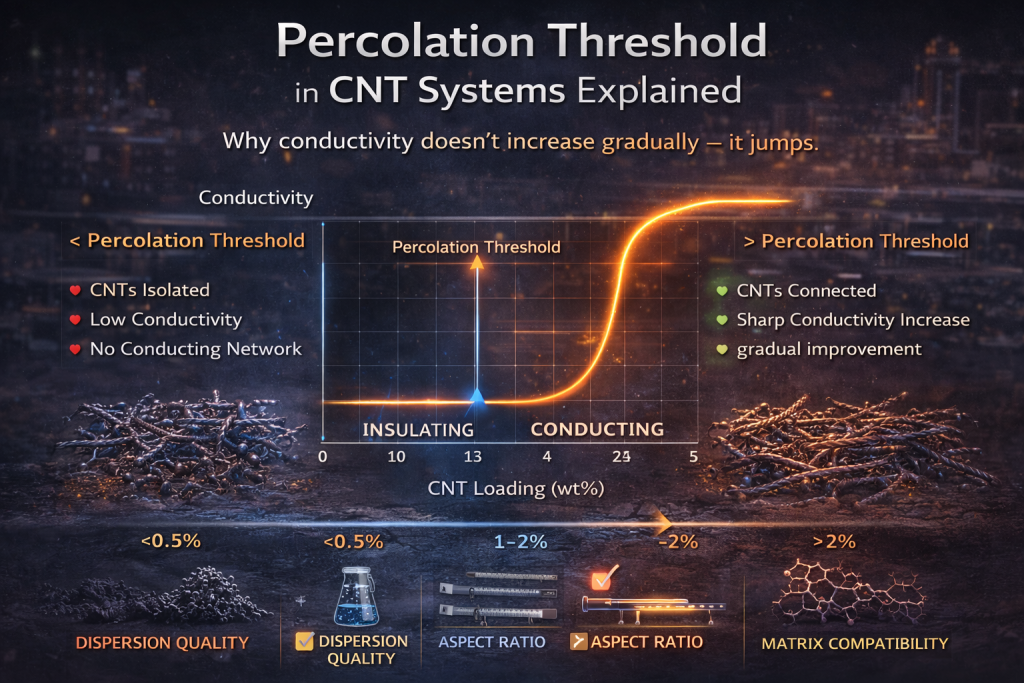
Carbon nanotube (CNT) systems behave differently from traditional conductive fillers. Instead of showing a linear increase in conductivity as loading increases, CNT-based composites typically exhibit a sharp transition point known as the percolation threshold.
Understanding this concept is essential for designing conductive coatings, inks, and polymer composites efficiently.
1️⃣ What Is Percolation Threshold?
The percolation threshold is the critical concentration of CNTs at which an electrically conductive network first forms inside a material.
Below this threshold:
-
CNTs are isolated or poorly connected
-
Electrical conductivity remains very low
-
The material behaves like an insulator
At the threshold:
-
CNTs begin to touch and form continuous pathways
-
A conductive network suddenly emerges
-
Conductivity increases dramatically (often by several orders of magnitude)
Above the threshold:
-
Additional CNTs improve network density
-
Conductivity continues to increase, but more gradually
This transition is not smooth — it’s a structural network phenomenon.
2️⃣ Why CNTs Have Low Percolation Thresholds
Compared to spherical fillers (like carbon black), CNTs have:
-
Extremely high aspect ratio (length/diameter)
-
Large surface area
-
Strong ability to form entangled networks
Because of their geometry, CNTs can form conductive pathways at very low loadings — sometimes below 0.5 wt% in optimized systems.
This makes them attractive for:
-
Lightweight conductive polymers
-
EMI shielding coatings
-
Antistatic films
-
Flexible electronics
3️⃣ Factors That Influence Percolation
Percolation threshold is not fixed. It depends on:
Dispersion Quality
-
Better dispersion → lower threshold
-
Agglomeration increases required loading
Aspect Ratio
-
Longer CNTs → lower threshold
-
Damaged or shortened CNTs → higher threshold
Matrix Compatibility
-
Surface functionalization affects network formation
-
Polymer viscosity influences CNT mobility
Processing Method
-
Shear forces can align CNTs
-
Alignment may increase or decrease connectivity depending on direction
4️⃣ The Trade-Off: Conductivity vs. Processability
Increasing CNT loading improves conductivity — but:
-
Viscosity rises sharply
-
Coating application becomes difficult
-
Mechanical brittleness may increase
-
Cost increases
The optimal formulation usually targets just above the percolation threshold, not the maximum loading.
5️⃣ Why This Matters in Real Applications
In industrial systems, poor scale-up control can shift the effective percolation threshold:
-
Batch-to-batch dispersion variation
-
Changes in mixing energy
-
Differences in curing conditions
This explains why some coatings “randomly” lose conductivity after scale-up — the conductive network was never robust.
The percolation threshold is the turning point where isolated nanotubes become a functional conductive network.
Mastering CNT systems is not about adding more material.
It’s about controlling structure, dispersion, and network formation.