
Graphene in Thermal Interface Materials (TIM)
As electronic systems become more powerful and compact, managing heat has become one of the most critical engineering challenges. From AI data centers to electric vehicles and consumer electronics, thermal performance directly impacts reliability, efficiency, and lifespan.
Thermal Interface Materials (TIMs) play a key role in this process—and increasingly, graphene is emerging as a promising material to enhance their performance.
This article explores how graphene is used in TIMs, why it matters, and what it means for next-generation thermal management systems.
What Are Thermal Interface Materials (TIM)?
Thermal Interface Materials are designed to improve heat transfer between two solid surfaces, typically:
- Chip ↔ Heat spreader
- Heat spreader ↔ Heat sink
- Battery module ↔ cooling plate
Even when surfaces appear smooth, microscopic air gaps exist. Since air is a poor thermal conductor, these gaps significantly reduce heat transfer efficiency.
TIMs fill these gaps and create a more thermally conductive path.
Common TIM types include:
- Thermal pastes / greases
- Gap fillers
- Thermal pads
- Phase change materials
The Limitations of Conventional TIMs
Traditional TIMs typically rely on fillers such as:
- Aluminum oxide
- Silver particles
- Boron nitride
While effective, these materials face several limitations:
- Limited thermal conductivity ceiling
- High loading requirements, affecting viscosity and processability
- Weight increase in large-scale systems
- Mechanical degradation over time
As power density increases in modern systems, these limitations become more significant.
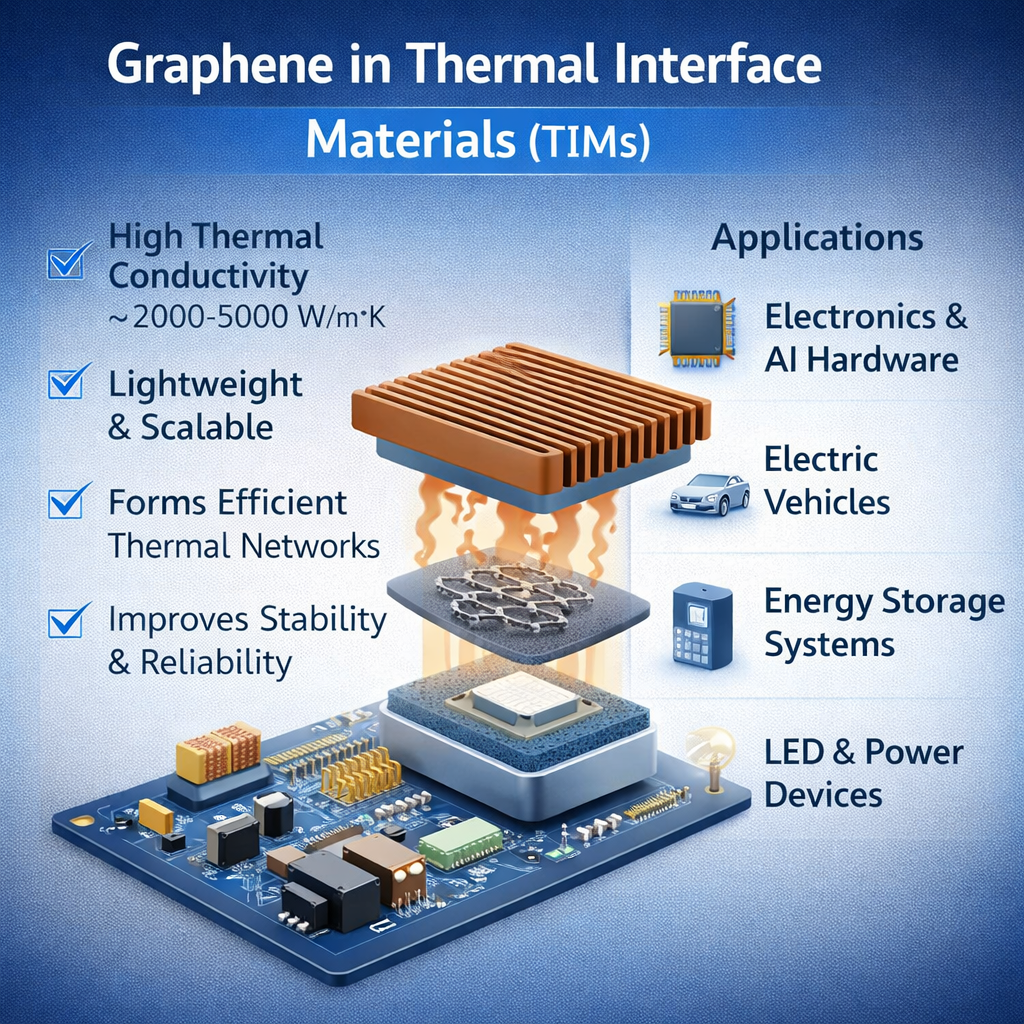
Why Graphene Makes a Difference
Graphene offers a unique combination of properties that make it particularly attractive for thermal interface applications.
1. Exceptional Thermal Conductivity
Graphene exhibits intrinsic thermal conductivity in the range of:
- ~2000–5000 W/m·K (in-plane)
This is significantly higher than conventional TIM fillers.
Even when incorporated into composites, graphene can:
- Create efficient thermal pathways
- Reduce thermal resistance
- Improve heat spreading
2. High Aspect Ratio and Network Formation
Graphene nanoplatelets (GNPs) have a large surface area and high aspect ratio.
This allows them to:
- Form conductive networks at lower loading levels
- Bridge micro-gaps more effectively
- Enhance percolation behavior in TIM formulations
Compared to spherical fillers, fewer graphene particles are needed to achieve similar or better performance.
3. Lightweight and Scalable
Graphene-based fillers can help:
- Reduce overall material weight
- Maintain performance with lower filler content
This is particularly important in:
- Electric vehicles
- Aerospace systems
- Portable electronics
4. Mechanical and Structural Benefits
Graphene can also improve:
- Mechanical strength
- Flexibility of TIM layers
- Long-term stability under thermal cycling
This contributes to more reliable interfaces over time.
Types of Graphene Used in TIMs
Different graphene materials are used depending on the application:
Graphene Nanoplatelets (GNPs)
- Most widely used in TIMs
- Cost-effective and scalable
- Good balance between performance and processability
Reduced Graphene Oxide (rGO)
- Easier dispersion in certain matrices
- Tunable surface chemistry
Functionalized Graphene
- Improved compatibility with polymers
- Better dispersion and bonding
The choice depends on formulation requirements and processing methods.
Applications of Graphene-Enhanced TIMs
Graphene-based TIMs are being explored and applied across multiple industries:
Electronics and AI Hardware
- CPUs, GPUs, and AI accelerators
- High-density server racks
- Edge computing devices
Electric Vehicles
- Battery modules
- Power electronics (inverters, converters)
- Charging systems
Energy Storage Systems
- Battery packs
- Thermal management plates
- Module-level heat dissipation
LED and Power Devices
- High-power LEDs
- RF and telecom equipment
From Materials to System Performance
The real value of graphene in TIMs is not just material-level improvement—it is system-level impact:
- Lower operating temperatures
- Higher power density
- Longer device lifespan
- Improved energy efficiency
However, achieving these benefits depends on:
- Proper material formulation
- Uniform dispersion
- Scalable processing methods
This is where material development and pilot-scale validation become critical.
The Role of Pilot Lines in TIM Development
In graphene-enhanced TIMs, moving from lab formulation to real application requires:
- Controlled mixing and dispersion
- Coating or molding processes
- Interface testing under realistic conditions
Pilot lines help bridge this gap by:
- Validating material performance at scale
- Ensuring consistency
- Testing compatibility with real systems
Without this step, many promising materials fail to translate into practical applications.
Challenges and Considerations
Despite its advantages, graphene in TIMs still faces challenges:
- Dispersion control
- Cost-performance balance
- Standardization of material quality
- Integration into existing manufacturing processes
These challenges are actively being addressed across the industry.
Graphene introduces a new dimension to thermal interface materials by combining high thermal conductivity, lightweight structure, and network-forming capability.
As electronic systems continue to demand better thermal management, graphene-enhanced TIMs offer a pathway toward more efficient and reliable solutions.
However, the transition from promising material to real-world application depends on careful engineering, scalable processes, and system-level validation.