
Pilot Production for Sodium-Ion Batteries
Bridging Innovation and Scalable Manufacturing
As the battery industry looks beyond lithium, sodium-ion batteries (SIBs) are gaining attention as a promising alternative for large-scale energy storage.
With advantages in cost, resource availability, and safety, sodium-ion technology is moving rapidly from lab research to industrial deployment.
However, one critical step determines success:
👉 Pilot production
Why Sodium-Ion Batteries Matter
Resource Advantage
Unlike lithium, sodium is:
- Abundant and widely distributed
- Lower cost and less geopolitically constrained
This makes sodium-ion batteries particularly attractive for:
- Grid-scale energy storage
- Emerging markets
- Cost-sensitive applications
Comparable System-Level Performance
While energy density is lower than lithium-ion, SIBs offer:
- Good cycle life
- Stable thermal behavior
- Strong safety profile
👉 The real value lies in system cost and scalability, not just energy density.
What Is Pilot Production?
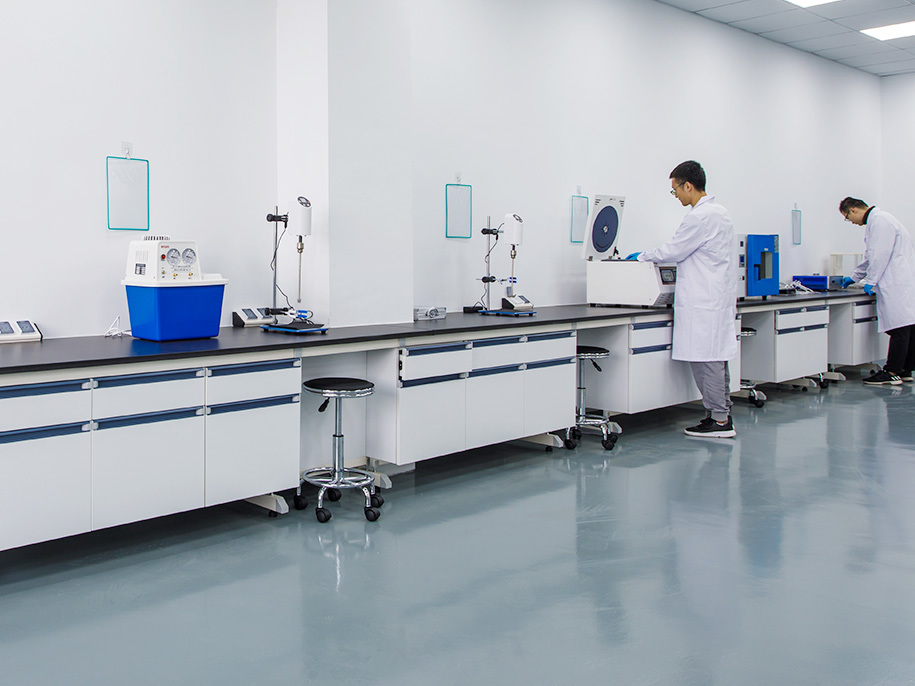
Pilot production sits between:
- Lab-scale validation
- Mass manufacturing
It is the stage where:
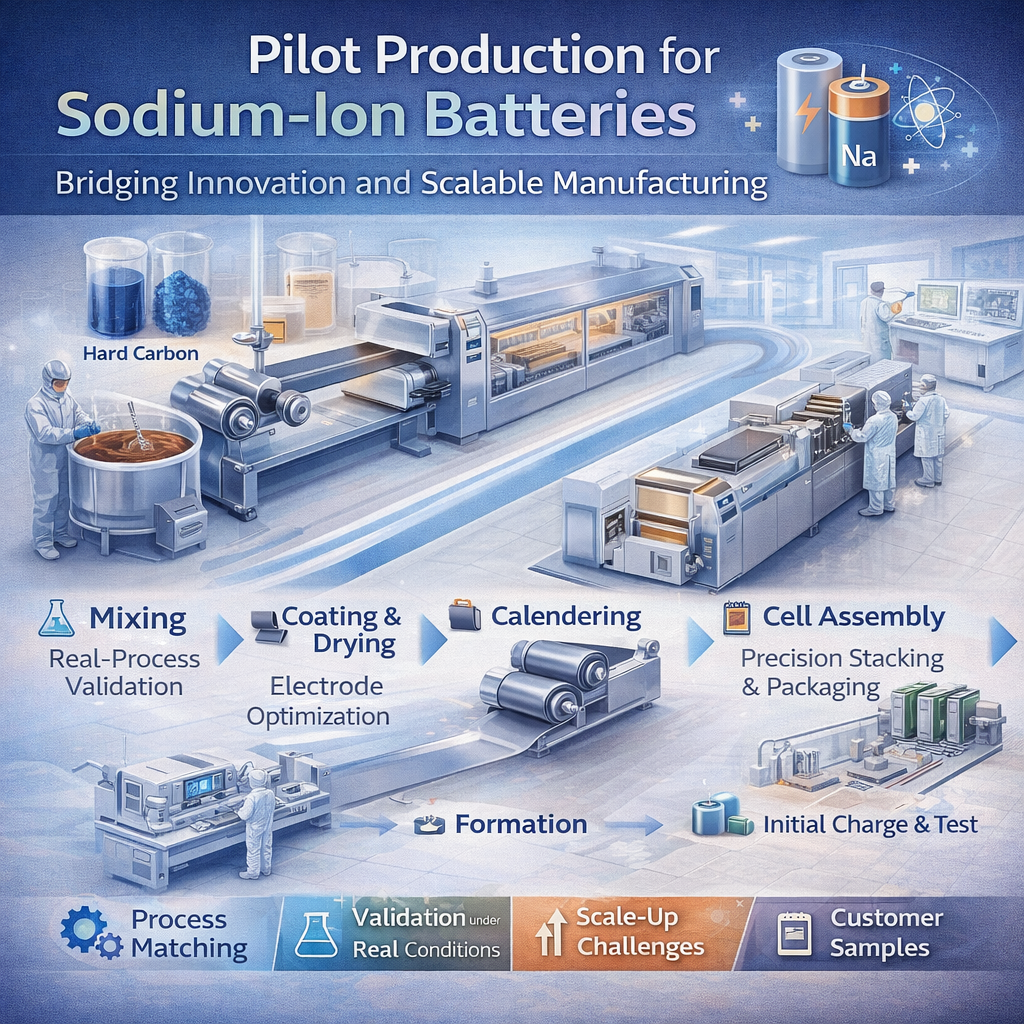
- Materials are tested under real process conditions
- Manufacturing parameters are optimized
- Product consistency is validated
Key Functions of Pilot Lines
- Process development
- Equipment matching
- Scale-up validation
- Early customer sampling
👉 Without pilot production, even the best materials cannot reach the market.
Unique Challenges for Sodium-Ion Pilot Production
1. Material System Differences
Sodium-ion batteries use different materials than lithium-ion:
- Hard carbon anodes
- Prussian blue or layered oxide cathodes
- Different electrolytes
👉 These require new process windows, not direct copying from Li-ion lines.
2. Electrode Processing Sensitivity
Critical factors include:
- Slurry formulation
- Coating uniformity
- Drying behavior
Small changes can significantly impact:
- Capacity
- Cycle life
- Internal resistance
3. Lower Process Maturity
Compared to lithium-ion:
- Fewer standardized processes
- Limited large-scale data
- Equipment compatibility still evolving
👉 This makes pilot lines essential for risk reduction.
Wet vs Dry Processing in Sodium-Ion
Wet Electrode Process (Current Mainstream)
- Mature and widely used
- Easier to implement on existing lines
Challenges:
- Solvent handling
- Energy consumption
- Drying cost
Dry Electrode Process (Emerging Direction)
- Solvent-free
- Lower energy consumption
- Potential cost reduction
Challenges:
- Material compatibility
- Process control
- Scale-up complexity
👉 Pilot production is the only way to validate which route works best for specific SIB systems.
Role of Advanced Carbon Materials
Carbon materials are especially critical in sodium-ion systems.
Hard Carbon (Core Anode Material)
- Determines capacity and efficiency
- Strongly dependent on microstructure
CNT / Graphene Additives
- Improve conductivity
- Enhance electrode integrity
- Reduce resistance
👉 In SIBs, conductive network design is often more critical than in lithium systems.
From Materials to Systems: The Real Challenge
Many projects fail because they focus only on:
- Material performance (lab data)
But ignore:
- Process compatibility
- Scale-up behavior
- System integration
Pilot Production Enables:
- Real electrode architecture validation
- Optimization of conductive networks
- Binder and formulation tuning
- Performance under realistic conditions
👉 This is where theoretical performance becomes commercial reality.
Strategic Value of Pilot Capability
For companies working in sodium-ion batteries, pilot production provides:
Faster Commercialization
- Reduce time from lab to market
- Enable early customer validation
Risk Control
- Identify issues before mass production
- Avoid costly scale-up failures
Stronger Customer Trust
- Provide real samples, not just data
- Support co-development projects
👉 Pilot capability is not just technical—it is a business advantage.
Future Outlook
Sodium-ion batteries are expected to grow rapidly in:
- Grid energy storage
- Low-cost EV segments
- Backup power systems
As the ecosystem develops, success will depend on:
- Material innovation
- Process engineering
- Scalable manufacturing
👉 And pilot production will be at the center of this transition.
Sodium-ion batteries offer a compelling path toward more sustainable and cost-effective energy storage.
However, the transition from lab innovation to industrial reality depends on one key factor:
👉 Pilot production capability
It enables:
- Material validation
- Process optimization
- System integration
Ultimately bridging the gap between innovation and scalable manufacturing.