

Conductive Fillers: Graphene vs Carbon Black vs CNT
Choosing the Right Material for Performance and Scalability
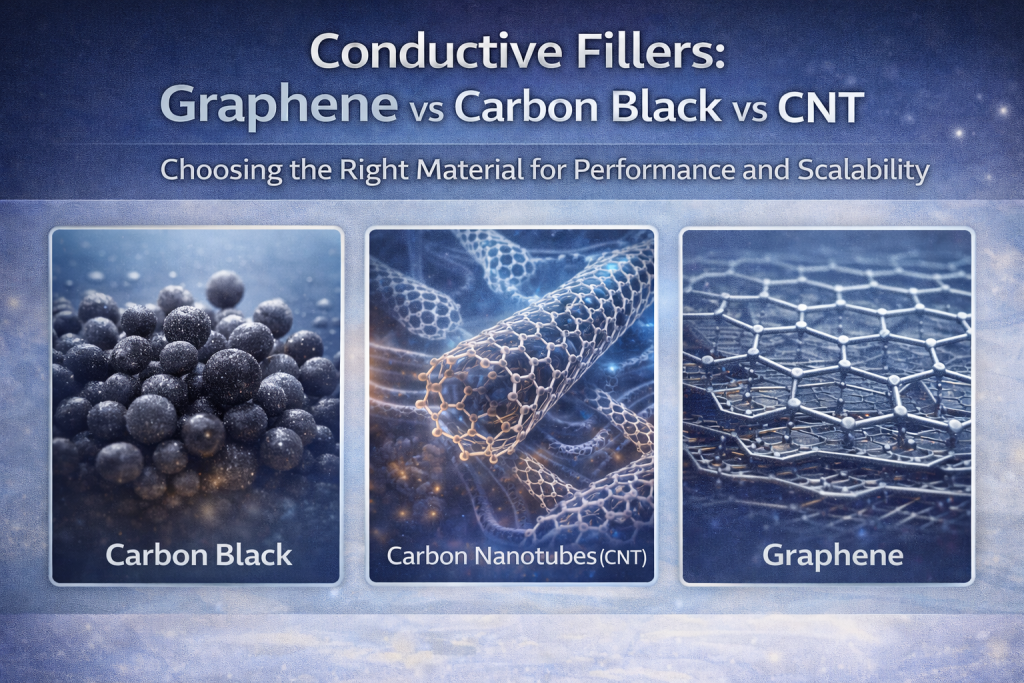
Conductive fillers are essential in a wide range of applications—from battery electrodes and conductive coatings to polymers and electronic components.
Among the most widely used materials are:
- Graphene
- Carbon Black
- Carbon Nanotubes (CNTs)
Each offers unique advantages and limitations. Choosing the right one is not just about conductivity—it is about how the material performs within a system.
Why Conductive Fillers Matter
Conductive fillers enable:
- Electrical conductivity
- Thermal conductivity
- Structural reinforcement
- Functional integration in composites
👉 The key is forming an effective conductive network inside the material.
Overview of the Three Materials
Carbon Black (CB)
- Traditional conductive additive
- Spherical particle structure
- Widely used in batteries and coatings
Advantages:
- Low cost
- Easy to disperse
- Mature industrial use
Limitations:
- Higher loading required
- Limited conductivity compared to nanomaterials
Carbon Nanotubes (CNTs)
- 1D tubular nanostructure
- Extremely high aspect ratio
Advantages:
- Excellent network formation
- Very low percolation threshold
- High electrical conductivity
Limitations:
- Higher cost
- Dispersion challenges
- Processing sensitivity
Graphene
- 2D sheet-like structure
- High surface area
Advantages:
- Excellent thermal conductivity
- Good electrical conductivity
- Effective for heat spreading
Limitations:
- Tendency to restack
- Requires careful dispersion
- Performance depends on structure quality
Visual Structure Comparison

Key Performance Comparison
1. Electrical Conductivity
- CNTs → Best network conductivity
- Graphene → High, but depends on dispersion
- Carbon Black → Moderate
👉 CNTs excel due to their ability to form long-range conductive pathways.
2. Percolation Threshold
- CNTs → Very low (efficient network formation)
- Graphene → Medium
- Carbon Black → High
👉 Lower threshold = less material needed.
3. Thermal Conductivity
- Graphene → Excellent (best for heat spreading)
- CNTs → High
- Carbon Black → Limited
4. Processability
- Carbon Black → Easiest
- Graphene → Moderate
- CNTs → Most challenging
5. Cost Consideration
- Carbon Black → Lowest
- Graphene → Medium
- CNTs → Highest
Application-Based Selection
Battery Electrodes
- Carbon Black → baseline conductivity
- CNTs → network enhancement
- Graphene → structural + conductive support
👉 Increasing trend: hybrid systems (CB + CNT + Graphene)
Conductive Polymers
- CNTs for conductivity
- Graphene for mechanical + thermal properties
Thermal Interface Materials
- Graphene for heat spreading
- CNTs for interface networks
Coatings
- Carbon Black for cost efficiency
- CNTs for high-performance conductivity
- Graphene for multifunctional coatings
The Rise of Hybrid Systems
In real-world applications, no single filler is perfect.
Why Hybrid Design Works
- CNTs → build conductive network
- Graphene → enhance thermal and planar conductivity
- Carbon Black → fill gaps and reduce cost
👉 Result:
- Better performance balance
- Improved processability
- Optimized cost-performance ratio
From Material Choice to System Design
A common mistake:
Selecting materials based only on datasheets
Real Performance Depends On:
- Dispersion quality
- Interaction with binders or matrices
- Processing conditions
- Electrode or composite structure
👉 The same material can perform very differently depending on how it is used.
Role of Pilot Validation
Before scaling up, it is critical to:
- Test different filler combinations
- Optimize formulation ratios
- Evaluate performance under real conditions
Pilot Lines Enable:
- Conductive network validation
- Process compatibility testing
- Scale-up feasibility assessment
👉 This is where material selection becomes engineering reality.
Graphene, carbon black, and CNTs each play a unique role in conductive systems:
- Carbon Black → cost-effective baseline
- CNTs → high-efficiency conductive networks
- Graphene → thermal and multifunctional enhancement
👉 The future is not about choosing one—it is about combining them intelligently.
In advanced applications, conductive fillers are no longer additives—
they are key design elements in system performance.