
Pilot Lines for Solid-State Battery Development
As the battery industry pushes toward safer, higher-energy-density solutions, solid-state batteries (SSBs) have emerged as one of the most promising next-generation technologies. However, transitioning from laboratory breakthroughs to scalable production remains a major challenge.
This is where pilot lines for solid-state battery development play a critical role. They bridge the gap between R&D and mass manufacturing by enabling process validation, material compatibility testing, and early-stage scale-up under controlled conditions.
What Is a Pilot Line in Solid-State Battery Development?
A pilot line is a small-scale, semi-industrial production setup designed to replicate key steps of full-scale manufacturing while maintaining flexibility for experimentation.
In the context of solid-state batteries, pilot lines are used to:
- Validate new electrolyte materials (sulfide, oxide, polymer-based)
- Optimize electrode–electrolyte interfaces
- Test coating, lamination, and densification processes
- Evaluate scalability and manufacturability
- Produce engineering samples for downstream testing
Unlike mass production lines, pilot lines prioritize process adaptability over throughput.
Why Pilot Lines Are Essential for Solid-State Batteries
1. Process Complexity Requires Iteration
Solid-state batteries introduce new challenges such as:
- Solid-solid interface resistance
- Moisture sensitivity (especially for sulfide electrolytes)
- High-pressure densification requirements
Pilot lines allow engineers to iterate quickly on process parameters without the risks associated with full-scale production.
2. Material–Process Coupling Is Critical
In SSBs, performance is highly dependent on how materials are processed:
- Particle size distribution affects interface contact
- Mixing and dispersion influence ionic pathways
- Coating uniformity impacts cycle life
Pilot lines enable co-optimization of materials and processing, which is essential before scaling.
3. De-Risking Scale-Up
Scaling directly from lab to gigafactory is risky and costly. Pilot lines help:
- Identify process bottlenecks
- Validate equipment compatibility
- Estimate yield and material consumption
- Define process windows
This reduces uncertainty when transitioning to commercial production.
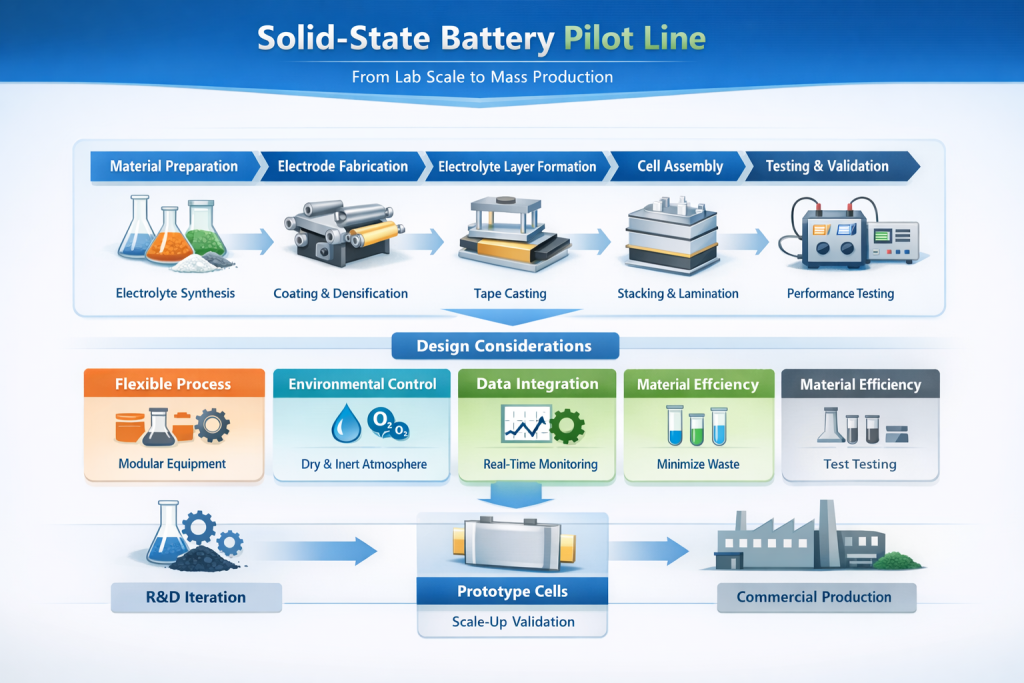
Key Processes in a Solid-State Battery Pilot Line
A well-designed pilot line typically includes:
1. Material Preparation
- Solid electrolyte synthesis or handling
- Conductive additive and binder mixing
- Controlled atmosphere processing (dry room or inert gas)
2. Electrode Fabrication
- Dry or wet coating processes
- Calendaring or densification
- Thickness and loading control
3. Electrolyte Layer Formation
- Tape casting or pressing
- Thin-film deposition (in some designs)
4. Cell Assembly
- Layer stacking or lamination
- Pressure-assisted assembly
- Interface engineering
5. Post-Treatment
- Heat treatment or sintering
- Pressure conditioning
6. Testing & Validation
- Electrochemical performance
- Mechanical stability
- Cycle life and safety testing
Design Considerations for Pilot Lines
To effectively support solid-state battery development, pilot lines should be designed with:
Flexibility
- Modular equipment to support different chemistries
- Adjustable process parameters (temperature, pressure, speed)
Environmental Control
- Ultra-low humidity environments for sensitive materials
- Oxygen control for reactive components
Data Integration
- Real-time monitoring of process variables
- Data collection for scale-up modeling
Material Efficiency
- Capability to operate with limited material quantities
- Minimized waste during trials
Common Challenges in Solid-State Pilot Lines
Despite their advantages, pilot lines face several challenges:
- Material cost: Solid electrolytes are often expensive and difficult to scale
- Equipment limitations: Standard lithium-ion equipment may not be suitable
- Process stability: Achieving consistent quality across batches can be difficult
- Interface engineering: Still a major unresolved issue in many SSB systems
Addressing these challenges requires close collaboration between material scientists, process engineers, and equipment designers.
Pilot Line vs. Lab Scale vs. Mass Production
| Stage | Focus | Output | Risk Level |
|---|---|---|---|
| Lab Scale | Material discovery | Coin cells | High |
| Pilot Line | Process validation | Prototype cells | Medium |
| Mass Production | Volume manufacturing | Commercial products | Lower (if validated) |
Pilot lines act as the critical transition layer, ensuring that promising lab results can be translated into manufacturable solutions.
Strategic Value for Industry Players
For companies developing solid-state batteries, investing in pilot lines provides:
- Faster time-to-market
- Better control over intellectual property
- Stronger customer validation capability
- Enhanced partnership opportunities with OEMs and research institutions
Pilot lines are not just technical assets—they are strategic enablers.
Solid-state batteries hold the potential to redefine energy storage, but their success depends heavily on manufacturing readiness. Pilot lines play a pivotal role in this transition by enabling controlled scale-up, process optimization, and risk reduction.
As the industry evolves, companies that build strong pilot capabilities will be better positioned to turn innovation into commercialization, accelerating the adoption of next-generation battery technologies.