
Dry Electrode Technology in Lithium Batteries
A Manufacturing Shift from Wet Chemistry to Scalable, Solvent-Free Processing
As lithium battery technology continues to evolve, most attention is often placed on materials—new cathodes, silicon anodes, or advanced conductive additives. However, one of the most important innovations is not only about materials, but about how electrodes are made.
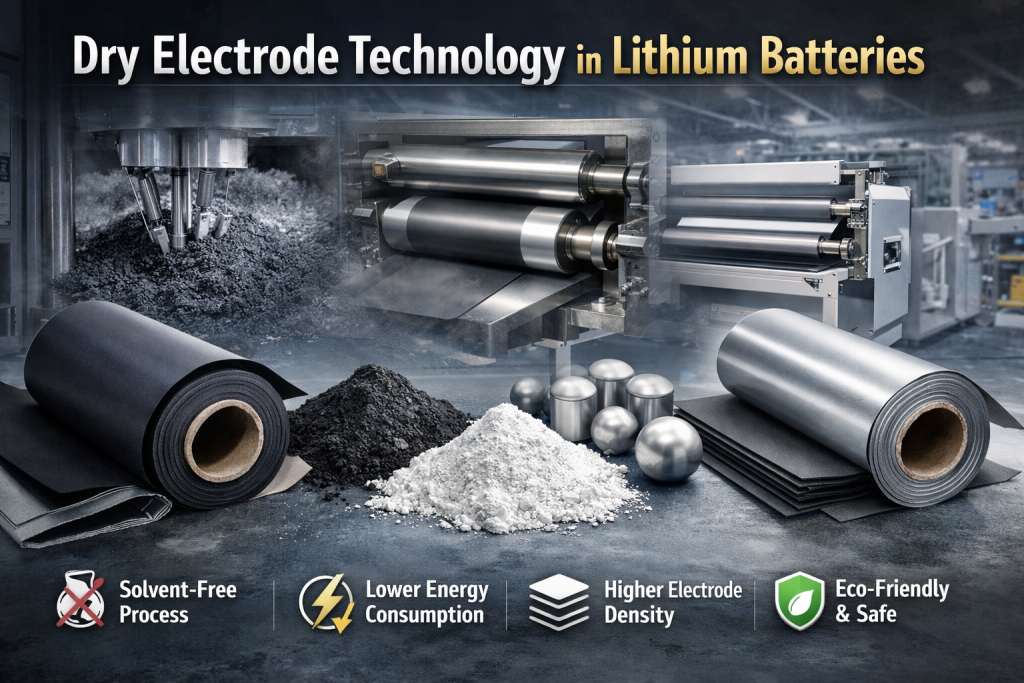
Dry electrode technology represents a fundamental shift in battery manufacturing. By eliminating solvents and simplifying processing, it has the potential to reduce cost, improve sustainability, and enable new material systems.
For companies working with advanced materials such as graphene and conductive carbons, dry electrode processing is not just a manufacturing change—it is a new integration challenge and opportunity.
What Is Dry Electrode Technology?
Traditional lithium-ion battery electrodes are produced using a wet coating process.
In this process:
-
Active materials, binders, and conductive additives are mixed with solvents
-
The slurry is coated onto current collectors
-
The coated electrodes are dried in large ovens
-
Residual solvents are recovered or removed
This method is widely used but comes with several drawbacks:
-
high energy consumption (drying ovens)
-
use of toxic or expensive solvents (e.g., NMP)
-
complex processing steps
-
large factory footprint
Dry electrode technology removes the solvent entirely.
Instead, electrode materials are processed in a solid-state or semi-solid form, and directly formed into electrode films.
How Dry Electrode Processing Works
Although different companies use different approaches, dry electrode processing typically involves:
1. Dry Mixing
Active materials, conductive additives, and binders are mixed without solvents.
2. Fibrillation (Binder Activation)
Polymer binders (such as PTFE) are mechanically processed to form a fibrous network.
3. Film Formation
The mixed material is formed into a free-standing electrode film.
4. Lamination
The dry electrode is pressed onto a current collector.
This process eliminates:
-
slurry preparation
-
solvent handling
-
drying stages
As a result, the manufacturing flow becomes significantly simpler.
Key Advantages of Dry Electrode Technology
1. Lower Energy Consumption
One of the biggest advantages is the removal of drying ovens.
Drying is one of the most energy-intensive steps in battery manufacturing. By eliminating it, dry electrode processing can significantly reduce:
-
energy usage
-
operating costs
-
carbon footprint
This is particularly important for large-scale battery production.
2. Simplified Manufacturing Process
Dry electrode technology reduces process complexity.
Compared to wet coating, it removes:
-
solvent mixing systems
-
coating liquids
-
drying lines
-
solvent recovery systems
This leads to:
-
smaller production footprint
-
lower capital expenditure
-
easier process control
3. Higher Electrode Density
Dry electrodes can achieve higher active material loading and density.
This can improve:
-
energy density
-
volumetric performance
-
electrode thickness
For next-generation batteries, especially high-energy systems, this is a major advantage.
4. Environmental and Safety Benefits
Removing solvents improves both environmental and workplace safety conditions.
Benefits include:
-
no toxic solvent emissions
-
reduced fire and explosion risks
-
simpler environmental compliance
This aligns with the growing demand for sustainable battery manufacturing.
Challenges of Dry Electrode Technology
Despite its advantages, dry electrode processing is not easy to implement.
1. Material Compatibility
Not all materials behave well in dry processing.
Challenges include:
-
poor particle binding
-
uneven distribution of conductive additives
-
difficulty forming stable films
Materials must be specifically engineered for dry processing.
2. Binder Network Formation
In wet processing, binders are dissolved and distributed uniformly.
In dry processing, binders must form a mechanical network through fibrillation.
This requires:
-
precise control of processing conditions
-
optimized binder selection
-
strong interaction between particles
3. Conductive Network Formation
For conductive additives such as graphene or carbon nanotubes, dispersion is more difficult without solvents.
Achieving a stable percolation network in dry conditions is a key challenge.
This directly impacts:
-
electrode conductivity
-
rate performance
-
cycle stability
4. Equipment and Process Development
Dry electrode manufacturing requires specialized equipment, such as:
-
high-shear dry mixers
-
calendering systems
-
lamination units
These systems are still evolving, and process optimization is ongoing.
Why Dry Electrode Technology Matters for Graphene Materials
Graphene materials are highly promising for battery applications due to their:
-
high conductivity
-
large surface area
-
mechanical strength
However, their performance depends heavily on dispersion and network formation.
In wet systems, dispersion is achieved through solvents.
In dry systems, this becomes more complex—but also more interesting.
Opportunity: Network Engineering
Graphene’s sheet-like structure can help form efficient conductive networks even at low loading levels.
In dry electrodes, this can:
-
improve electron transport
-
reduce conductive additive usage
-
enhance electrode uniformity
Challenge: Agglomeration Control
Without solvents, graphene materials may agglomerate more easily.
This requires:
-
advanced mixing strategies
-
surface functionalization
-
hybrid material design
Opportunity: Structural Reinforcement
Graphene can also contribute to:
-
mechanical strength of dry electrodes
-
crack resistance
-
structural stability during cycling
This is particularly valuable for thick electrodes.
The Role of Pilot Lines in Dry Electrode Development
Dry electrode technology cannot be fully developed in laboratory settings alone.
It requires pilot-scale validation.
Pilot lines help in:
-
optimizing dry mixing parameters
-
testing binder fibrillation behavior
-
evaluating electrode formation quality
-
validating performance in real battery cells
Because dry processing is highly sensitive to:
-
pressure
-
shear forces
-
material interactions
pilot lines are essential to translate theory into practice.
Industrial Outlook
Dry electrode technology is gaining increasing attention across the battery industry.
It is particularly relevant for:
-
electric vehicle batteries
-
high-energy-density cells
-
next-generation battery chemistries
Some companies are already investing heavily in dry electrode production lines, aiming to:
-
reduce manufacturing cost
-
improve scalability
-
enhance sustainability
However, widespread adoption will depend on continued advances in:
-
materials engineering
-
process control
-
pilot-scale validation
Dry electrode technology represents a major shift in lithium battery manufacturing.
By eliminating solvents and simplifying processing, it offers significant advantages in cost, efficiency, and sustainability.
At the same time, it introduces new challenges in:
-
material design
-
conductive network formation
-
process integration
For advanced materials such as graphene, dry electrode systems create both new opportunities and new requirements.
Success in this field will depend not only on material innovation, but also on the ability to integrate materials into scalable manufacturing processes.
And once again, this is where pilot lines play a critical role—turning promising concepts into real battery technologies.