
From Graphene Material to Coating System
Why adding graphene is easy — but building a functional coating system is engineering.
In many discussions, the focus is on the material:
-
Single-layer or few-layer graphene
-
Surface area
-
Conductivity
-
Sheet size
But in real industrial applications, graphene is never used alone.
It must become part of a coating system.
And that transformation — from raw graphene material to functional coating — is where most projects succeed or fail.
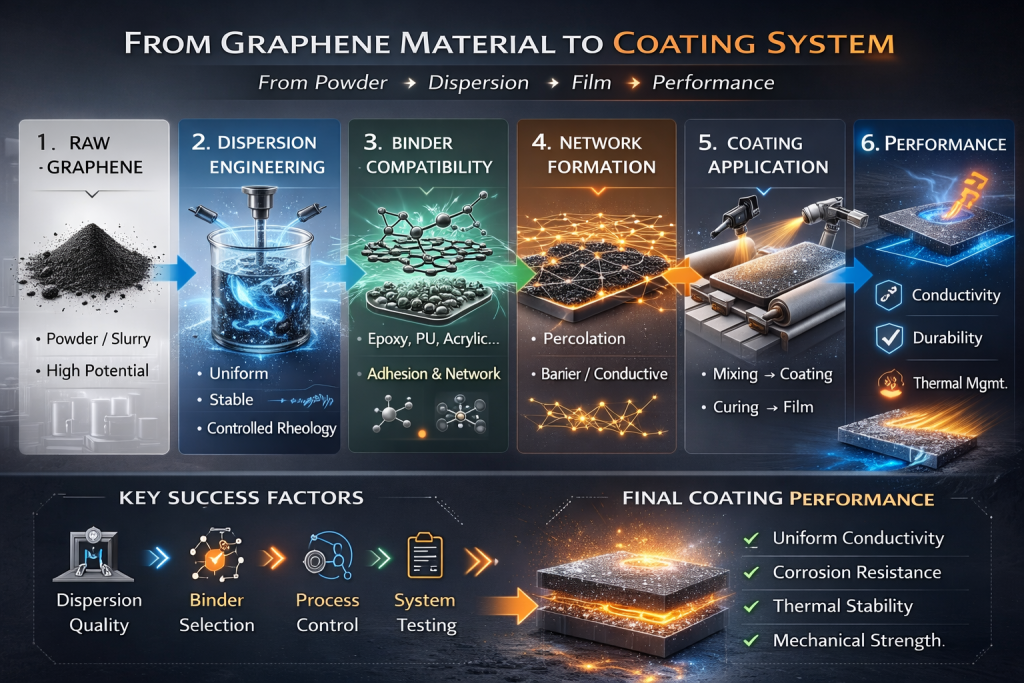
Step 1: Graphene as a Raw Material
At the material level, graphene offers:
-
High electrical conductivity
-
Barrier properties
-
Mechanical reinforcement
-
Thermal transport potential
But at this stage, it is:
-
A powder
-
Or a slurry
-
Or a dispersion concentrate
It is not yet a product.
Step 2: Dispersion Engineering
Before graphene can function inside a coating, it must be:
-
Uniformly dispersed
-
Stabilized
-
Compatible with the binder
This requires:
-
Shear control
-
Dispersant selection
-
Solid content balance
-
Rheology management
Poor dispersion leads to:
-
Agglomeration
-
Sedimentation
-
Uneven conductivity
-
Weak barrier performance
At this stage, graphene performance is defined more by processing than intrinsic properties.
Step 3: Binder Compatibility
Graphene must integrate into:
-
Epoxy systems
-
Polyurethane systems
-
Acrylic coatings
-
Waterborne systems
-
Solvent-based systems
Each binder system affects:
-
Interfacial adhesion
-
Network formation
-
Curing behavior
-
Mechanical strength
-
Electrical continuity
A graphene material that performs well in one binder may fail in another.
The coating system is more than the additive.
Step 4: Network Formation
For conductive or anticorrosion coatings, graphene must form:
-
A percolation network (conductive systems)
-
A tortuous diffusion barrier (anticorrosion systems)
-
A thermal pathway (heat-spreading systems)
Too little loading → no network
Too much loading → poor film formation
The balance is application-specific.
Step 5: Application Process Integration
A coating must survive:
-
Mixing
-
Storage
-
Transportation
-
Spray or roll application
-
Drying or curing
Graphene can affect:
-
Viscosity
-
Leveling
-
Sag resistance
-
Sprayability
-
Film smoothness
If the coating cannot be applied consistently, performance data becomes meaningless.
Step 6: Real-World Testing
Lab test panels are not enough.
A coating system must demonstrate:
-
Salt spray resistance
-
Adhesion stability
-
Long-term conductivity stability
-
Thermal cycling durability
-
Environmental resistance
Graphene alone does not guarantee durability.
System engineering does.
The Common Mistake
Many projects assume:
“High-performance graphene = high-performance coating.”
In reality:
High-performance graphene
-
Poor dispersion
-
Binder incompatibility
-
Process instability
= Unstable coating performance.
The bottleneck shifts from material science to formulation engineering.
Why System Thinking Wins
Successful graphene coatings are built by:
-
Defining target performance first
-
Selecting binder chemistry accordingly
-
Engineering dispersion
-
Optimizing loading level
-
Validating processing stability
-
Scaling carefully
Graphene is a component of a system — not the system itself.
Practical Takeaway
Moving from graphene material to coating system requires:
✔ Materials knowledge
✔ Formulation expertise
✔ Process control
✔ Application understanding
✔ Long-term reliability testing
The transformation from nano-material to macro-performance happens at the system level.
And that is where real industrial value is created.