
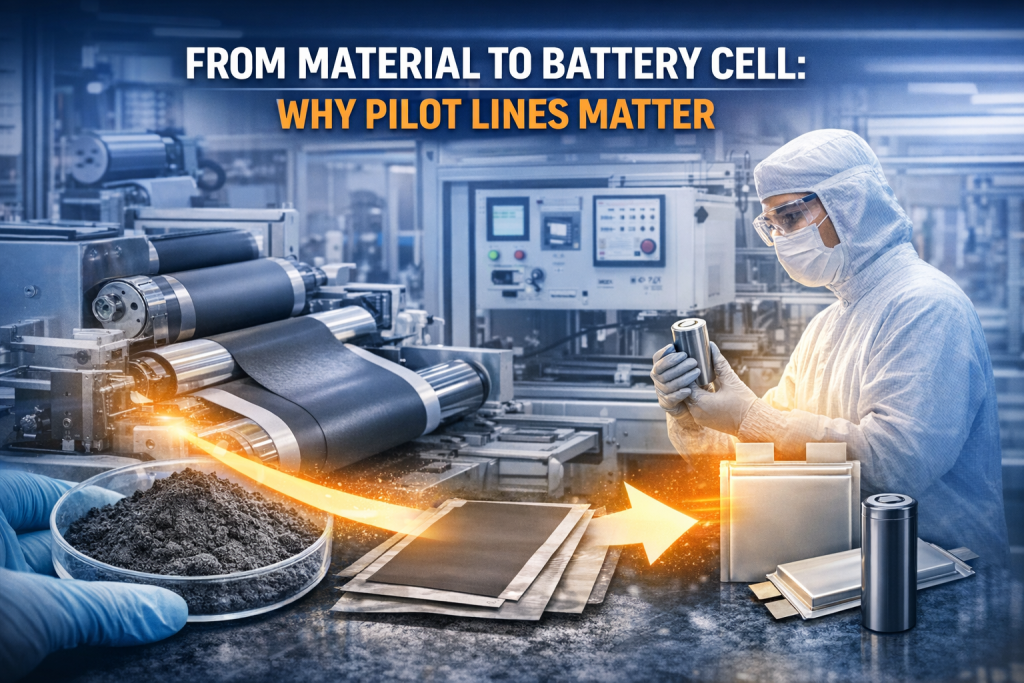
From Material to Battery Cell: Why Pilot Lines Matter
Bridging the Critical Gap Between Advanced Materials and Real Battery Systems
In the battery industry, innovation often starts with materials—but success is ultimately measured at the cell level.
A new conductive additive, a graphene-enhanced coating, or a novel electrode formulation may show excellent results in laboratory testing. However, many of these materials fail to translate into real battery cells.
Why?
Because the journey from material → electrode → battery cell → system integration is not linear. It requires a deep understanding of processing, engineering, and manufacturing constraints.
This is where pilot lines become essential.
The Missing Link: From Material Innovation to Battery Cells
Most advanced battery materials are first validated in controlled laboratory environments.
Typical early-stage validation includes:
-
coin cell testing
-
small-scale slurry preparation
-
simplified electrode fabrication
-
short-cycle performance evaluation
While these tests are useful, they do not reflect real battery production conditions.
In industrial environments, battery cells must meet strict requirements:
-
consistent electrode quality
-
uniform coating thickness
-
controlled porosity and density
-
mechanical integrity
-
long-term cycling stability
A material that performs well in a lab may fail when exposed to real manufacturing processes.
This disconnect is one of the biggest challenges in battery innovation.
Understanding the Material-to-Cell Pathway
To understand why pilot lines matter, it is important to break down the full pathway:
1. Material Development
New materials such as graphene, carbon nanotubes, or silicon composites are synthesized and characterized.
2. Electrode Formulation
Materials are mixed into slurries with binders, solvents, and active materials.
3. Electrode Manufacturing
The slurry is coated onto current collectors, dried, and processed.
4. Cell Assembly
Electrodes are assembled into battery cells (cylindrical, prismatic, or pouch).
5. Performance Validation
Cells are tested under real operating conditions.
Each step introduces new variables and risks.
A failure at any stage can prevent a material from reaching commercialization.
Where Pilot Lines Fit In
Pilot lines operate between laboratory research and mass production.
They simulate real manufacturing conditions while maintaining flexibility for testing and optimization.
Their role is to de-risk the transition from material to battery cell.
Instead of testing materials in isolation, pilot lines validate them within a complete process chain.
1. Translating Materials into Electrode Reality
One of the biggest challenges in battery development is translating material properties into electrode performance.
For example:
A graphene additive may show high conductivity in powder form.
But in an electrode, its performance depends on:
-
dispersion quality
-
interaction with binders
-
distribution within the active material
-
network formation (percolation)
Pilot lines enable engineers to test how materials behave in real electrode formulations, not just in theory.
This step is critical for:
-
conductivity optimization
-
mechanical stability
-
electrode uniformity
2. Simulating Industrial Manufacturing Conditions
Battery manufacturing involves complex processes such as:
-
high-shear mixing
-
slot-die coating
-
drying ovens
-
calendaring under pressure
-
roll-to-roll processing
These processes cannot be accurately replicated in small laboratory setups.
Pilot lines provide access to scaled-down industrial equipment, allowing materials to be tested under realistic conditions.
This helps answer key questions:
-
Will the material disperse at scale?
-
Can it survive coating and drying?
-
Does it maintain performance after compression?
Without this step, materials carry significant risk when moving to production.
3. Identifying Hidden Failure Modes
Many materials fail not because of chemistry, but because of engineering incompatibility.
Common failure modes include:
-
agglomeration during mixing
-
poor adhesion to current collectors
-
cracking during drying
-
conductivity loss after calendaring
-
instability during cycling
Pilot lines help uncover these issues early.
By identifying failure modes at the pilot stage, companies can:
-
adjust formulations
-
modify processes
-
redesign materials
This significantly reduces the cost of failure compared to discovering problems at full production scale.
4. Enabling Real Battery Cell Prototyping
A key advantage of pilot lines is the ability to produce real battery cells, not just test samples.
These may include:
-
cylindrical cells (e.g., 18650, 21700)
-
prismatic cells
-
pouch cells
This allows materials to be evaluated in:
-
realistic geometries
-
full electrochemical systems
-
application-relevant conditions
For example, a graphene-enhanced electrode can be tested for:
-
fast charging performance
-
thermal behavior
-
cycle life
-
safety characteristics
This level of validation is essential before industrial adoption.
5. Accelerating Time to Market
Without pilot lines, the transition from lab to production can take years.
Pilot-scale validation accelerates this process by:
-
reducing trial-and-error in production
-
providing reliable data for decision-making
-
enabling faster iteration cycles
-
supporting customer validation
For companies working with advanced materials, this speed can be a major competitive advantage.
6. Supporting Collaboration Across the Value Chain
Battery development involves multiple stakeholders:
-
material suppliers
-
cell manufacturers
-
equipment providers
-
system integrators
Pilot lines serve as a collaborative platform where these stakeholders can test and validate solutions together.
For example:
A material supplier can work with a battery manufacturer to optimize electrode formulations.
An equipment provider can adjust process parameters based on material behavior.
This integrated approach increases the likelihood of successful commercialization.
Why Pilot Lines Are Especially Important for Graphene Materials
Graphene and other advanced carbon materials offer significant potential in batteries, but they also introduce complexity.
Challenges include:
-
dispersion control
-
consistency at scale
-
interaction with other materials
-
process compatibility
These challenges cannot be solved through lab testing alone.
Pilot lines allow graphene materials to be:
-
engineered into usable forms
-
tested in real electrodes
-
validated in battery cells
This is why companies like GrapheneRich combine material expertise with pilot-line capabilities—ensuring that graphene solutions are not only innovative, but also manufacturable.
From Material to Market: A Structured Pathway
The journey from material innovation to battery deployment can be summarized as:
Material → Formulation → Pilot Validation → Cell Integration → Manufacturing
Pilot lines sit at the center of this pathway.
They transform uncertainty into engineering knowledge.
They convert promising materials into viable technologies.
In the battery industry, success is not defined by material properties alone—but by the ability to integrate those materials into real battery cells.
Pilot lines play a critical role in this process.
They bridge the gap between laboratory innovation and industrial manufacturing by enabling:
-
realistic process validation
-
electrode engineering
-
cell-level testing
-
failure analysis
-
scalable solutions
As battery technologies continue to evolve, pilot lines will become even more important.
They are not just a step in the process.
They are the foundation that makes advanced materials truly usable in the real world.