
From Slurry Development to Industrial Electrode Production
The performance of a lithium-ion battery depends not only on its materials but also on how those materials are processed into electrodes.
Many promising battery technologies achieve excellent laboratory results but encounter significant challenges when moving toward industrial production.
The journey from slurry formulation to large-scale electrode manufacturing involves multiple interconnected process steps, each of which influences final battery performance, manufacturing yield, and production cost.
Understanding this pathway is essential for companies seeking to commercialize new battery materials and accelerate scale-up.
Why Electrode Manufacturing Matters
Battery electrodes serve as the foundation of electrochemical performance.
Even when using advanced materials such as:
- High-nickel cathodes
- Silicon-rich anodes
- Graphene-enhanced formulations
- CNT conductive networks
poor manufacturing practices can limit their performance.
Electrode production determines:
- Material utilization
- Conductivity
- Porosity
- Adhesion
- Mechanical stability
- Manufacturing consistency
As battery technologies continue to evolve, process engineering has become just as important as material innovation.
Step 1: Slurry Development
Electrode manufacturing begins with slurry formulation.
The slurry typically contains:
Active Materials
Responsible for energy storage.
Conductive Additives
Supporting electron transport throughout the electrode.
Examples include:
- Carbon black
- Carbon nanotubes (CNTs)
- Graphene materials
Binders
Providing mechanical integrity and adhesion.
Solvents
Allowing materials to be mixed and coated.
The formulation stage determines how materials interact during all downstream processes.
The Importance of Dispersion
Proper dispersion is one of the most critical requirements for slurry development.
Poor dispersion may result in:
- Particle agglomeration
- Conductivity loss
- Coating defects
- Capacity variation
Advanced carbon materials require particularly careful processing because they naturally tend to form aggregates.
Achieving stable and homogeneous dispersion is often a key factor in successful scale-up.
Step 2: Slurry Characterization and Optimization
Before coating begins, the slurry must be carefully evaluated.
Key parameters include:
Viscosity
Influencing coating behavior and process stability.
Solid Content
Affecting electrode loading and drying efficiency.
Rheology
Determining flow behavior during coating.
Stability
Ensuring consistent performance throughout production.
Optimization at this stage reduces manufacturing risk and improves coating quality.
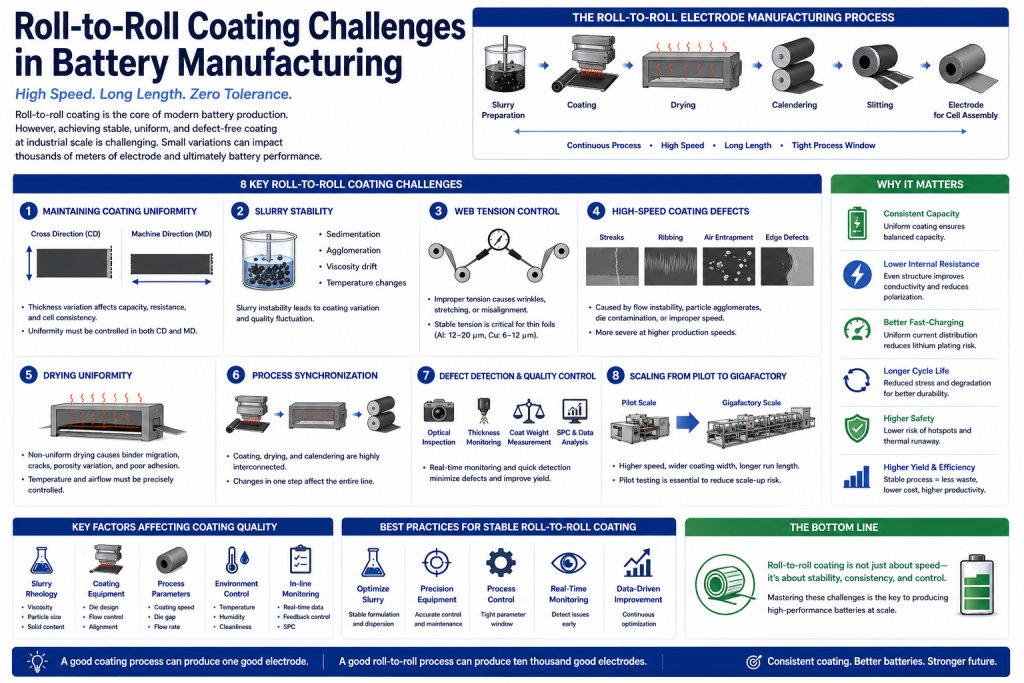
Step 3: Electrode Coating
After slurry preparation, the material is deposited onto a current collector.
Common coating technologies include:
- Slot-die coating
- Comma coating
- Knife-over-roll coating
- Gravure coating
Among these, slot-die coating has become a preferred solution for pilot and industrial production because of its precision and scalability.
The objective is to create a uniform wet film with controlled thickness and coat weight.
Why Coating Uniformity Is Critical
Small variations in coating thickness can significantly affect battery performance.
Potential consequences include:
- Capacity variation
- Increased resistance
- Poor cell consistency
- Reduced yield
Manufacturers therefore focus on controlling:
- Wet film uniformity
- Coat weight
- Edge quality
- Process stability
Uniform coatings contribute directly to reliable battery production.
Step 4: Drying and Solvent Removal
Once coated, the electrode enters the drying stage.
Although drying may appear straightforward, it is one of the most influential steps in electrode manufacturing.
During drying:
- Solvents evaporate
- Binders redistribute
- Pores form
- Electrode structure develops
Drying conditions affect:
- Adhesion
- Porosity
- Conductive network formation
- Long-term battery performance
Improper drying can lead to defects that are difficult to correct later in the process.
Step 5: Calendering
After drying, electrodes are typically compressed using calendering equipment.
Calendering improves:
- Electrode density
- Surface smoothness
- Particle contact
- Electrical conductivity
The process also influences pore structure and ion transport characteristics.
Finding the optimal balance between density and porosity is essential for achieving desired battery performance.
Step 6: Slitting and Electrode Finishing
Large coated rolls are converted into production-ready electrodes.
This stage includes:
- Slitting
- Edge inspection
- Defect detection
- Roll preparation
Quality control becomes increasingly important as production volume increases.
Manufacturers must ensure that every electrode meets specification requirements before cell assembly.
The Role of Pilot Production
Pilot manufacturing serves as the bridge between laboratory research and commercial production.
Pilot lines allow engineers to evaluate:
- Slurry processability
- Coating behavior
- Drying performance
- Equipment compatibility
- Manufacturing repeatability
Pilot-scale validation helps identify potential issues before full-scale deployment.
This significantly reduces technical and financial risk.
Common Scale-Up Challenges
Many challenges emerge during industrialization.
Dispersion Stability
Large batch production may affect slurry consistency.
Coating Defects
Issues such as streaks, pinholes, and edge irregularities may appear.
Drying Variability
Industrial drying conditions often differ significantly from laboratory environments.
Process Repeatability
Maintaining consistent performance over long production runs can be difficult.
Addressing these challenges requires both material expertise and process optimization.
Advanced Carbon Materials in Modern Electrode Manufacturing
Carbon-based materials are playing an increasingly important role in next-generation batteries.
Examples include:
CNT Conductive Networks
Supporting electron transport and fast charging.
Graphene Additives
Enhancing conductivity and thermal management.
Hybrid Carbon Architectures
Combining multiple carbon materials to optimize electrode performance.
Successful implementation depends on achieving consistent processing at manufacturing scale.
Why Industrialization Requires More Than Materials
Many battery projects focus heavily on material development.
However, commercialization ultimately depends on manufacturing capability.
A successful electrode technology must demonstrate:
- Scalable production
- Consistent quality
- Competitive cost
- Reliable performance
Industrialization therefore requires integration of materials science, process engineering, and pilot-scale validation.
Future Trends
Several trends are shaping the future of electrode manufacturing.
High-Energy-Density Batteries
Requiring thicker and more sophisticated electrode structures.
Silicon-Rich Anodes
Creating new processing challenges.
Faster Charging Technologies
Demanding highly optimized conductive networks.
Advanced Carbon Materials
Driving innovation in conductivity and electrode architecture.
As battery technology advances, manufacturing processes will continue to evolve alongside material development.
The pathway from slurry development to industrial electrode production involves far more than simply mixing materials and applying coatings.
Every stage—including dispersion, slurry optimization, coating, drying, calendering, and pilot validation—plays a critical role in determining battery performance and manufacturing success.
For companies developing next-generation battery materials, understanding and optimizing this complete process chain is essential for successful commercialization.
Ultimately, the future of battery innovation will depend not only on better materials but also on the ability to manufacture those materials reliably, efficiently, and at scale.