
How Carbon Nanomaterials Improve Heat Dissipation
Mechanisms, Material Choices, and Practical Design Insights
Why Heat Dissipation Has Become a Bottleneck
As power density continues to increase across electronics, energy storage, and industrial systems, thermal management has become a primary performance limiter rather than a secondary consideration.
Traditional thermal solutions—metal heat sinks, ceramic fillers, and phase-change materials—are approaching their practical limits. This has driven growing interest in carbon nanomaterials, particularly carbon nanotubes (CNTs) and graphene, as next-generation heat dissipation enhancers.
But how exactly do these materials improve heat dissipation—and what are the real-world design considerations?
What Limits Heat Dissipation in Conventional Materials?
Heat dissipation is governed by several bottlenecks:
-
Low intrinsic thermal conductivity of polymer matrices
-
Poor interfacial contact between filler particles
-
Thermal interface resistance between layers
-
Weight and thickness constraints in compact systems
Traditional fillers such as aluminum oxide or boron nitride improve thermal conductivity, but often require very high loading levels, which negatively impact processability, flexibility, and mechanical integrity.
Why Carbon Nanomaterials Are Different
Carbon nanomaterials stand out due to their unique combination of intrinsic properties and network behavior.
| Material | Intrinsic Thermal Conductivity (theoretical) |
|---|---|
| CNTs | > 3000 W/m·K (along tube axis) |
| Graphene | > 5000 W/m·K (in-plane) |
While these values are rarely achieved at the system level, they explain why even low loadings of carbon nanomaterials can significantly enhance heat dissipation when properly designed.
Mechanism 1: High-Aspect-Ratio Thermal Pathways
Unlike spherical fillers, CNTs and graphene sheets exhibit extremely high aspect ratios.
This enables:
-
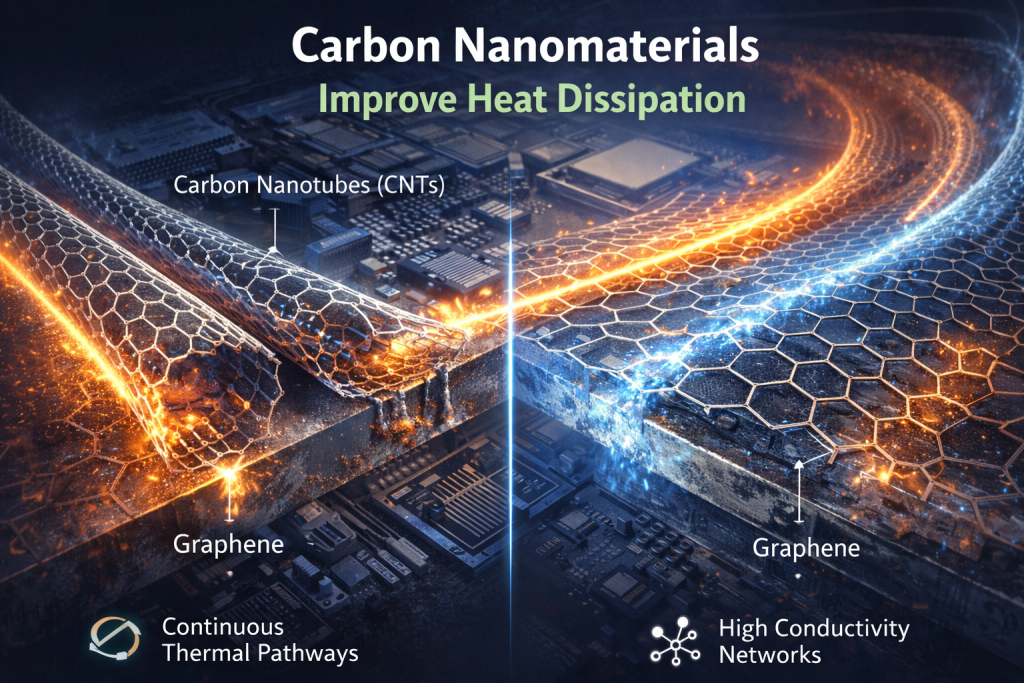
Rapid formation of continuous thermal pathways
-
Lower percolation thresholds for heat transport
-
Reduced reliance on particle-to-particle contact
CNTs, in particular, act as one-dimensional heat highways, bridging heat sources and spreading energy across the matrix.
Mechanism 2: Phonon-Dominated Heat Transport
Heat in carbon nanomaterials is primarily carried by phonons rather than free electrons.
This results in:
-
Low phonon scattering along aligned CNTs
-
Efficient in-plane heat spreading in graphene sheets
-
Superior performance in thin films and coatings
When dispersed effectively, these phonon pathways extend into the surrounding matrix, improving bulk heat dissipation.
Mechanism 3: Network Formation at Low Loading Levels
A critical advantage of carbon nanomaterials is their ability to form interconnected thermal networks at very low concentrations.
Typical trends:
-
CNTs: effective thermal enhancement at <1 wt%
-
Graphene: strong in-plane enhancement at 1–5 wt%
Lower loading means:
-
Better mechanical flexibility
-
Easier processing
-
Lower weight penalty
-
Maintained surface quality in coatings and films
CNTs vs Graphene in Heat Dissipation
Although often grouped together, CNTs and graphene play different roles in thermal management.
CNTs excel at:
-
Bridging gaps between interfaces
-
Enhancing through-plane heat transport
-
Improving thermal connectivity in composites
Graphene excels at:
-
In-plane heat spreading
-
Thin-film heat dissipation
-
Coating-based thermal barriers and spreaders
In many applications, hybrid CNT–graphene systems outperform either material alone.
Role of Dispersion and Alignment
Material selection alone does not guarantee performance.
Key design factors include:
-
Degree of dispersion
-
CNT alignment direction
-
Graphene sheet orientation
-
Interfacial bonding with the matrix
Poor dispersion leads to agglomeration, which:
-
Reduces effective thermal pathways
-
Increases thermal resistance
-
Creates mechanical weak points
Controlled dispersion and partial alignment dramatically improve heat dissipation efficiency.
Carbon Nanomaterials in Thermal Coatings
In thermal coatings, carbon nanomaterials offer a unique balance:
-
Thin coating thickness
-
High heat spreading capability
-
Compatibility with metals such as aluminum and steel
Graphene-enhanced coatings are increasingly used to:
-
Improve heat dissipation on heat sinks
-
Reduce surface hot spots
-
Enhance durability under thermal cycling
CNTs contribute by improving interfacial thermal connectivity between coating layers and substrates.
Applications in Thermal Interface Materials (TIMs)
In TIM systems, contact resistance often dominates thermal performance.
Carbon nanomaterials help by:
-
Filling micro-gaps at interfaces
-
Reducing interfacial thermal resistance
-
Maintaining performance under compression and cycling
CNT-based gels, graphene-enhanced pads, and hybrid TIM films are now widely explored for:
-
Power modules
-
Battery systems
-
Data center electronics
Lightweight Heat Dissipation for Energy and Mobility
For EVs, energy storage systems, and portable electronics, weight reduction is as critical as thermal performance.
Carbon nanomaterials enable:
-
Thinner thermal layers
-
Reduced metal mass
-
Integrated multifunctional performance (thermal + electrical)
This makes them particularly attractive for next-generation mobility and renewable energy platforms.
Practical Limitations and Trade-Offs
Despite their advantages, carbon nanomaterials are not a universal solution.
Design challenges include:
-
Cost sensitivity at scale
-
Dispersion consistency in mass production
-
Balancing thermal, electrical, and mechanical properties
-
Process compatibility with existing manufacturing lines
Successful designs focus on system-level optimization, not maximum filler loading.
Testing and Evaluation Considerations
Thermal performance should be evaluated using:
-
In-plane vs through-plane measurements
-
Long-term thermal cycling tests
-
Interface resistance characterization
Lab-scale conductivity values must always be validated under real application conditions.
From Material to Thermal System Design
Carbon nanomaterials improve heat dissipation not simply because they are thermally conductive, but because they enable new thermal architectures.
Their real value lies in:
-
Network formation at low loading
-
Directional heat transport
-
Compatibility with thin, lightweight systems
When properly selected and formulated, CNTs and graphene transform thermal management from a passive constraint into an active design advantage.