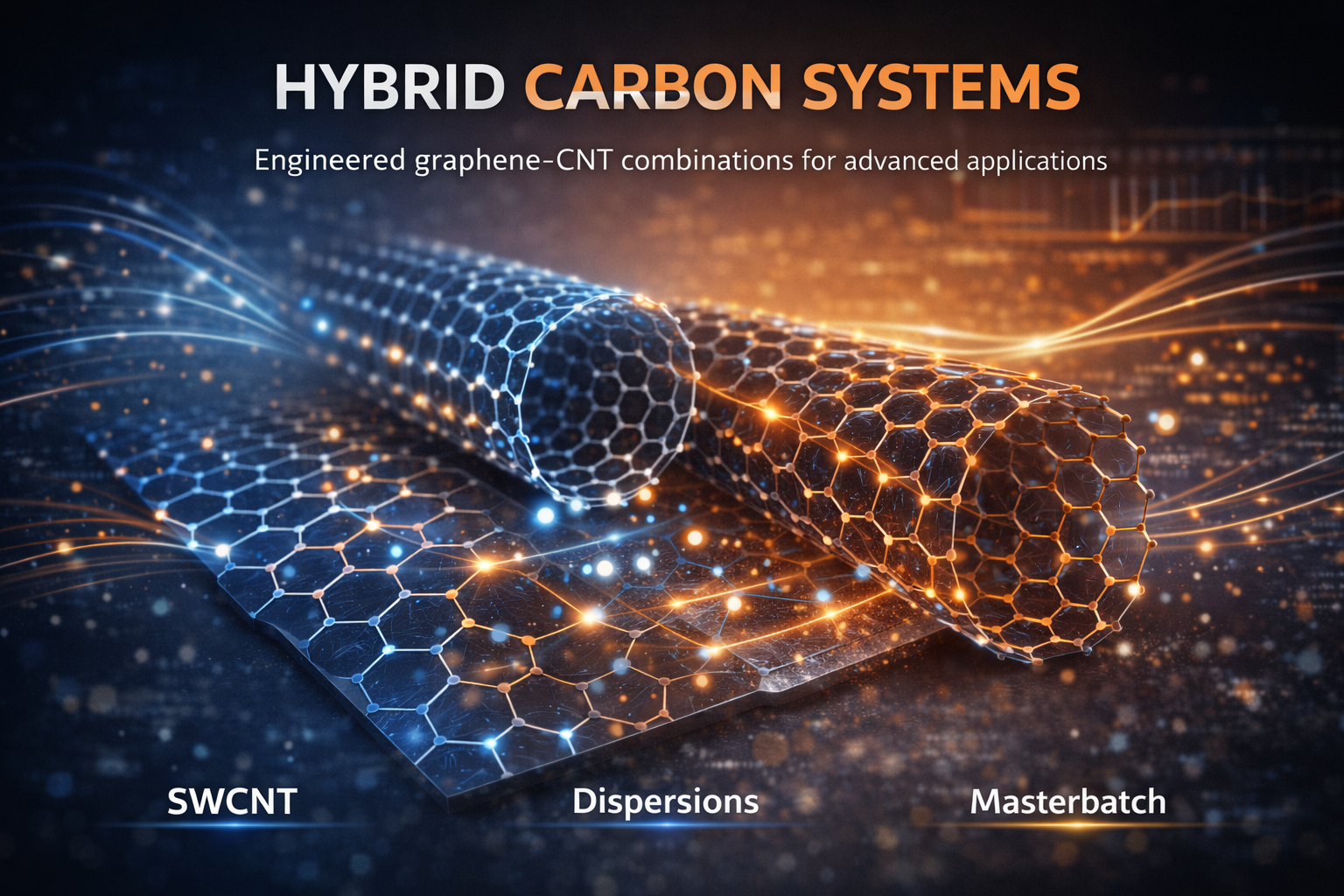
Hybrid Carbon Systems
Engineered Carbon Systems for Advanced Performance–Hybrid systems bridge the gap between raw materials and real-world applications.
Hybrid Carbon Systems combine graphene, carbon nanotubes (CNT), and other functional materials to create optimized solutions for thermal, electrical, and protective applications.
By leveraging synergistic effects between different carbon structures, these systems deliver enhanced performance beyond individual materials.
What Are Hybrid Carbon Systems?
Hybrid Carbon Systems are engineered material combinations designed to achieve specific performance targets such as conductivity, heat dissipation, or durability.
These systems integrate:
- Graphene (2D structure)
- Carbon nanotubes (1D conductive network)
- Functional additives and matrices
Resulting in improved dispersion, connectivity, and stability.
🔥 Key System Categories
 Thermal Hybrid Systems
Designed for efficient heat dissipation and thermal management.
Typical Features:
- Enhanced thermal conductivity
- Improved heat spreading
- Reduced interface resistance
Applications:
- Thermal interface materials (TIM)
- Heat sinks and cooling systems
- Electronics and AI hardware
 Connect to: Thermal Management
 Conductive Hybrid Systems
Engineered for stable and efficient electrical conductivity.
Typical Features:
- Low percolation threshold
- Stable conductive networks
- EMI shielding performance
Applications:
- Conductive coatings and inks
- ESD / EMI shielding materials
- Printed and flexible electronics
Connect to: Conductive Materials
 Coating & Composite Systems
Advanced systems for protection and durability.
Typical Features:
- Anti-corrosion performance
- Mechanical reinforcement
- Barrier protection
Applications:
- Industrial coatings
- Marine and chemical environments
- Protective composite materials
Connect to: Advanced Coatings
Material Integration
–Hybrid systems are built from our core materials:
From Materials to Engineering Validation
To ensure real-world performance, hybrid systems can be tested and validated through our Battery Materials Pilot Line:
- Electrode fabrication
- Cell-level testing (cylindrical, pouch, prismatic)
- Process optimization (dry & wet methods)
Why Hybrid Systems Matter
Combine advantages of multiple carbon materials
Improve performance without excessive material loading
Enable scalable industrial applications
Reduce development time for new products
Typical Use Cases
- High-performance thermal interface materials
- Conductive polymer systems
- Anti-corrosion coatings for harsh environments
- Energy storage materials and electrodes
Looking for a tailored material system rather than a single material?