
Hybrid Carbon Systems: Combining Graphene and CNT
As advanced materials move toward real-world applications, single-component systems often struggle to meet all performance requirements. Hybrid carbon systems, which combine graphene and carbon nanotubes (CNTs), are emerging as a powerful solution to overcome these limitations.
By integrating 2D graphene sheets with 1D CNT networks, these hybrid materials create synergistic effects that significantly enhance electrical, thermal, and mechanical performance across multiple industries.
What Are Hybrid Carbon Systems?
Hybrid carbon systems are engineered composites that combine:
- Graphene → high surface area, उत्कृष्ट conductivity, planar structure
- CNTs → high aspect ratio, network formation, उत्कृष्ट electron pathways
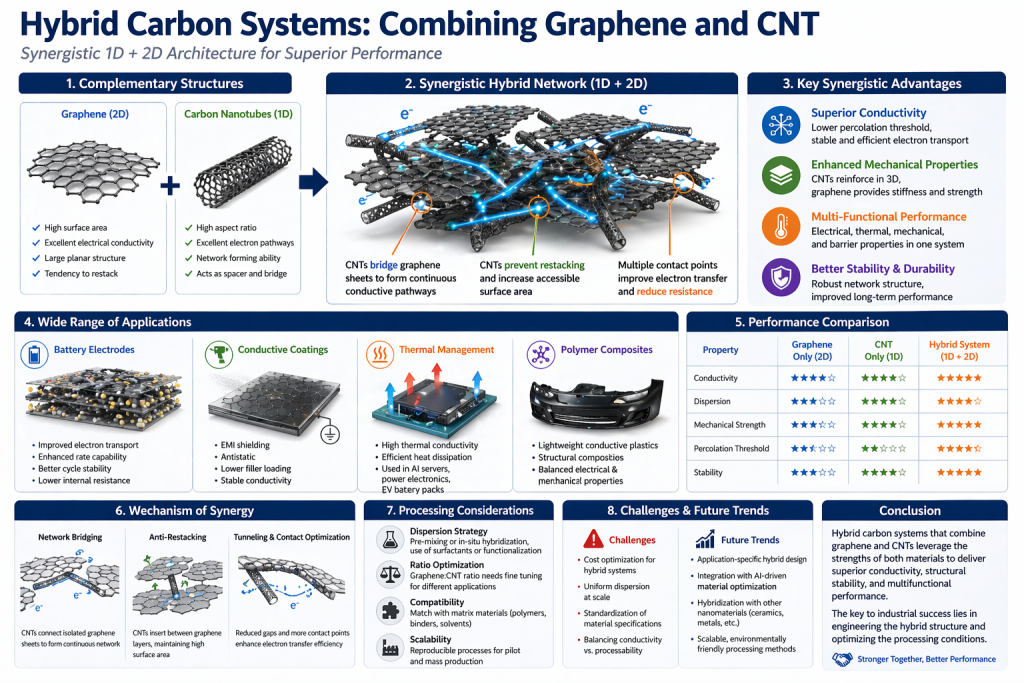
Together, they form a multi-dimensional conductive architecture (1D + 2D) that outperforms either material alone.
Why Combine Graphene and CNTs?
1. Complementary Structures
- Graphene sheets tend to restack, reducing effective surface area
- CNTs act as spacers and bridges, preventing restacking
Result:
👉 More accessible surface + better conductivity
2. Enhanced Conductive Networks
- CNTs create long-range conductive pathways
- Graphene provides high conductivity planes
This leads to:
- Lower percolation threshold
- More stable electron transport
- Reduced contact resistance
3. Improved Mechanical Properties
- CNTs reinforce the structure in 3D
- Graphene improves stiffness and strength
Result:
👉 Stronger, more durable composite systems
4. Multi-Functional Performance
Hybrid systems enable:
- Electrical conductivity
- Thermal conductivity
- Mechanical reinforcement
- Barrier properties
All in one material system.
Key Mechanisms of Synergy
Network Bridging Effect
CNTs connect isolated graphene sheets, forming a continuous conductive network.
Anti-Restacking Effect
CNTs insert between graphene layers, maintaining:
- High surface area
- Better dispersion
Tunneling and Contact Optimization
- Reduced gaps between conductive elements
- Enhanced electron transfer efficiency
Industrial Applications
1. Battery Electrodes
Hybrid graphene-CNT systems are widely used in:
- Lithium-ion batteries
- Solid-state batteries
- Supercapacitors
Benefits:
- Improved electron transport
- Enhanced rate capability
- Better cycle stability, especially in thick electrodes
2. Conductive Coatings
Applications include:
- EMI shielding
- Antistatic coatings
- Smart surfaces
Advantages:
- Lower filler loading
- Stable conductivity
- Improved coating durability
3. Thermal Management Materials
Hybrid systems improve:
- Heat dissipation
- Thermal interface performance
Used in:
- AI servers
- Power electronics
- EV battery packs
4. Polymer Composites
Used for:
- Lightweight conductive plastics
- Structural composites
Benefits:
- Balanced mechanical and electrical properties
- Reduced material usage
Performance Comparison
| Property | Graphene Only | CNT Only | Hybrid System |
|---|---|---|---|
| Conductivity | High (planar) | High (network) | Highest (synergistic) |
| Dispersion | Moderate | Good | Improved |
| Mechanical Strength | High | High | Enhanced |
| Percolation Threshold | Medium | Low | Lower |
| Stability | Moderate | Good | Best |
Processing Considerations
Dispersion Strategy
- Pre-mixing vs in-situ hybridization
- Use of surfactants or functionalization
Ratio Optimization
- Graphene:CNT ratio impacts performance
- Typical systems require fine tuning for each application
Compatibility
- Must match with matrix materials (polymers, binders, solvents)
Scalability
- Processes must be reproducible at pilot and production scale
Challenges
- Cost optimization for hybrid systems
- Uniform dispersion at scale
- Standardization of material specifications
- Balancing conductivity vs processability
Future Trends
- Application-specific hybrid design
- Integration with AI-driven material optimization
- Hybridization with other nanomaterials (e.g., ceramics, metals)
- Scalable, environmentally friendly processing methods
Hybrid carbon systems that combine graphene and CNTs represent a next-generation material platform. By leveraging the strengths of both materials, they deliver superior conductivity, structural stability, and multifunctional performance.
For industrial applications, the key lies in engineering the hybrid structure and optimizing the processing conditions—this is where true competitive advantage is created.