
Material Innovation Needs Engineering Validation
Why breakthrough materials must pass the engineering test.
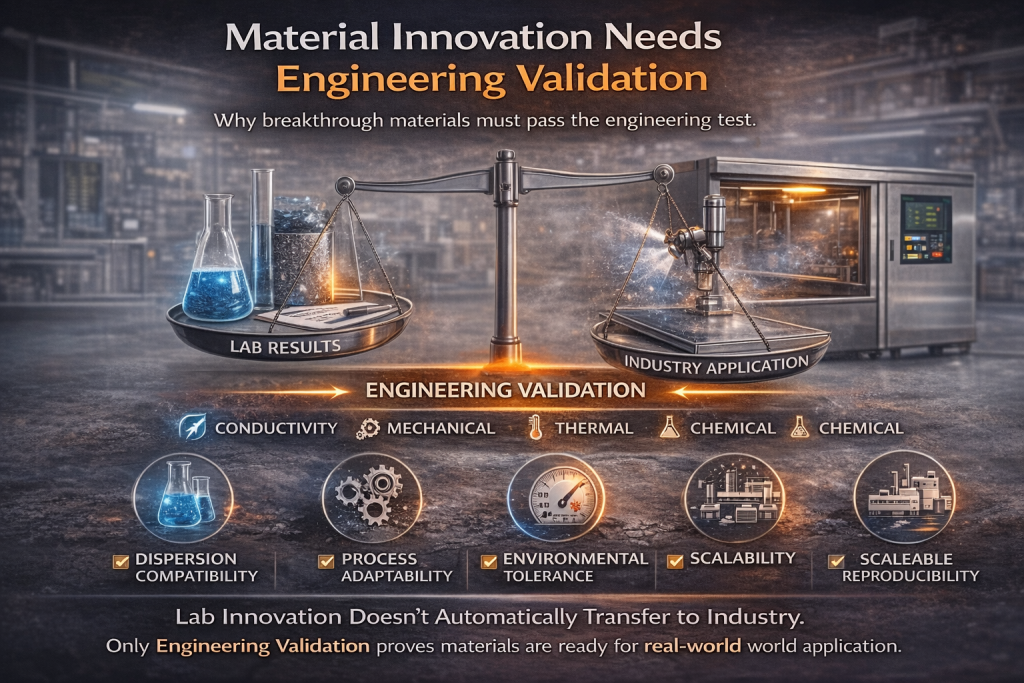
New materials often begin with impressive laboratory results. Graphene, carbon nanotubes, advanced polymers, and hybrid nanomaterials frequently demonstrate exceptional properties under controlled experimental conditions.
However, real industrial adoption does not depend on material novelty alone. It depends on whether the material can perform reliably within an engineered system.
This is why material innovation must go through engineering validation before it becomes a practical solution.
1️⃣ Laboratory Performance Is Only the First Step
In research environments, materials are typically evaluated based on intrinsic properties such as:
-
Electrical conductivity
-
Thermal conductivity
-
Mechanical strength
-
Barrier performance
-
Chemical stability
While these measurements are important, they do not fully represent how the material behaves when integrated into a real product.
Engineering validation examines how those properties translate into practical performance.
2️⃣ Integration Into Real Systems
Materials rarely function alone. In most applications they must interact with:
-
Polymers or binders
-
Solvents or dispersions
-
Additives and fillers
-
Substrates and surfaces
During engineering validation, researchers determine:
-
Whether the material disperses well
-
Whether it is compatible with the matrix
-
Whether it maintains its structure during processing
A material with excellent intrinsic properties can fail if it does not integrate well into the system.
3️⃣ Process Compatibility
Industrial processes impose constraints that laboratory testing often does not consider.
These include:
-
Mixing energy limitations
-
Coating or printing methods
-
Temperature and curing profiles
-
Production throughput
Engineering validation ensures the material can withstand these conditions while maintaining performance.
4️⃣ Performance Under Real Conditions
Materials must also perform consistently under real operating environments, such as:
-
Humidity and temperature fluctuations
-
Mechanical stress
-
Chemical exposure
-
Long-term aging
Testing under these conditions helps determine whether a material can deliver stable, long-term performance.
5️⃣ Scalability and Reproducibility
One of the most critical parts of engineering validation is determining whether a material can be produced consistently at larger scale.
This includes evaluating:
-
Batch-to-batch consistency
-
Manufacturing repeatability
-
Supply chain feasibility
-
Cost-performance balance
Without scalability, even the most advanced material remains confined to the laboratory.
Material innovation creates possibilities.
Engineering validation turns those possibilities into reliable technologies.
The path from discovery to application requires more than scientific breakthroughs—it requires a systematic process of testing, integration, and scale-up.
Only when a material passes this stage does it truly become ready for industry.