
Pilot-Scale Validation for Battery Electrode Coating
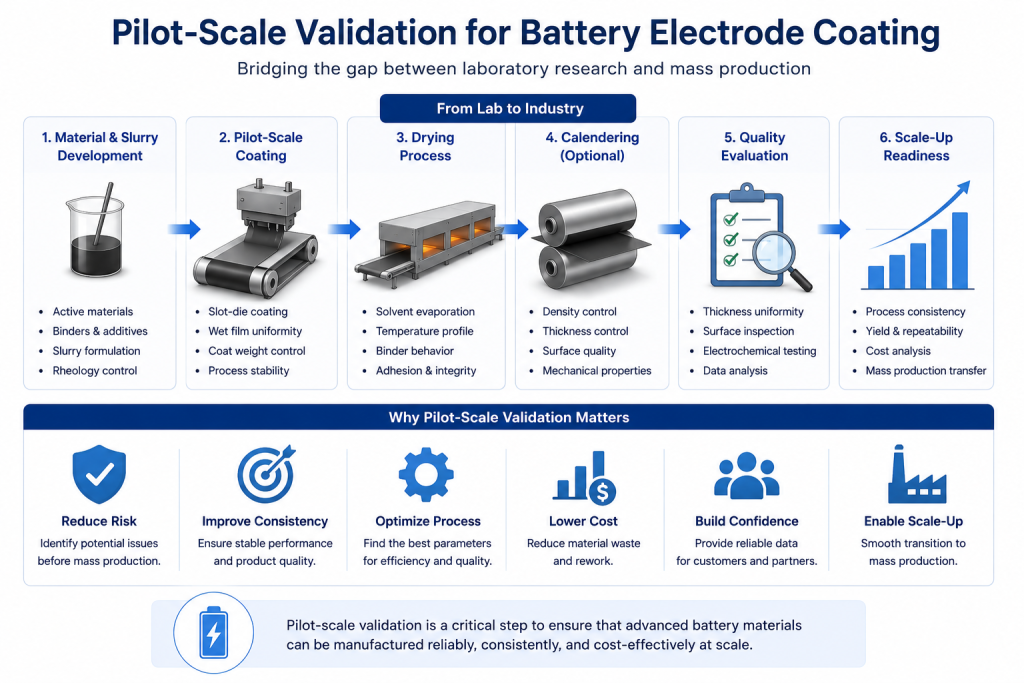
Developing a promising battery material in the laboratory is only the first step toward commercialization.
Before a new electrode formulation can enter large-scale manufacturing, it must demonstrate that it can be processed consistently, economically, and reliably under realistic production conditions.
This is where pilot-scale validation becomes essential.
For lithium-ion battery manufacturers, pilot-scale coating trials provide critical insight into how electrode materials behave during continuous production and help identify potential risks before major investments are made.
Pilot validation serves as the bridge between laboratory innovation and commercial battery manufacturing.
Why Laboratory Success Is Not Enough
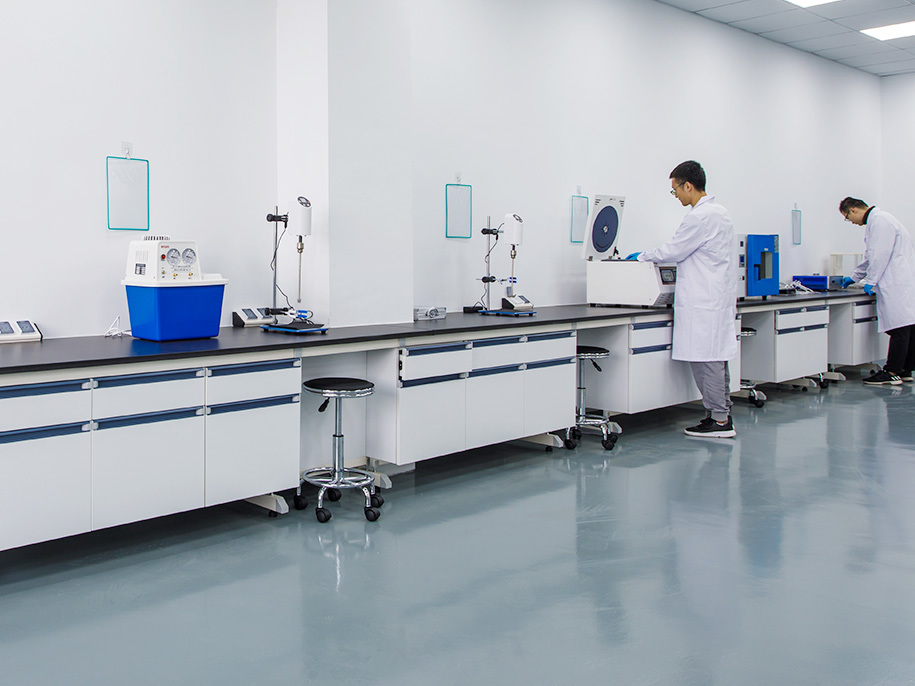
Battery research is often conducted using:
- Small batch slurry preparation
- Hand coating techniques
- Laboratory drying ovens
- Limited sample sizes
These methods are valuable for evaluating electrochemical performance, but they do not fully represent industrial production environments.
Challenges that may not appear in the laboratory often emerge during scale-up, including:
- Slurry stability issues
- Coating defects
- Drying non-uniformity
- Process variability
- Production yield losses
As a result, successful laboratory results do not automatically guarantee manufacturing success.
What Is Pilot-Scale Validation?
Pilot-scale validation involves testing electrode materials and processes on equipment that closely resembles commercial production systems.
Typical pilot lines include:
- Continuous slurry mixing
- Precision coating systems
- Drying ovens
- Web handling equipment
- Calendering units
- Quality inspection systems
The goal is to evaluate whether a process can consistently produce high-quality electrodes under realistic manufacturing conditions.
The Role of Pilot Coating Lines
Pilot coating lines allow engineers to study interactions between materials, equipment, and process conditions.
Unlike laboratory testing, pilot production introduces factors such as:
- Continuous operation
- Larger coating widths
- Longer production runs
- Higher coating speeds
- Industrial drying conditions
These factors often reveal scale-up challenges that are not visible during early-stage development.
Validating Slurry Processability
One of the first objectives of pilot-scale testing is evaluating slurry behavior.
Important parameters include:
Dispersion Stability
The slurry must remain homogeneous throughout the production run.
Viscosity Control
Consistent rheology is essential for coating quality.
Pumpability
The material must flow reliably through industrial coating equipment.
Storage Stability
The slurry should maintain performance during production scheduling and handling.
Poor slurry behavior often becomes a major obstacle during scale-up.
Validating Coating Performance
Coating quality directly affects battery performance.
Pilot-scale testing evaluates:
Wet Film Uniformity
Consistent coating thickness across the substrate.
Coat Weight Control
Accurate deposition of active materials.
Edge Quality
Minimizing defects at coating boundaries.
Process Stability
Maintaining consistent performance over extended runs.
These factors influence both product quality and manufacturing efficiency.
Evaluating Drying Behavior
Drying is one of the most critical stages of electrode manufacturing.
Pilot-scale drying studies help engineers understand:
- Solvent evaporation dynamics
- Binder migration
- Porosity formation
- Crack development
- Electrode adhesion
Drying profiles that work in laboratory ovens may not perform identically under industrial conditions.
Pilot validation helps optimize these parameters before commercial deployment.
Assessing Electrode Microstructure
The electrode structure formed during coating and drying has a direct impact on battery performance.
Pilot-scale validation evaluates:
Thickness Uniformity
Ensuring consistent electrode dimensions.
Density Distribution
Supporting predictable electrochemical behavior.
Porosity Control
Balancing energy density and ion transport.
Conductive Network Formation
Maintaining efficient electron pathways.
These characteristics influence cell performance, cycle life, and safety.
Supporting Advanced Materials Development
Pilot-scale validation is particularly important for emerging battery materials.
Examples include:
Silicon-Rich Anodes
Requiring control of expansion-related challenges.
CNT Conductive Networks
Demanding uniform dispersion and network formation.
Graphene-Enhanced Electrodes
Requiring optimized coating and drying conditions.
High-Loading Electrodes
Needing improved process control and structural stability.
Pilot testing helps determine whether these materials can be integrated into scalable manufacturing processes.
Measuring Manufacturing Consistency
Commercial battery production requires more than high performance.
Manufacturers must achieve:
- Repeatability
- Reliability
- Yield
- Cost efficiency
Pilot validation generates data that helps evaluate:
Batch-to-Batch Consistency
Can the process deliver the same results repeatedly?
Long-Run Stability
Can quality be maintained over extended production periods?
Production Yield
How much material is lost to defects?
Process Capability
Can manufacturing tolerances be consistently achieved?
These factors strongly influence commercial viability.
Reducing Scale-Up Risk
One of the primary benefits of pilot-scale validation is risk reduction.
Without pilot testing, companies may encounter costly issues during commercial launch, including:
- Unexpected coating defects
- Low manufacturing yield
- Equipment incompatibility
- Quality inconsistencies
- Delayed product qualification
Pilot trials help identify these challenges early, reducing both technical and financial risk.
Why Pilot Data Matters to Customers
Battery manufacturers increasingly require evidence that new materials can be processed reliably.
Pilot-scale data provides confidence in:
- Manufacturing readiness
- Process stability
- Quality control
- Scale-up feasibility
This information often plays a critical role during customer qualification and commercialization discussions.
Future Trends
Several industry trends are increasing the importance of pilot validation.
Higher Energy Density Batteries
Requiring tighter process control.
Faster Charging Technologies
Demanding optimized electrode structures.
Thick Electrode Development
Creating new coating and drying challenges.
Advanced Carbon Materials
Requiring validation of novel conductive architectures.
As battery technology evolves, pilot-scale manufacturing will become increasingly important in reducing development risk and accelerating commercialization.
Pilot-scale validation is one of the most important steps in transforming battery materials from laboratory concepts into commercially viable products.
By evaluating slurry processability, coating performance, drying behavior, electrode structure, and manufacturing consistency, pilot testing provides essential insight into industrial feasibility.
For advanced battery materials—including graphene-enhanced electrodes, CNT conductive networks, silicon-rich anodes, and next-generation chemistries—pilot-scale validation helps bridge the gap between innovation and mass production.
In today’s rapidly evolving battery industry, successful commercialization depends not only on material performance but also on proving that those materials can be manufactured reliably at scale.