
Pilot Validation for Dry Electrode Manufacturing
Dry electrode manufacturing is emerging as one of the most promising innovations in lithium-ion battery production.
By reducing or eliminating solvents, drying ovens, and solvent recovery systems, dry electrode processes have the potential to lower manufacturing costs, reduce energy consumption, and simplify production lines.
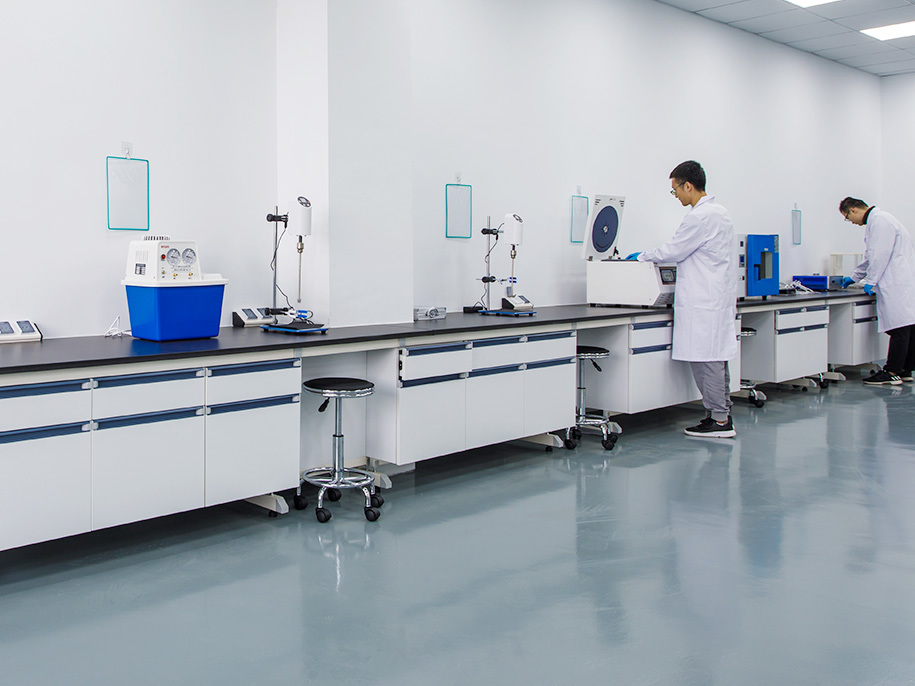
However, laboratory success alone is not enough to ensure commercial viability.
Before dry electrode technologies can be deployed in gigafactories, they must demonstrate stable, repeatable, and scalable performance under realistic manufacturing conditions.
This is where pilot validation becomes essential.
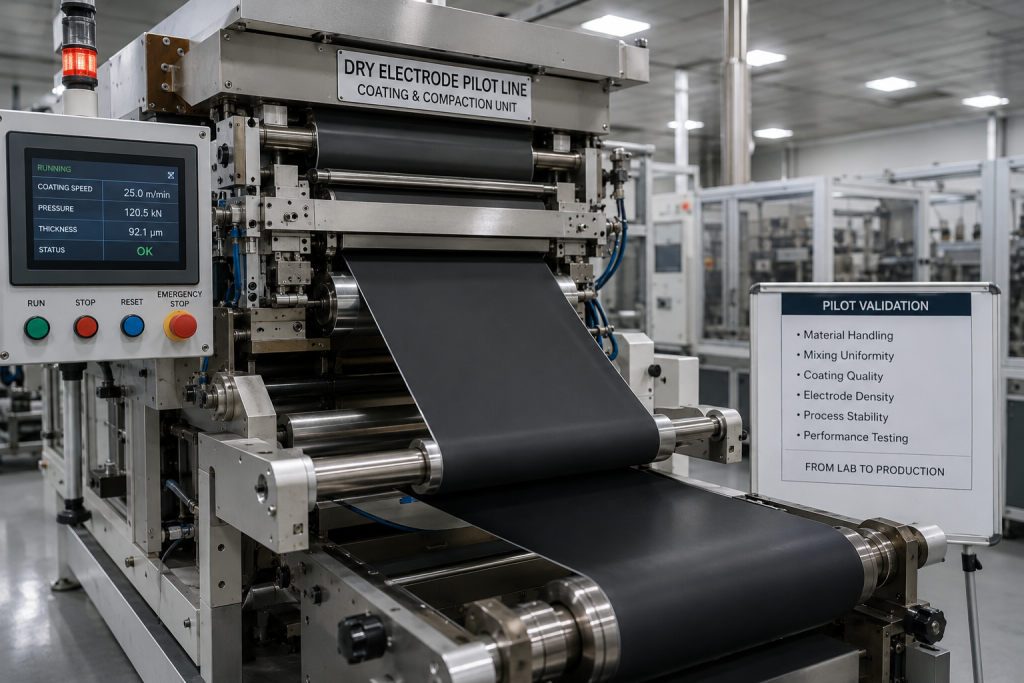
Pilot-scale production bridges the gap between laboratory development and full-scale industrial manufacturing, helping engineers optimize processes, reduce risk, and verify production readiness.
Why Pilot Validation Matters
A dry electrode that performs well in a laboratory may behave very differently during continuous production.
Industrial manufacturing introduces challenges that are difficult to reproduce in small-scale experiments, including:
- Continuous material feeding
- Long production runs
- Equipment variability
- Environmental fluctuations
- Batch-to-batch consistency
Pilot validation allows these factors to be evaluated before major investments are made in commercial production.
Verifying Material Processability
Dry electrode systems depend on the controlled interaction of active materials, conductive additives, and binders—or, in some concepts, binder-free structures.
Pilot trials help determine whether materials can be:
- Mixed uniformly
- Transported consistently
- Formed into stable electrodes
- Processed without excessive material loss
Poor material handling often becomes apparent only during extended pilot production.
Optimizing Powder Mixing and Distribution
Unlike wet slurry processing, dry electrode manufacturing relies on precise powder blending.
Key process objectives include:
- Uniform particle distribution
- Stable conductive networks
- Controlled material segregation
- Consistent composition throughout production
Pilot validation provides valuable data for optimizing mixing equipment and process parameters.
Evaluating Electrode Formation
The quality of the electrode depends on more than its chemical composition.
Pilot-scale production evaluates:
- Electrode thickness
- Density
- Porosity
- Surface quality
- Mechanical integrity
These structural characteristics directly influence battery performance and manufacturing yield.
Assessing Equipment Compatibility
Many dry electrode concepts require specialized equipment or modifications to existing production lines.
Pilot manufacturing allows engineers to evaluate:
- Powder feeding systems
- Web handling performance
- Compression and lamination equipment
- Process synchronization
- Production speed
This information helps determine whether a process can be integrated into commercial manufacturing.
Maintaining Process Stability
Long production runs reveal challenges that short laboratory tests often overlook.
During pilot validation, manufacturers monitor:
- Material flow stability
- Equipment performance
- Temperature variation
- Process repeatability
- Production interruptions
Stable operation over time is one of the strongest indicators of manufacturing readiness.
Quality Control During Pilot Trials
Comprehensive quality control is essential throughout pilot production.
Typical evaluations include:
Physical Measurements
- Thickness
- Density
- Surface uniformity
- Electrode dimensions
Mechanical Testing
- Adhesion
- Flexibility
- Compression strength
Electrical Evaluation
- Conductivity
- Internal resistance
- Uniformity across the electrode
Electrochemical Performance
- Capacity
- Cycle life
- Rate capability
Together, these tests verify whether the manufacturing process consistently delivers high-quality electrodes.
Reducing Scale-Up Risk
One of the greatest benefits of pilot validation is reducing uncertainty before commercial deployment.
Pilot trials help identify:
- Process bottlenecks
- Equipment limitations
- Material inconsistencies
- Yield losses
- Cost drivers
Addressing these issues early minimizes technical and financial risks during industrial scale-up.
Supporting Customer Qualification
Battery manufacturers and downstream customers often require evidence that a new manufacturing process is reliable.
Pilot production provides:
- Representative product samples
- Process validation data
- Manufacturing consistency records
- Performance verification
These results support customer evaluation and accelerate commercialization.
The Role of Advanced Carbon Materials
Advanced carbon materials remain important in many dry electrode technologies.
Carbon Nanotubes (CNTs)
CNTs help establish interconnected conductive pathways while improving mechanical reinforcement.
Graphene
Graphene can enhance electrical conductivity, mechanical strength, and electrode architecture when properly integrated into dry processing systems.
Pilot validation ensures these materials perform consistently under industrial manufacturing conditions.
Future Outlook
As battery manufacturing continues to evolve, pilot validation will become increasingly important.
Future trends include:
Digital Process Monitoring
Real-time monitoring will improve manufacturing control and product consistency.
AI-Assisted Process Optimization
Machine learning tools will help identify optimal process windows more efficiently.
High-Throughput Pilot Lines
Pilot facilities will increasingly simulate commercial production environments.
Sustainable Manufacturing
Dry electrode technologies combined with pilot validation will support lower-energy and lower-emission battery production.
Dry electrode manufacturing offers exciting opportunities for the future of lithium-ion battery production, but successful commercialization requires more than innovative materials.
Pilot validation provides the practical foundation for industrial success by verifying material processability, optimizing manufacturing parameters, evaluating equipment performance, and ensuring consistent product quality.
By identifying challenges early and refining production methods before large-scale investment, pilot-scale validation significantly reduces commercialization risk.
For next-generation battery technologies, pilot manufacturing is not simply a development step—it is a critical pathway from laboratory innovation to reliable industrial production.