
The Gap Between Coin Cell Results and Industrial Battery Production
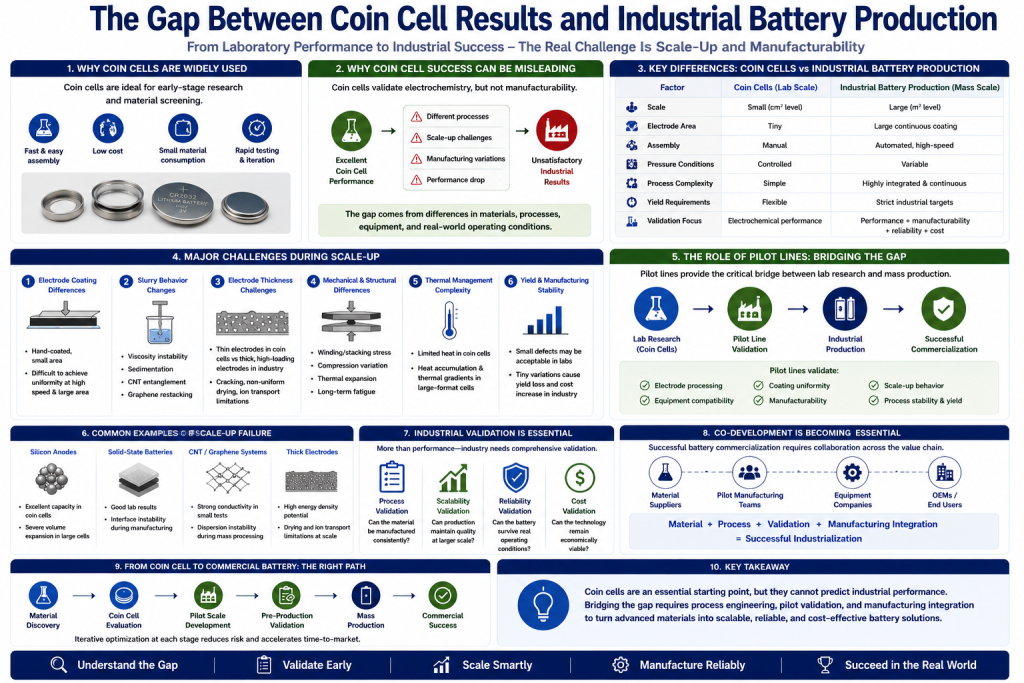
In battery research, coin cells are widely used for early-stage material evaluation because they are:
- Fast to assemble
- Cost-effective
- Convenient for laboratory testing
However, strong coin cell performance does not necessarily translate into successful industrial battery production. Many promising materials fail during scale-up because the transition from laboratory coin cells to commercial manufacturing introduces entirely different challenges related to:
- Electrode processing
- Manufacturability
- Process stability
- Industrial validation
Understanding this gap is critical for companies developing next-generation battery technologies.
Why Coin Cells Are Widely Used
Coin cells are valuable for:
- Screening new materials
- Comparing formulations
- Studying electrochemical behavior
- Rapid R&D iteration
Advantages include:
- Small material consumption
- Simple assembly
- Fast testing cycles
- Low development cost
This makes coin cells ideal for early-stage research.
Why Coin Cell Success Can Be Misleading
Coin cells operate under highly controlled laboratory conditions that differ significantly from industrial battery production.
In many cases:
Coin cells validate electrochemistry.
They do not validate manufacturability.
Key Differences Between Coin Cells and Industrial Cells
| Factor | Coin Cells | Industrial Battery Production |
|---|---|---|
| Scale | Small | Large-scale |
| Electrode Area | Tiny | Large continuous coating |
| Assembly | Manual | Automated high-speed |
| Pressure Conditions | Controlled | Variable |
| Process Complexity | Simple | Highly integrated |
| Yield Requirements | Flexible | Strict industrial targets |
| Validation Focus | Performance | Performance + manufacturability |
Major Challenges During Scale-Up
1. Electrode Coating Differences
Coin cell electrodes are often:
- Hand-coated
- Small-area coated
- Carefully optimized manually
Industrial production requires:
- Continuous roll-to-roll coating
- Uniform thickness control
- High-speed throughput
Small inconsistencies become major industrial problems.
2. Slurry Behavior Changes at Scale
A slurry that works in laboratory batches may fail in industrial mixing systems due to:
- Viscosity instability
- Sedimentation
- CNT entanglement
- Graphene restacking
Scale changes material behavior significantly.
3. Electrode Thickness Challenges
Coin cells often use:
- Thin electrodes
- Low loading structures
Industrial batteries increasingly require:
- Thick electrodes
- High energy density architectures
This introduces issues such as:
- Cracking
- Drying non-uniformity
- Ion transport limitations
4. Mechanical and Structural Differences
Industrial cells experience:
- Winding or stacking stress
- Compression variation
- Thermal expansion
- Long-term mechanical fatigue
These effects are rarely visible in coin cell testing.
5. Thermal Management Complexity
Coin cells generate limited heat.
Large-format batteries must manage:
- Heat accumulation
- Thermal gradients
- Cooling integration
Thermal behavior changes dramatically at production scale.
6. Yield and Manufacturing Stability
In laboratories:
- Small defects may be acceptable
In industrial production:
- Tiny variations can reduce yield significantly
- Yield loss directly impacts cost and scalability
Manufacturing stability becomes a critical success factor.
Why Pilot Lines Matter
Pilot lines bridge the gap between:
- Laboratory research
- Commercial manufacturing
They allow validation of:
- Electrode processing
- Coating uniformity
- Scale-up behavior
- Equipment compatibility
- Manufacturability
before gigafactory-scale investment.
The Importance of Industrial Validation
Battery commercialization requires more than electrochemical performance.
It also requires:
Process Validation
Can the material be manufactured consistently?
Scalability Validation
Can production maintain quality at larger scale?
Reliability Validation
Can the battery survive real operating conditions?
Cost Validation
Can the technology remain economically viable?
Common Examples of Scale-Up Failure
Silicon Anodes
- Excellent coin cell capacity
- Severe expansion issues in large cells
Solid-State Batteries
- Good lab results
- Interface instability during manufacturing
CNT / Graphene Conductive Systems
- Strong conductivity in small tests
- Dispersion instability during mass processing
Thick Electrodes
- High energy density potential
- Drying and ion transport limitations at scale
Co-Development Is Becoming Essential
The battery industry is increasingly moving toward integrated collaboration between:
- Material suppliers
- Pilot manufacturing teams
- Equipment companies
- OEMs
Successful industrialization now depends on:
Material + Process + Validation + Manufacturing Integration
Future Trends
The next generation of battery development will focus on:
- Pilot-scale process engineering
- AI-assisted manufacturing optimization
- Dry electrode manufacturing
- Digital twin production systems
- Manufacturability-first material design
Conclusion
Coin cells are an essential starting point for battery innovation—but they are only the beginning.
The real challenge lies in translating laboratory performance into:
- Stable manufacturing
- Scalable production
- Reliable industrial performance
Companies that understand the gap between coin cell testing and industrial production will be better positioned to commercialize advanced battery technologies successfully.