
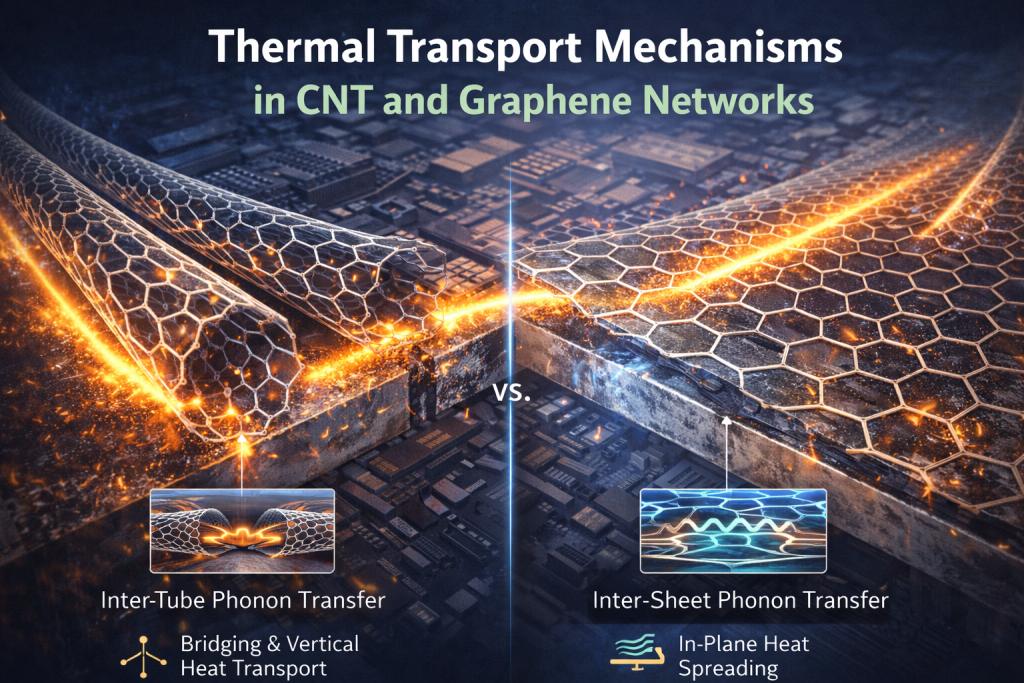
Thermal Transport Mechanisms in CNT and Graphene Networks
Understanding How Heat Really Moves at the Nanoscale
Beyond Thermal Conductivity Numbers
Carbon nanotubes (CNTs) and graphene are often introduced through their impressive intrinsic thermal conductivity values. However, real thermal performance in composites, films, and coatings is governed not by single-particle properties, but by network-level heat transport mechanisms.
Understanding how heat travels through CNT and graphene networks is essential for designing effective thermal materials—especially in thin, lightweight, and multifunctional systems.
Heat Transport at the Nanoscale: A Phonon Story
In CNTs and graphene, heat is primarily carried by phonons, which are quantized lattice vibrations.
Key characteristics:
-
Minimal phonon scattering along well-ordered carbon lattices
-
Extremely long phonon mean free paths
-
Direction-dependent heat transport behavior
Unlike metals, where electrons dominate heat transfer, phonon transport defines thermal performance in carbon nanomaterials.
Thermal Transport in Carbon Nanotube Networks
1. One-Dimensional Heat Conduction
CNTs act as one-dimensional thermal conductors, with heat flowing efficiently along the tube axis.
This enables:
-
Rapid heat transfer over long distances
-
Effective bridging between heat sources and sinks
-
Strong enhancement of through-plane thermal conductivity
However, axial conduction alone is not sufficient—inter-tube transport is equally critical.
2. Inter-Tube Thermal Resistance
When CNTs contact each other, heat must cross tube-to-tube junctions.
Challenges include:
-
Weak van der Waals contacts
-
Phonon mismatch between tubes
-
Contact resistance at junctions
As a result, network connectivity and contact quality often dominate overall thermal performance, more than individual CNT conductivity.
3. Role of Alignment and Network Density
Aligned CNT networks exhibit:
-
Higher directional thermal conductivity
-
Reduced phonon scattering
-
Improved thermal pathway continuity
Random networks rely on:
-
Higher CNT loading
-
Increased junction density
-
Optimized dispersion to minimize bottlenecks
Design choice depends on whether directional or isotropic heat transport is required.
Thermal Transport in Graphene Networks
1. Two-Dimensional In-Plane Heat Spreading
Graphene is a two-dimensional thermal conductor, excelling at in-plane heat transport.
Advantages include:
-
Exceptional lateral heat spreading
-
Uniform temperature distribution
-
Reduced hot spot formation
This makes graphene ideal for thermal coatings, films, and heat spreader layers.
2. Inter-Sheet Heat Transfer Challenges
In stacked graphene systems:
-
Heat must transfer across sheet interfaces
-
Interlayer thermal resistance becomes significant
-
Sheet orientation strongly affects performance
Poor alignment or excessive stacking can limit through-plane conductivity, even with high graphene loading.
3. Effect of Sheet Size and Layer Number
Thermal performance improves with:
-
Larger lateral sheet dimensions
-
Fewer defects
-
Controlled layer thickness
However, larger sheets increase dispersion difficulty, requiring careful formulation strategies.
CNT vs Graphene: Network Transport Comparison
| Aspect | CNT Networks | Graphene Networks |
|---|---|---|
| Dimensionality | 1D | 2D |
| Dominant Transport | Axial conduction | In-plane spreading |
| Key Limitation | Junction resistance | Interlayer resistance |
| Best Use Case | Bridging, through-plane | Surface heat spreading |
This fundamental difference explains why CNTs and graphene often complement rather than replace each other.
Hybrid CNT–Graphene Networks: Synergistic Transport
Hybrid systems combine:
-
CNTs as vertical or bridging connectors
-
Graphene sheets as lateral heat spreaders
Benefits include:
-
Reduced interfacial thermal resistance
-
Improved network continuity
-
Balanced in-plane and through-plane conductivity
Such hybrid architectures are increasingly used in advanced thermal interface materials and coatings.
Impact of Dispersion on Thermal Transport
Dispersion quality directly affects:
-
Network formation efficiency
-
Junction density and quality
-
Phonon scattering behavior
Poor dispersion leads to:
-
Agglomeration
-
Thermal dead zones
-
Inconsistent performance across the material
Effective dispersion strategies often matter more than increasing filler loading.
Interfacial Thermal Resistance with the Matrix
Even with a well-formed carbon network, heat must transfer between:
-
CNT/graphene and the polymer or binder
-
Adjacent layers in coatings or films
Surface functionalization, matrix selection, and processing conditions significantly influence carbon–matrix phonon coupling.
Thin Films and Coatings: Transport Under Confinement
In thin systems:
-
Boundary scattering becomes more pronounced
-
Orientation dominates transport behavior
-
Thickness constraints amplify interfacial effects
Graphene-based coatings often outperform CNT-only systems in ultra-thin layers due to superior in-plane transport.
Practical Design Implications
Effective thermal material design requires balancing:
-
Network architecture
-
Filler loading
-
Dispersion quality
-
Processing constraints
Optimized systems rarely use maximum filler content; instead, they focus on efficient thermal pathway design.
Testing Considerations: Avoiding Misleading Metrics
Thermal transport should be evaluated using:
-
Direction-specific measurements
-
Realistic thickness and interface conditions
-
Long-term thermal cycling tests
Bulk conductivity values alone do not predict real application performance.
Thermal Transport Is a Network Problem
Thermal transport in CNT and graphene systems is governed by how networks are formed, connected, and integrated, not just by intrinsic material properties.
-
CNTs enable directional heat transfer and interfacial bridging
-
Graphene enables efficient in-plane heat spreading
-
Hybrid networks unlock balanced thermal architectures
Understanding these mechanisms allows engineers to design lighter, thinner, and more efficient thermal solutions for next-generation systems.