
Understanding Graphene Materials: Types and Industrial Applications
A Practical Guide to Graphene Forms and Their Real-World Uses
Graphene has become one of the most discussed advanced materials of the past decade. Known for its exceptional electrical conductivity, thermal performance, and mechanical strength, graphene has attracted attention across industries ranging from electronics and batteries to coatings and composites.
However, in real industrial applications, “graphene” is not a single material. Instead, it represents a family of carbon materials with different structures, production methods, and performance characteristics.
Understanding the different types of graphene materials—and how they are used in industry—is essential for engineers, product developers, and manufacturers seeking to integrate graphene into real products.
This article explains the major types of graphene materials and how they are applied in industrial environments.
Why Graphene Materials Are Unique
Graphene is a two-dimensional sheet of carbon atoms arranged in a hexagonal lattice. It is often described as a single atomic layer of graphite.
This structure gives graphene remarkable properties:
• Extremely high electrical conductivity
• High thermal conductivity (up to ~5000 W/m·K in ideal conditions)
• Exceptional mechanical strength
• Very low density
• Large surface area
These characteristics make graphene particularly attractive for applications requiring conductivity, heat dissipation, structural reinforcement, or barrier performance.
However, producing perfect single-layer graphene at industrial scale remains challenging and expensive. As a result, most commercial applications rely on graphene-based materials rather than pure monolayer graphene.
Major Types of Graphene Materials
In industrial practice, graphene materials are typically categorized based on their layer structure, production method, and surface chemistry.
Below are the most common graphene forms used today.
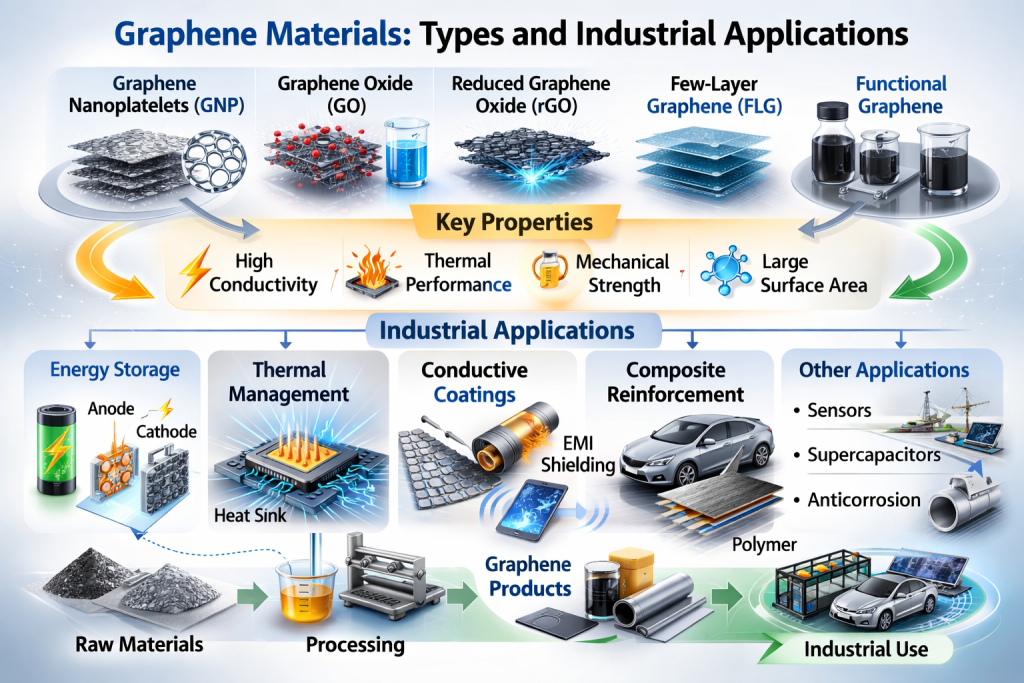
1. Graphene Nanoplatelets (GNP)
Graphene nanoplatelets are among the most widely used graphene materials in industry.
They consist of multiple graphene layers stacked together in platelet form, typically ranging from a few layers to several tens of layers.
Key characteristics include:
• High electrical conductivity
• Good thermal conductivity
• Large lateral size
• Relatively cost-effective production
GNP materials are commonly produced through exfoliation of graphite, which makes them more scalable than single-layer graphene.
Industrial applications include:
• conductive plastics
• thermal interface materials
• EMI shielding composites
• battery electrode additives
• structural composites
Because of their balance between performance and cost, graphene nanoplatelets are often the first choice for commercial graphene integration.
2. Graphene Oxide (GO)
Graphene oxide is a chemically modified form of graphene that contains oxygen-bearing functional groups such as hydroxyl, epoxy, and carboxyl groups.
These functional groups provide two key advantages:
• excellent dispersibility in water and solvents
• strong chemical reactivity for further modification
Unlike pristine graphene, graphene oxide is hydrophilic, which allows it to be easily processed into coatings, films, and composite materials.
Typical applications include:
• conductive coatings
• membranes and filtration materials
• energy storage electrodes
• sensors
• biomedical materials
Graphene oxide is often used as an intermediate material that can be further processed into reduced graphene oxide.
3. Reduced Graphene Oxide (rGO)
Reduced graphene oxide is produced by removing oxygen functional groups from graphene oxide through thermal, chemical, or electrochemical reduction.
This process partially restores the electrical conductivity of graphene while maintaining relatively scalable production.
Key properties include:
• improved electrical conductivity compared to GO
• high surface area
• tunable defect structure
• relatively low production cost
Reduced graphene oxide is commonly used in:
• battery electrodes
• supercapacitors
• conductive inks
• energy storage systems
• catalysts and catalyst supports
Because of its defect-rich structure, rGO often performs particularly well in electrochemical applications.
4. Few-Layer Graphene (FLG)
Few-layer graphene refers to graphene structures consisting of 2 to 10 layers of graphene sheets.
These materials maintain many of the desirable properties of single-layer graphene while being easier to produce in larger quantities.
Typical properties include:
• high electrical conductivity
• strong mechanical performance
• improved structural stability
Few-layer graphene is often used in:
• conductive coatings
• composite reinforcement
• thermal management materials
• electronic applications
For many engineering applications, few-layer graphene offers a practical compromise between performance and manufacturability.
5. Graphene Dispersions and Functional Graphene
In industrial environments, graphene is rarely used as a dry powder alone. Instead, it is often delivered in engineered forms such as dispersions, masterbatches, or functional coatings.
These formats make graphene easier to integrate into manufacturing processes.
Common forms include:
• graphene dispersions in water or solvents
• polymer masterbatches containing graphene
• graphene-enhanced coatings
• conductive pastes
• thermal interface materials
These engineered products allow manufacturers to incorporate graphene into existing production lines with minimal process modifications.
Key Industrial Applications of Graphene Materials
Graphene’s versatility allows it to be used across multiple industries. Several applications have already reached commercial deployment.
Energy Storage and Batteries
Graphene is widely explored in lithium-ion batteries, sodium-ion batteries, and supercapacitors.
Its high electrical conductivity helps improve electron transport within electrodes, while its large surface area supports active material dispersion.
Typical roles include:
• conductive additives in electrodes
• current collector coatings
• structural reinforcement for electrodes
• fast-charging battery architectures
Graphene materials can help improve power density, cycle stability, and thermal performance in advanced battery systems.
Thermal Management
Another major application area is thermal management.
Graphene’s high thermal conductivity makes it attractive for:
• thermal interface materials (TIMs)
• heat spreaders
• electronic cooling systems
• battery thermal management
Graphene-enhanced materials can improve heat dissipation in devices such as:
• power electronics
• data center hardware
• battery modules
• LED lighting systems
Conductive and Antistatic Coatings
Graphene is also widely used in conductive coatings and antistatic materials.
Applications include:
• EMI shielding coatings
• conductive paints
• electrostatic discharge protection
• corrosion-resistant conductive layers
Compared with traditional conductive fillers such as carbon black or metal powders, graphene can achieve conductivity at lower loading levels, helping maintain mechanical performance.
Composite Reinforcement
Graphene can significantly improve the performance of polymer composites.
When properly dispersed, graphene can enhance:
• tensile strength
• stiffness
• thermal conductivity
• electrical conductivity
• barrier properties
These properties make graphene attractive for applications in:
• automotive components
• aerospace structures
• industrial equipment
• sports equipment
Protective and Anticorrosion Coatings
Graphene’s impermeable structure makes it a strong barrier against moisture, oxygen, and corrosive chemicals.
As a result, graphene-based coatings are increasingly used in:
• marine coatings
• industrial equipment protection
• pipeline coatings
• infrastructure protection
Such coatings can extend the service life of metal components while reducing maintenance requirements.
From Graphene Materials to Industrial Solutions
Although graphene’s properties are impressive, successful industrial applications depend on engineering integration rather than material properties alone.
Key challenges include:
• dispersion control
• process compatibility
• scalable production
• cost optimization
• performance stability
This is why many companies focus not only on graphene production but also on material engineering and pilot-scale validation.
By combining material development with pilot-line testing, graphene technologies can be integrated into real manufacturing systems more effectively.
Graphene is not a single material but a family of advanced carbon materials, each with different structures and performance characteristics.
From graphene nanoplatelets to graphene oxide and reduced graphene oxide, each type serves different industrial purposes.
As manufacturing technologies continue to evolve, graphene materials are becoming increasingly practical for applications in energy storage, thermal management, coatings, and advanced composites.
The key to successful graphene adoption lies in understanding the right material type, optimizing formulations, and validating performance through engineering and pilot-scale testing.
With these steps in place, graphene can move from laboratory curiosity to a powerful industrial material.