

When to Use CNT Instead of Graphene in Conductive Systems
Choosing the Right Carbon Material for Real-World Performance
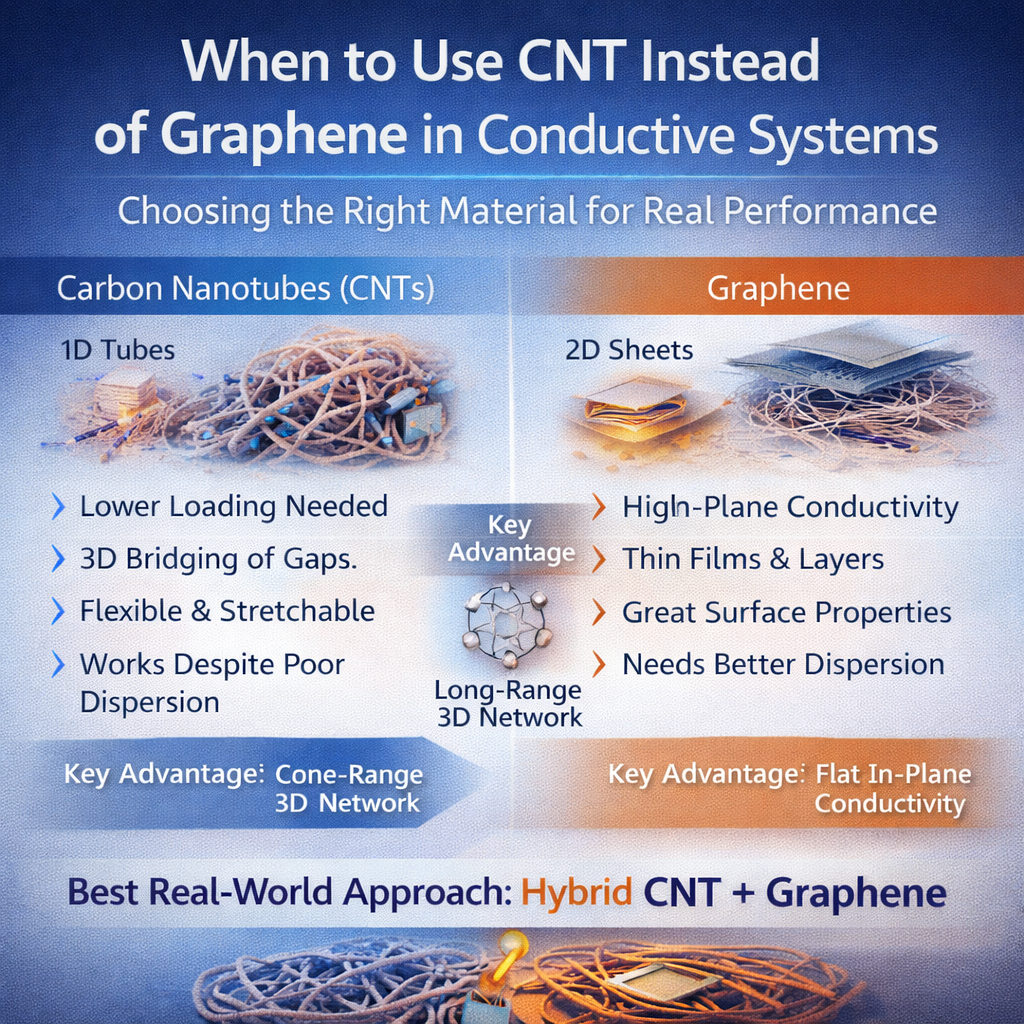
In conductive systems, both carbon nanotubes (CNTs) and graphene are often presented as high-performance solutions.
However, a common misunderstanding in real projects is:
“Which one is better?”
In reality, the more relevant question is:
“Which one works better in my system?”
CNTs and graphene have fundamentally different structures—and therefore behave differently in real materials.
This article explains when CNTs are the better choice, based on network formation, processing behavior, and application requirements.
Understanding the Structural Difference
Carbon Nanotubes (CNTs)
- 1D tubular structure
- Extremely high aspect ratio (length >> diameter)
- Flexible and entangled
👉 Think: “long conductive wires”
Graphene
- 2D sheet structure
- Large surface area
- Planar geometry
👉 Think: “flat conductive plates”
The Core Difference: Network Formation
In conductive systems, performance depends on how conductive pathways form.
CNT Networks
- Form long-range conductive pathways
- Bridge gaps efficiently
- Create percolation at low loading
Graphene Networks
- Provide in-plane conductivity
- Require overlap between sheets
- Less effective in bridging large gaps
👉 Key Insight:
- CNT = connectivity
- Graphene = conductivity
When CNTs Are the Better Choice
1. Ultra-Low Loading Requirements
When your system requires conductivity at very low filler content:
CNTs are usually superior because:
- High aspect ratio enables percolation at low loading
- Fewer particles needed to form a network
Typical applications:
- Antistatic coatings
- Conductive polymers
- Lightweight systems
2. Systems with Complex or Thick Structures
CNTs are more effective when:
- The material is thick
- The structure is ثلاثي维 (3D)
- Conductive paths must span longer distances
Why?
- CNTs can bridge gaps across the material
- Graphene sheets may not connect effectively in ضخامة systems
3. Flexible or Stretchable Materials
CNT networks can:
- Maintain connectivity under deformation
- Adapt to bending and stretching
Applications:
- Flexible electronics
- Wearables
- Soft conductive composites
4. Systems with Challenging Dispersion Conditions
In many real systems:
- Perfect dispersion is not achievable
- Processing is limited
CNTs can still form networks even when:
- Partially agglomerated
- Not perfectly aligned
👉 Graphene typically requires better dispersion to perform well.
5. Conductive Additives in Battery Electrodes
CNTs are widely used in electrodes because they:
- Create stable conductive pathways
- Maintain performance during cycling
- Connect active materials effectively
Especially important in:
- High-loading electrodes
- Thick electrode designs
When Graphene Might Be Better
To make the decision clear, CNT is not always the answer.
Graphene is often preferred when:
- High in-plane thermal or electrical conductivity is needed
- Thin films are used
- Barrier or surface properties matter
- Layered structures are designed
CNT vs Graphene: Practical Comparison
| Aspect | CNT | Graphene |
|---|---|---|
| Structure | 1D (tubes) | 2D (sheets) |
| Network Formation | Excellent (3D) | Moderate (layer-dependent) |
| Percolation Threshold | Low | Higher |
| Gap Bridging | Strong | Limited |
| Dispersion Sensitivity | Medium | High |
| Mechanical Flexibility | High | Moderate |
| Thermal Conductivity | Good (network-based) | Excellent (in-plane) |
The Hybrid Approach (Most Real Systems)
In many industrial applications, the best solution is:
👉 CNT + Graphene hybrid systems
Why Hybrid Works
- CNTs provide connectivity
- Graphene enhances conductivity
- Combined network is more robust
This is especially effective in:
- Thermal interface materials (TIMs)
- Battery electrodes
- Conductive coatings
From Material Choice to System Design
Choosing CNT vs graphene is not just about properties.
It depends on:
- Processing method
- Matrix compatibility
- Target conductivity
- Mechanical requirements
👉 The real decision framework is:
Material + Process + Structure = Performance
Why Pilot Validation Is Critical
Even if CNTs look ideal on paper, real performance depends on:
- Mixing conditions
- Shear forces
- Coating or forming processes
- Final application environment
Pilot validation helps:
- Confirm network formation
- Optimize loading levels
- Reduce scale-up risk
A Simple Decision Guide
Use CNT when:
- You need conductivity at low loading
- Your system is thick or complex
- Flexibility is required
- Dispersion is difficult
Use graphene when:
- You need high in-plane conductivity
- You work with thin films
- Surface properties matter
Use hybrid when:
- You want balanced performance
- Your system is complex
- You are optimizing both thermal and electrical properties
CNTs and graphene are not competing materials—they are complementary tools.
CNTs excel in building conductive networks across real, complex systems, especially where connectivity and robustness matter.
Graphene excels in enhancing conductivity within well-structured systems.
In practice, the best performance often comes not from choosing one over the other, but from understanding:
👉 how each material behaves inside your process and your system