
How Is Graphene Integrated into Commercial Products?
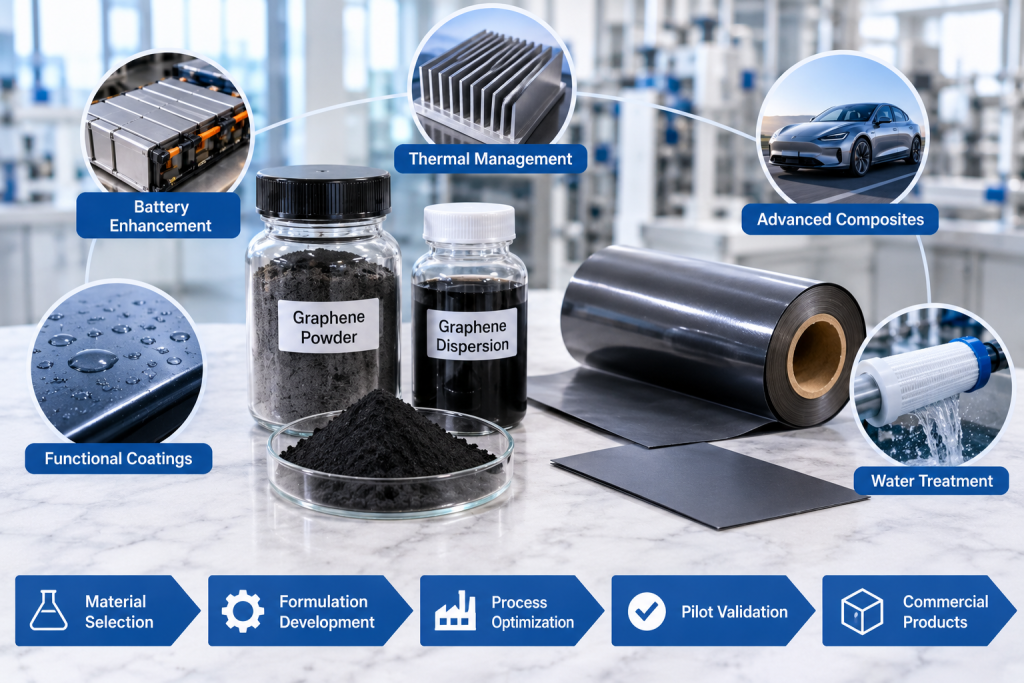
Graphene has attracted significant attention across energy storage, electronics, thermal management, coatings, composites, and functional materials. Its electrical conductivity, thermal properties, mechanical strength, and high specific surface area create opportunities for improving the performance of many industrial products.
However, integrating graphene into a commercial product is not simply a matter of adding graphene powder to an existing formulation.
Commercial integration requires a complete engineering process. Graphene must be supplied in a suitable material form, compatible with the host material, processed using available manufacturing equipment, and validated under real operating conditions.
A graphene material that performs well in laboratory testing may not necessarily deliver the same benefits after mixing, coating, molding, curing, or assembly.
The key question for manufacturers is therefore not just whether graphene has desirable properties, but how those properties can be transferred into a finished product in a reliable, repeatable, and economically viable way.
This article explores the main methods of integrating graphene into commercial products, the processing considerations involved, and the validation steps required before industrial adoption.
1. Start with the Product Requirement, Not the Graphene Material
The first step in commercial integration is understanding what the finished product needs to achieve.
Different applications require different performance improvements, and these requirements determine the appropriate graphene material, formulation, and processing route.
For example:
- A battery manufacturer may want to improve electrical conductivity within an electrode.
- An electronics company may need better heat spreading in a compact device.
- A coating manufacturer may be looking for improved corrosion resistance or electrical functionality.
- A polymer producer may want to improve mechanical, thermal, or antistatic properties.
- A water treatment company may investigate graphene-based materials for adsorption or membrane-related applications.
These applications cannot use an identical graphene formulation.
A practical development process should begin by defining measurable product-level targets.
| Product requirement | Relevant evaluation |
|---|---|
| Electrical conductivity | Resistivity, sheet resistance, contact resistance |
| Thermal management | Thermal conductivity, thermal resistance, temperature distribution |
| Mechanical performance | Tensile strength, elongation, impact resistance, adhesion |
| Corrosion protection | Salt spray exposure, electrochemical testing, coating integrity |
| Dispersion stability | Sedimentation, particle distribution, storage stability |
| Battery performance | Electrode conductivity, capacity retention, impedance, cycle life |
| Water treatment | Removal efficiency, selectivity, regeneration, operating stability |
The important distinction is between graphene’s intrinsic material properties and the performance of the finished product.
A material’s laboratory conductivity, for example, does not automatically translate into lower resistance in a manufactured component. The final result also depends on filler concentration, orientation, interfaces, processing conditions, and product geometry.
2. Choose the Right Graphene Form for Integration
Graphene is available in several forms, and each has different advantages for industrial processing.
Selecting the correct form is one of the most important decisions in product integration.
2.1 Graphene Powder
Graphene powder is commonly considered for applications where the material needs to be incorporated into another formulation or manufacturing system.
Potential applications include:
- Polymer composites
- Conductive coatings
- Thermal management composites
- Battery electrode materials
- Functional masterbatches
- Cementitious and construction materials
Powder offers flexibility in formulation development, but it introduces challenges related to agglomeration, dust handling, wetting, and dispersion.
Manufacturers must determine whether the powder can be incorporated into their existing mixing or compounding process without compromising production efficiency.
2.2 Graphene Dispersion
Graphene dispersions contain graphene-based materials distributed in a liquid medium.
Depending on the material and formulation, the carrier may be water, alcohol, NMP, DMF, or another compatible solvent.
Dispersions can simplify integration into:
- Water-based and solvent-based coatings
- Printing inks
- Conductive pastes
- Battery electrode slurries
- Functional surface treatments
However, a dispersion should not be evaluated only by its initial appearance.
Important parameters include concentration, viscosity, particle distribution, sedimentation behavior, compatibility with other ingredients, and storage stability.
A stable dispersion in one solvent may become unstable when introduced into a different binder or formulation.
2.3 Graphene Films and Coatings
Graphene-based films and coatings provide another integration route.
They may be deposited, transferred, printed, sprayed, or applied through other suitable coating processes, depending on the substrate and product design.
Potential applications include:
- Transparent or flexible conductive films
- Surface protection systems
- Heating elements
- Electromagnetic interference shielding
- Functional electronic components
Film-based integration requires particular attention to substrate preparation, adhesion, film continuity, thickness, electrical contacts, and environmental stability.
The quality of the interface between the graphene layer and the underlying substrate can be just as important as the graphene itself.
2.4 Graphene-Based Masterbatches and Composite Materials
For plastics and polymer products, graphene can be introduced through a masterbatch or pre-formulated composite.
This approach can make industrial integration easier because the graphene is incorporated into a compatible polymer carrier before final processing.
The material can then be introduced through conventional processes such as extrusion or injection molding, provided that the formulation is compatible with the processing conditions.
However, manufacturers still need to evaluate dispersion quality, filler distribution, melt flow behavior, mechanical properties, and the effect of processing temperature and shear.
3. Main Integration Methods Across Industrial Applications
There is no universal method for integrating graphene into commercial products. The appropriate route depends on the host material, manufacturing process, and intended function.
3.1 Integration into Polymer Composites
Graphene can be incorporated into thermoplastic or thermosetting polymer systems to modify their functional properties.
Typical development routes include:
- Selecting a suitable graphene grade.
- Preparing a compatible masterbatch or dispersion.
- Incorporating graphene into the polymer matrix.
- Optimizing mixing and compounding conditions.
- Processing the composite into a finished component.
- Evaluating mechanical, thermal, and electrical performance.
Potential applications include antistatic components, conductive polymer parts, thermal management housings, and functional engineering plastics.
One important challenge is maintaining a uniform conductive or reinforcing network without excessively increasing viscosity or reducing processability.
Higher graphene loading does not necessarily produce better overall performance. Excessive loading can lead to agglomeration, poor flow, reduced elongation, and higher manufacturing costs.
3.2 Integration into Battery Electrodes
In battery manufacturing, graphene and other graphene-based materials can be considered as conductive additives or functional components in electrode formulations.
The integration process may involve:
- Graphene material selection
- Slurry formulation
- Mixing and dispersion
- Electrode coating
- Drying
- Calendering
- Cell assembly and testing
The goal may be to improve electronic conductivity, modify the conductive network, or support electrode structural stability.
However, graphene must be compatible with the active material, binder, solvent, and other conductive additives.
Its effect should be assessed at electrode and cell levels rather than inferred from powder conductivity alone.
Important evaluation parameters include electrode resistivity, coating uniformity, adhesion, loading, porosity, impedance, capacity retention, and cycle performance.
For commercial adoption, the material must also fit the manufacturer’s existing slurry preparation and electrode production processes.
3.3 Integration into Thermal Management Products
Graphene’s thermal transport properties make it interesting for thermal management applications.
Potential product categories include:
- Thermal interface materials
- Heat-spreading films
- Thermally conductive polymer composites
- Electronic thermal management components
- Thermal coatings and functional layers
The integration route depends on whether the product requires in-plane heat spreading, through-plane heat transfer, or both.
Graphene-based fillers can contribute to thermal transport, but the final performance depends on filler orientation, loading, dispersion, particle contact, polymer-filler interfaces, and component geometry.
For example, a heat-spreading film may benefit from strong in-plane thermal transport, while a thermal interface material requires effective heat transfer through the material thickness and good contact with adjacent surfaces.
Electrical insulation is another critical design requirement. Graphene is electrically conductive, so it may not be suitable for every thermal interface application without additional formulation strategies.
3.4 Integration into Functional Coatings
Graphene and graphene oxide are being explored in protective and functional coating systems.
Depending on the formulation, they may contribute to:
- Corrosion protection
- Electrical conductivity
- Antistatic functionality
- Thermal management
- Barrier performance
- Surface functionality
Possible integration routes include water-based coatings, solvent-based coatings, resin systems, and multi-layer coating structures.
For corrosion protection, graphene-based materials may help create a more tortuous diffusion pathway for water and corrosive species when properly dispersed and incorporated into a suitable coating structure.
However, the result depends on coating formulation, filler distribution, substrate preparation, film thickness, adhesion, and defect control.
Poorly dispersed conductive fillers can sometimes create unwanted pathways or interfacial defects. Therefore, graphene addition should be evaluated through electrochemical testing, salt spray exposure, adhesion testing, and other application-relevant assessments.
3.5 Integration into Water Treatment Systems
Graphene oxide and other graphene-based materials have also been investigated for water treatment.
Potential approaches include:
- Graphene oxide functionalized adsorbents
- Graphene-based composite membranes
- Graphene-coated porous substrates
- Hybrid materials combining graphene derivatives with activated carbon or other adsorbents
In these systems, graphene may contribute surface functional groups, interfacial properties, or structural characteristics that influence contaminant interaction and separation.
Commercial integration requires more than demonstrating pollutant removal in a small laboratory experiment.
Manufacturers and project developers should also evaluate:
- Target contaminant concentration and removal efficiency
- Adsorption capacity and selectivity
- Water chemistry and pH sensitivity
- Regeneration and reuse
- Pressure drop and flow rate, where relevant
- Material stability and potential release
- Operating cost and replacement frequency
The final product must meet the requirements of the actual treatment system, not just a laboratory test solution.
4. Formulation Compatibility Is a Critical Integration Challenge
One of the most common difficulties in graphene integration is compatibility with the existing product formulation.
Graphene has a strong tendency to interact with itself and form agglomerates. Its surface chemistry, particle characteristics, and interactions with other formulation ingredients can significantly influence the final result.
Several factors should be evaluated.
Wetting and dispersion
Graphene must be adequately wetted by the selected solvent, resin, polymer, or binder. Poor wetting can result in agglomeration and inconsistent material distribution.
Solvent compatibility
A graphene dispersion developed in one solvent may not be directly compatible with another formulation. Solvent exchange or additional formulation development may be necessary.
Binder and resin interaction
The binder must maintain suitable adhesion, mechanical properties, and processing behavior after graphene is introduced.
Viscosity and rheology
Graphene can change the viscosity and flow behavior of a formulation. This may affect pumping, spraying, printing, coating, and mixing operations.
Storage stability
A formulation that performs well immediately after mixing may change during storage. Sedimentation, aggregation, viscosity drift, or chemical interactions can affect production consistency.
For commercial applications, compatibility must be evaluated throughout the intended storage and manufacturing cycle.
5. Adapt Graphene Integration to Existing Manufacturing Equipment
Industrial customers rarely want to redesign an entire production line just to introduce a new material.
A commercially viable graphene solution should therefore consider the customer’s existing equipment and process limitations.
Different manufacturing processes introduce different challenges.
| Manufacturing process | Key graphene integration considerations |
|---|---|
| High-speed mixing | Shear level, mixing time, dispersion uniformity |
| Ultrasonic dispersion | Energy input, temperature rise, material degradation |
| Extrusion | Melt flow, shear history, temperature stability |
| Injection molding | Flow behavior, filler distribution, component properties |
| Coating and printing | Viscosity, surface tension, coating thickness, drying |
| Spray application | Nozzle compatibility, agglomeration, atomization |
| Electrode manufacturing | Slurry rheology, coating uniformity, drying, calendering |
| Lamination | Interfacial adhesion, pressure, temperature, flexibility |
An important point is that more intensive processing does not always produce better graphene dispersion.
Excessive shear or prolonged ultrasonic treatment may alter particle size, defect characteristics, or the structure of graphene-based materials.
The objective should be to identify a suitable process window that achieves the required product performance without creating unnecessary manufacturing complexity.
6. Move from Laboratory Samples to Pilot Production
A laboratory formulation is only an early stage of commercial integration.
Once a promising formulation has been identified, the next step is to evaluate whether it can be reproduced under more realistic manufacturing conditions.
A typical development pathway includes four stages.
Stage 1: Laboratory Screening
The objective is to identify suitable graphene materials and establish initial formulation feasibility.
Activities may include:
- Comparing graphene grades
- Testing different concentrations
- Screening solvents and binders
- Evaluating initial dispersion behavior
- Measuring basic electrical, thermal, or mechanical properties
The output should be a preliminary formulation and a set of measurable performance results.
Stage 2: Prototype Development
At this stage, graphene is introduced into a representative product or component.
The purpose is to understand how the material behaves in the actual product structure.
Testing may include:
- Component-level performance
- Coating or molding quality
- Adhesion and mechanical properties
- Functional performance
- Initial reliability assessment
Stage 3: Pilot-Scale Validation
Pilot production evaluates whether the formulation can be processed with greater material quantities and more representative equipment.
Key questions include:
- Can the formulation be prepared consistently?
- Does the manufacturing process remain stable?
- Is product performance repeatable across batches?
- Are there changes in yield, cycle time, or production cost?
- Can the process be transferred to the customer’s production environment?
Pilot validation helps identify problems that are difficult to detect in small laboratory experiments.
Stage 4: Commercial Production
Before full adoption, manufacturers need to establish a repeatable production process and an appropriate quality control system.
This may include:
- Approved material specifications
- Standardized formulation and process parameters
- Incoming material inspection
- In-process quality monitoring
- Finished-product testing
- Batch traceability
- Supplier qualification
- Change management procedures
Commercial production requires consistent product performance, not just a successful initial sample.
7. How Should Manufacturers Evaluate Commercial Readiness?
Graphene integration should be evaluated at three connected levels.
Material-Level Evaluation
This determines whether the graphene material itself meets the required specifications.
Relevant parameters may include:
- Layer number and lateral size
- Defect characteristics
- Carbon purity
- Oxygen content, where relevant
- Surface chemistry
- Moisture content
- Dispersion characteristics
- Electrical or thermal properties
Not every application requires every parameter. The material specification should be aligned with its intended function.
Process-Level Evaluation
This determines whether the material can be incorporated into the customer’s manufacturing process.
Important considerations include:
- Mixing and dispersion requirements
- Viscosity and rheology
- Processing temperature
- Shear sensitivity
- Equipment compatibility
- Storage and handling
- Production yield
- Batch-to-batch consistency
A material that performs well but requires an impractical manufacturing process may not be commercially attractive.
Product-Level Evaluation
This determines whether graphene produces a meaningful improvement in the finished product.
The evaluation should compare the graphene-containing product with an appropriate reference product.
For example:
- Does the coating provide better corrosion protection?
- Does the composite achieve the required conductivity?
- Does the thermal component reduce operating temperature?
- Does the battery electrode maintain performance during cycling?
- Does the water treatment material maintain removal efficiency over repeated use?
The comparison should use consistent testing conditions and relevant performance metrics.
Ultimately, commercial value depends on measurable improvements in product performance, manufacturing efficiency, reliability, or total cost of ownership.
8. Common Mistakes When Integrating Graphene into Commercial Products
Several mistakes can slow down or prevent industrial adoption.
1. Selecting graphene based only on its name
Graphene, graphene oxide, reduced graphene oxide, and different graphene nanoplatelet grades have different characteristics. Material selection must be based on application requirements.
2. Assuming higher loading always means better performance
Increasing graphene concentration can improve certain properties up to a point, but excessive loading may cause agglomeration, poor processability, and higher costs.
3. Ignoring formulation compatibility
A graphene material may be suitable in isolation but incompatible with the customer’s existing solvent, binder, resin, or additives.
4. Evaluating only laboratory performance
Small-scale results may not represent actual manufacturing conditions. Production equipment, batch size, process history, and product geometry can all affect performance.
5. Overlooking long-term stability
Initial performance is not enough. Storage stability, thermal aging, environmental exposure, mechanical durability, and repeated operation may determine commercial suitability.
6. Failing to define acceptance criteria
Without clear performance targets and testing methods, suppliers and customers may have different expectations about what constitutes a successful result.
7. Ignoring manufacturing economics
Material price is only one part of the cost. Dispersion equipment, processing time, yield loss, quality control, and production changes must also be considered.
9. What Information Should Customers Provide Before Starting a Graphene Integration Project?
A clear technical brief can reduce development time and prevent unnecessary material testing.
Customers should ideally provide:
| Information | Why it matters |
|---|---|
| Target product or component | Defines the application |
| Existing material formulation | Helps assess compatibility |
| Required performance improvement | Establishes development targets |
| Current manufacturing process | Determines the integration route |
| Available equipment | Identifies process constraints |
| Operating environment | Defines reliability requirements |
| Target production volume | Helps assess scale-up requirements |
| Testing standards | Establishes acceptance criteria |
| Target cost | Supports commercial feasibility |
| Sample and delivery requirements | Defines project scope and timeline |
If the customer does not yet have a complete specification, an initial technical discussion can help identify the most important unknowns.
It is usually more efficient to clarify the target application and manufacturing process before selecting a graphene grade or preparing samples.
10. The Future of Graphene Integration: From Material Supply to Application Engineering
As graphene moves toward broader industrial adoption, its commercial value will increasingly depend on how effectively it can be integrated into existing products and manufacturing systems.
Material suppliers will need to provide more than powder specifications and basic characterization reports.
Customers increasingly need support with:
- Material selection
- Dispersion and formulation development
- Process compatibility assessment
- Prototype preparation
- Pilot-scale validation
- Quality control and repeatability
- Technical documentation
- Production transfer
This creates opportunities for collaboration between graphene producers, formulation specialists, testing laboratories, equipment providers, pilot facilities, and product manufacturers.
The most successful integration projects are likely to be application-driven rather than material-driven.
Instead of asking customers to adopt graphene simply because it is an advanced material, developers need to demonstrate where it provides a measurable advantage and how that advantage can be maintained during manufacturing.
Integrating graphene into commercial products requires a coordinated approach involving material selection, formulation development, manufacturing compatibility, pilot validation, and product-level qualification.
Graphene can be introduced through powders, dispersions, films, coatings, masterbatches, and composite systems. Each route presents different technical and manufacturing requirements.
The central challenge is not simply adding graphene to an existing product. It is creating a stable material system that delivers measurable performance improvements without compromising processability, reliability, production consistency, or commercial economics.
For manufacturers, the practical starting point is to define the product requirement, understand the existing production process, and select a graphene integration route that can be tested and validated step by step.
Commercial success ultimately depends on whether graphene can become a reliable part of the product—not just an interesting ingredient in a laboratory formulation.
Questions
1. Can graphene be directly added to an existing commercial product?
Sometimes, but direct addition is not always practical. Graphene may require pre-dispersion, surface treatment, a compatible carrier, or formulation adjustment to achieve uniform distribution and suitable performance.
2. What is the easiest way to integrate graphene into industrial products?
There is no universally easiest route. Graphene dispersions may simplify integration into liquid coatings and slurries, while masterbatches can be useful for polymer processing. The best approach depends on the host material and manufacturing process.
3. Can graphene be integrated into existing production lines?
In many cases, yes. However, the formulation may require adjustments to mixing conditions, processing temperature, viscosity, feeding systems, or coating parameters. Pilot trials are recommended before full production adoption.
4. How much graphene should be added to a commercial formulation?
The appropriate concentration depends on the application, graphene grade, host material, and required performance. A concentration screening study is generally needed to identify an effective loading range while maintaining processability and cost efficiency.
5. How can manufacturers confirm that graphene improves product performance?
They should compare graphene-containing products with appropriate reference products under consistent testing conditions. Evaluation should include both functional performance and manufacturing-related properties, such as processability, batch consistency, and long-term reliability.
6. Why is pilot production important for graphene commercialization?
Pilot production helps determine whether a laboratory formulation can be reproduced with larger material quantities and more representative equipment. It also reveals potential issues with yield, process stability, production cost, and batch-to-batch consistency.
7. Which industries are currently exploring graphene integration?
Key areas include batteries, electronics, thermal management, functional coatings, polymer composites, water treatment, and advanced construction materials. The commercial maturity of individual applications varies significantly.