
Graphene Glass Technology: Manufacturing Principles, Key Properties, and Emerging Industrial Applications
1. Why Graphene Glass Is Attracting Industrial Interest
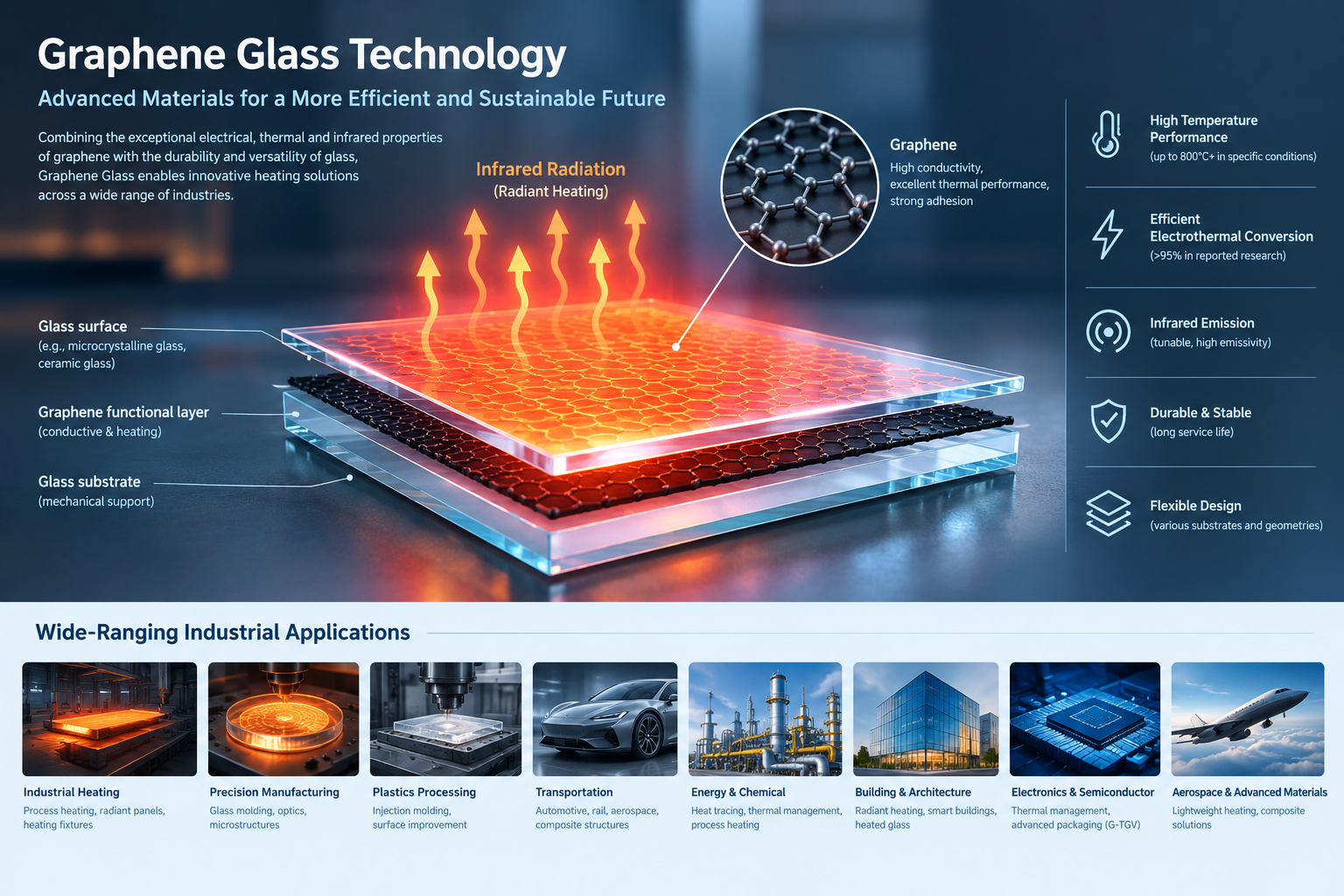
Graphene glass technology combines the electrical, thermal, and surface properties of graphene with the structural and functional characteristics of glass-based materials. Depending on the manufacturing process and product architecture, graphene can serve as an electrically conductive heating layer, a functional coating, or part of a composite material designed for specialized thermal applications.
Interest in graphene glass is growing because conventional heating technologies face several engineering challenges. These include slow thermal response, uneven temperature distribution, complex assembly, high energy consumption in certain processes, and difficulties maintaining stable performance under repeated thermal cycling.
Graphene-based heating structures offer an alternative approach. By integrating a conductive graphene layer with a suitable substrate, electrical energy can be converted into heat through Joule heating. Depending on the design, the resulting heat can be transferred through conduction, convection, thermal radiation, or a combination of these mechanisms.
Research has demonstrated graphene-based heating structures for precision glass molding, rapid heat-cycle molding, and infrared radiant heating. Other research has explored large-area graphene growth directly on glass substrates, potentially reducing the need for conventional graphene transfer processes. [1][2][3]
However, graphene glass is not a single standardized product. Its performance depends on the graphene structure, substrate composition, electrical design, manufacturing process, and intended operating environment.
Understanding these differences is essential when evaluating graphene glass for industrial heating, transportation, energy systems, advanced materials, and emerging electronic applications.
2. What Is Graphene Glass?
Graphene glass generally refers to a glass-based structure that incorporates graphene as a functional material. The term can describe several different product architectures, which should be distinguished during technical evaluation.
2.1 Graphene-coated glass
In this configuration, graphene is deposited or grown on a glass substrate to create an electrically conductive surface.
When an appropriate voltage is applied across the conductive layer, electrical resistance generates heat. The glass substrate provides mechanical support and influences the thermal response and surface characteristics of the overall component.
Potential functions include:
- Electrically heated glass panels
- Planar heating elements
- Infrared radiant heating surfaces
- Localized heating for precision manufacturing
- Functional conductive coatings
The suitability of a particular glass composition depends on its thermal properties, electrical requirements, surface condition, and compatibility with the graphene deposition process.
2.2 In-situ-grown graphene glass
Conventional chemical vapor deposition (CVD) graphene processes often involve growing graphene on a catalytic metal substrate and subsequently transferring the graphene to another material. Transfer introduces additional processing steps and may create defects, contamination, wrinkles, or interface-related problems.
Direct growth on nonmetallic substrates is an important research direction because it can reduce or eliminate the need for a separate transfer process.
A 2024 study published in Advanced Functional Materials reported a scanning electromagnetic induction quenching method for growing multilayer graphene directly on glass in air. The researchers demonstrated a 400 × 400 mm graphene glass sample produced in approximately two minutes using laboratory-grade equipment, with reported surface resistance below 500 Ω/sq and electrothermal operation demonstrated up to 1,000°C under the study’s experimental conditions. [1]
These results illustrate the potential of direct-growth manufacturing. They should not, however, be interpreted as a universal specification for commercial graphene glass products or as proof of long-term operation at 1,000°C.
For industrial adoption, manufacturers must establish repeatability, substrate compatibility, electrical uniformity, production yield, and durability under the intended operating conditions.
2.3 Graphene glass fiber and glass-fiber composites
Graphene glass fiber materials are related to graphene glass heating technology, but they are not the same product.
In graphene glass fiber fabric, graphene and glass fibers can contribute to the material’s electrical heating and infrared radiation characteristics. The resulting material may be flexible or fabric-like rather than a rigid glass panel.
Research published in ACS Nano demonstrated a dual-emitter graphene glass fiber fabric with reported infrared emissivity of 0.92 and thermal radiation efficiency of 79.4% under the study’s test conditions. The research also reported rapid electrothermal response and improved radiant heating performance relative to the comparison alloy heating wire. [3]
These results are relevant to radiant heating and thermal management, but they cannot automatically be applied to rigid graphene-coated glass panels. The substrate, radiation mechanism, geometry, and measurement conditions differ.
3. How Does Graphene Glass Generate Heat?
Graphene glass heating elements generally rely on Joule heating.
When electric current passes through a resistive graphene-based layer, part of the electrical energy is converted into heat. The resulting temperature depends on the electrical resistance, applied voltage or current, geometry of the conductive layer, heat losses, and thermal properties of the surrounding structure.
The generated heat may then be transferred through several mechanisms.
Conduction: Heat travels through the glass substrate or into a contacting component.
Convection: Heat transfers between the heated surface and the surrounding air or another fluid.
Thermal radiation: The heated surface emits electromagnetic radiation, including infrared radiation.
For industrial applications, the relative importance of these mechanisms depends on the operating temperature, surface emissivity, surrounding environment, and component design.
3.1 Electrical heating and thermal radiation are different performance metrics
A graphene glass element may convert electrical energy into heat efficiently, but this does not mean that all of the input electricity is converted into useful radiant energy directed toward the target.
A complete performance assessment should distinguish among:
- Electrical power consumption
- Electrical-to-thermal conversion efficiency
- Surface temperature and temperature uniformity
- Total thermal radiation emitted
- Spectral emissivity and radiation wavelength
- Useful heat delivered to the target
- Heat losses to the substrate, mounting structure, and surroundings
These distinctions are especially important when evaluating high-temperature infrared heaters, precision manufacturing equipment, and electronic thermal-management systems.
4. Potential Advantages of Graphene Glass Technology
The following advantages are potential benefits of well-designed graphene glass systems, rather than guaranteed characteristics of every product.
4.1 Planar heating architecture
A conductive layer distributed over a surface can provide a planar heating architecture instead of relying on a separate wire or bulky heating assembly.
This may be useful where compact dimensions, surface integration, or a relatively uniform temperature distribution are important.
However, uniform heating must be demonstrated through temperature mapping. Electrical contact design, local resistance variation, edge effects, and heat dissipation can all affect the actual temperature profile.
4.2 Rapid thermal response
Graphene-based resistive heating structures can respond rapidly to electrical input, particularly when the active heating layer has low thermal mass.
Research on graphene heaters has demonstrated rapid heating in precision molding applications. In one study, a graphene-coated silicon wafer was used for rapid heat-cycle molding, with a reported average heating rate of 11.6°C/s at 360 W under the experimental conditions. [2]
Actual heating rates vary significantly with substrate thickness, component dimensions, thermal insulation, operating temperature, and measurement method.
4.3 Potential for direct growth and simplified manufacturing
Direct growth of graphene on glass may eliminate certain transfer steps associated with conventional CVD processing.
If a manufacturing process can achieve consistent film quality over large areas, it may offer advantages in process integration, yield, and production economics.
Nevertheless, claims of lower manufacturing cost or substantially higher production speed require comparison under equivalent conditions, including substrate preparation, equipment utilization, inspection, yield, finishing, and final component assembly.
4.4 Functional integration
Graphene glass can potentially combine several functions in one structure, including electrical conduction, resistive heating, and infrared emission.
This may simplify certain designs by reducing the number of separate components. In other applications, additional electrodes, protective layers, insulation, temperature sensors, and control systems will still be required.
4.5 Design flexibility
Depending on the process, graphene-based heating structures may be developed for different surface geometries, power levels, dimensions, and substrate configurations.
The practical design range must be established for each manufacturing route. Not every graphene growth method can be applied to every glass composition or component shape.
5. Industrial Applications of Graphene Glass and Related Graphene Heating Materials
The application landscape extends beyond one type of heating panel. Some uses have been demonstrated in published research, while others remain promising development directions that require application-specific validation.
5.1 Industrial heating and infrared radiant heating
Industrial heating is one of the most direct application areas for graphene-based electrothermal materials.
Potential applications include:
- Planar radiant heating panels
- Infrared heating assemblies
- Localized heating surfaces
- Industrial process heating
- Temperature-controlled heating fixtures
- Heating modules integrated into specialized equipment
Radiant heating can transfer energy without direct physical contact between the heater and the target. This can be useful for heating surfaces, materials, or objects where contact heating is impractical.
The actual benefit depends on the target material’s absorptivity, distance from the heater, view factor, surface emissivity, and operating environment.
For high-temperature industrial use, the complete heating assembly must be evaluated, not just the graphene layer. Glass composition, thermal stress, electrical insulation, electrodes, mounting methods, and temperature control all influence reliability.
5.2 Precision glass molding and optical manufacturing
Precision glass molding is an established research application for graphene-based localized heating.
Conventional glass molding often requires heating substantial portions of the mold assembly. Localized heating can instead concentrate thermal energy near the surface or region being processed.
A study published in Optics and Lasers in Engineering investigated graphene-coated fused silica for localized rapid heating during precision molding of chalcogenide glass. The graphene layer functioned as a resistive heater, allowing the researchers to heat the target surface without heating the entire assembly to the same extent. [4]
Potential areas of relevance include:
- Precision optical components
- Microstructured glass
- Infrared optical materials
- Microlens arrays
- Specialized glass replication processes
The attraction is not simply a higher maximum temperature. More controlled thermal localization may reduce unnecessary heating of surrounding components and improve process-cycle efficiency.
Whether these benefits can be achieved at production scale depends on mold design, temperature uniformity, thermal gradients, surface quality, cycle repeatability, and equipment integration.
5.3 Plastics processing and rapid heat-cycle molding
Graphene-based heaters have also been studied for rapid heat-cycle molding in plastics manufacturing.
In this process, mold surface temperature can affect polymer flow, surface replication, weld-line appearance, and final product quality.
A 2020 study reported a graphene-based heater that exceeded 300°C in its experimental configuration and was used in rapid heat-cycle molding. The researchers reported improvements in the surface appearance of long-glass-fiber-reinforced polypropylene parts, including reduced weld-line and floating-fiber effects. [2]
Potential applications include:
- Injection molding
- Surface-quality improvement in molded plastics
- Replication of fine surface structures
- Specialized polymer processing
- Precision molding applications requiring controlled surface heating
Graphene heating technology is not necessarily suitable for every molding machine or polymer. Tool geometry, thermal cycling, mechanical wear, surface protection, and integration with the molding system must be evaluated.
5.4 Transportation and automotive systems
Transportation equipment can require heating materials that are compact, lightweight, electrically controlled, or integrated into composite structures.
Potential development areas for graphene-based heating technologies include:
- Localized heating modules
- Radiant heating assemblies
- Heated surfaces in transportation equipment
- Thermal management of selected composite structures
- Specialized heating elements for vehicle components
These are application opportunities rather than a claim that all such systems are commercially established.
Automotive adoption requires much more than demonstrating that a material can generate heat. Vibration, humidity, thermal cycling, electrical safety, fire behavior, aging, and manufacturing consistency are critical.
For vehicle applications, the relevant validation standards and certification requirements depend on the component and intended vehicle system.
5.5 Energy systems and industrial equipment
Graphene-based heating materials may be relevant to industrial energy equipment where localized heating, thermal response, or radiant heat transfer is important.
Potential development directions include:
- Industrial thermal-processing equipment
- Heating systems for specialized energy processes
- Thermal management of selected equipment surfaces
- Electrically heated composite structures
- Process heating in energy-related manufacturing
The suitability of graphene glass depends on the required temperature range, heat flux, mechanical loading, and operating environment.
In energy applications, it is also important to assess total system efficiency. A high electrical-to-thermal conversion rate alone does not establish lower energy consumption for the complete process.
5.6 Energy and chemical processing: heat tracing and corrosion-related environments
Some graphene-containing composite heating products are being developed for industrial heat tracing and process-temperature maintenance.
Potential areas of interest include pipelines, vessels, chemical-processing equipment, and selected composite structures that require controlled heating.
However, graphene glass panels and graphene glass fiber composites are different architectures. A rigid glass-based heating element should not be assumed to be suitable for pipeline heat tracing simply because a related graphene composite product is designed for that purpose.
For chemical-processing environments, the complete system must be evaluated for chemical compatibility, moisture ingress, insulation integrity, mechanical protection, and temperature limits.
5.7 Building materials and architectural heating
Graphene-based heating materials may be considered for selected building-related applications, including radiant heating panels and functional heated surfaces.
Potential development directions include:
- Wall-mounted radiant heating panels
- Integrated heating elements in selected building components
- Heating surfaces for specialized indoor environments
- Electrically heated glass-based assemblies
For architectural applications, important design factors include touch safety, fire performance, electrical protection, energy consumption, mounting arrangements, and thermal uniformity.
Transparent or translucent heating applications also require careful evaluation of optical transmission, appearance, surface resistance, and the impact of the conductive layer on visible-light performance.
5.8 Aerospace and advanced composite structures
Aerospace applications place strong demands on weight, reliability, temperature performance, and environmental durability.
Graphene-based glass fiber fabrics and composite heating materials may be relevant to selected aerospace thermal-management or radiant-heating concepts.
Potential research areas include:
- Lightweight heating structures
- Thermal management of selected composite components
- Specialized radiant-heating materials
- Functional coatings for advanced composite systems
These remain application-dependent development areas. Aerospace qualification involves demanding mechanical, environmental, electrical, and long-duration reliability testing. A laboratory heating result is not sufficient evidence for flight-qualified performance.
5.9 Coating curing, drying, and surface treatment
Radiant heating can be used in industrial drying and curing processes where energy needs to be transferred to a coating, substrate, or workpiece.
Potential applications for graphene-based radiant heaters include:
- Selected industrial coating-curing processes
- Surface drying
- Localized thermal treatment
- Heating of components during manufacturing
The benefit depends on the coating chemistry, substrate temperature limits, absorption characteristics, required curing profile, and process throughput.
It is important to distinguish between a graphene heater used as a heat source and graphene incorporated into the coating itself. They are different material and engineering solutions.
5.10 Industrial kilns and thermal processing
Graphene-based heating structures may be investigated for specialized thermal-processing equipment, especially where localized or planar heating is desirable.
Potential areas of exploration include small-scale process heaters, specialized heating fixtures, and selected high-temperature processing applications.
However, conventional industrial kilns often involve sustained high temperatures, complex atmospheres, large thermal masses, and demanding structural requirements. Graphene glass should not be assumed to replace conventional kiln heating elements without application-specific evidence.
The maximum temperature of a graphene layer under a particular experimental condition does not establish the temperature rating of the entire glass assembly.
5.11 Electronics manufacturing and thermal management
Electronics manufacturing presents opportunities for compact, electrically controlled heating structures.
Potential applications include:
- Localized heating during manufacturing
- Precision thermal processing
- Heating fixtures for selected electronic components
- Thermal control in specialized equipment
- Research into integrated planar heating elements
For electronics applications, the required temperature may be high during manufacturing but much lower during normal operation. These two use cases must be clearly distinguished.
A process heater designed to operate at several hundred degrees Celsius may be unsuitable for direct use near sensitive electronic components unless it is carefully isolated and integrated.
For electronic thermal management, the most relevant parameters may include temperature uniformity, thermal response, power density, insulation, electromagnetic compatibility, component-level reliability, and the ability to control the temperature precisely.
5.12 Semiconductor packaging and glass substrate technologies
Advanced semiconductor packaging is another area of interest, but it requires an important distinction.
Graphene glass heating technology and graphene through-glass via (G-TGV) substrates are not the same product.
G-TGV refers to a glass substrate architecture incorporating through-glass vias for electrical interconnection. Glass substrates and TGV technology are being investigated for advanced packaging, sensors, RF components, and other microelectronic applications. [5]
Potential opportunities associated with glass substrate technology include:
- Glass interposers for advanced packaging
- High-density electrical interconnections
- Selected RF and high-frequency electronic devices
- Sensor and MEMS packaging
- Glass-based carrier and substrate structures
Some companies are exploring graphene-related functionalization or graphene integration in advanced glass materials. However, graphene’s role in a particular G-TGV product must be specified separately.
For semiconductor packaging, the main qualification requirements include dimensional stability, via fabrication, metallization, electrical performance, thermal-mechanical reliability, and compatibility with downstream packaging processes. A heating-related graphene glass product does not automatically satisfy these requirements.
6. Key Technical Parameters for Evaluating Graphene Glass Heating Elements
For industrial buyers and engineering teams, a useful technical evaluation should cover the complete heating assembly.
6.1 Maximum operating temperature
The maximum temperature must be defined precisely.
It may refer to:
- The graphene layer temperature
- The glass substrate temperature
- The external surface temperature
- A short-duration peak temperature
- A rated continuous operating temperature
These values are not interchangeable.
A product that reaches a high temperature briefly may not maintain that temperature under continuous electrical loading. Oxygen exposure, substrate properties, electrode stability, and thermal stress may affect long-term performance.
6.2 Electrical resistance and power density
The electrical resistance of the graphene layer influences the current and voltage required to produce the desired heating output.
Power density is particularly important for planar heating systems because it indicates how much electrical power is applied per unit area.
For a target design, engineers should evaluate:
- Operating voltage
- Rated power
- Current
- Sheet resistance
- Electrode geometry
- Power distribution
- Temperature uniformity
These parameters must be designed together. Sheet resistance alone does not determine the heating performance of the complete component.
6.3 Infrared emissivity and radiant output
For radiant heating applications, surface emissivity and actual radiative power are important.
The thermal radiation emitted by a surface depends on its temperature, emissivity, area, and spectral characteristics. The fraction of this energy absorbed by the target depends on the target surface and the system geometry.
A technically meaningful assessment should therefore include surface temperature, spectral emissivity where relevant, radiation distribution, and the target’s heating response.
6.4 Substrate compatibility
Glass is not a single material with a universal temperature limit.
Different glass and glass-ceramic compositions have different thermal expansion coefficients, softening behavior, thermal conductivity, and resistance to thermal shock.
The substrate must be compatible with the graphene growth or coating process, the electrode materials, and the intended operating cycle.
For higher-temperature applications, substrate selection should be evaluated alongside mounting stress, temperature gradients, and repeated heating and cooling.
6.5 Electrical insulation and safety
A conductive graphene layer requires a carefully designed electrical system.
Depending on the application, the assembly may need electrical insulation, protective coatings, safe terminal design, grounding or other protective measures, and appropriate temperature controls.
Relevant tests may include insulation resistance, dielectric withstand, leakage current, and performance under humidity or thermal aging.
The required tests depend on the final product category, voltage, installation, and applicable safety standards.
6.6 Long-term reliability
Long-term performance is a major consideration for industrial adoption.
A comprehensive validation program may include:
- Continuous-operation testing
- Repeated power-on and power-off cycles
- Thermal cycling
- Electrical resistance monitoring
- Power degradation measurements
- Temperature-uniformity measurements
- Adhesion and surface-integrity assessment
- Electrode and connection reliability
- Insulation performance after aging
A high maximum operating temperature does not, by itself, establish a long service life. Durability must be demonstrated under representative operating conditions.
7. Manufacturing Challenges and Commercialization Considerations
Despite promising research results, scaling graphene glass technology from laboratory demonstrations to commercial production remains an engineering challenge.
7.1 Large-area uniformity
Large-area graphene growth requires consistent electrical and structural properties across the entire substrate.
Local differences in layer thickness, defects, surface resistance, or growth conditions may cause uneven heating and localized hot spots.
Manufacturers need suitable process controls and inspection methods to verify repeatability.
7.2 Substrate and process compatibility
A process suitable for one type of glass may not work with another.
Growth temperature, surface chemistry, glass composition, thermal expansion, and cooling conditions can affect graphene formation and adhesion.
Direct growth may simplify manufacturing, but the process must still be matched to the selected substrate.
7.3 Electrode design and electrical connections
Electrodes introduce additional design challenges, especially at elevated temperatures.
Contact resistance, current distribution, oxidation, connection stability, and thermal expansion can influence the performance of the finished component.
For high-power applications, electrode design is as important as the graphene layer itself.
7.4 Quality control and manufacturing yield
Industrial production requires consistent product performance from batch to batch.
Quality control may include sheet-resistance mapping, optical inspection, dimensional measurements, electrical power testing, temperature mapping, and reliability sampling.
A manufacturing process that produces one successful laboratory sample is not necessarily ready for high-volume production.
7.5 Cost and scalability
Direct-growth processes may reduce certain transfer and assembly steps, but the final manufacturing cost depends on equipment, throughput, energy consumption, process yield, substrate preparation, inspection, and finishing.
Cost comparisons should therefore use equivalent finished products and production conditions rather than comparing only the graphene-growth step.
8. How to Select a Graphene Glass Technology Partner
For B2B engineering projects, selecting a suitable supplier requires more than reviewing a headline temperature rating.
A practical assessment should include five areas.
First, material and process capability. Confirm the substrate, graphene formation method, electrode system, and manufacturing process.
Second, validated performance. Request relevant test reports for operating temperature, electrical resistance, heating power, radiation performance, and durability.
Third, application compatibility. Confirm whether the supplier has experience with the intended geometry, voltage, installation conditions, and target environment.
Fourth, customization and engineering support. Determine whether the supplier can adjust the material architecture and produce samples for application-specific evaluation.
Fifth, production readiness. Assess process repeatability, inspection methods, quality management, traceability, and the ability to scale after successful validation.
For exploratory projects, it is particularly important to distinguish existing validated capabilities from proposed development work.
A supplier may possess promising material technology without having a fully qualified product for a specific industrial application. Early technical discussion can help determine whether the remaining work involves routine engineering or substantial research and development.
9. Future Development of Graphene Glass Technology
Several development directions are likely to remain important as graphene glass moves toward broader industrial use.
Higher-temperature operation
Research into graphene growth on glass and graphene-based heating structures has demonstrated promising high-temperature behavior under particular experimental conditions. Future work will need to establish continuous-operation limits, oxidation resistance, electrical stability, and component-level reliability.
Large-area manufacturing
Improving growth uniformity, production throughput, and yield will be important for applications that require larger heating panels or high-volume manufacturing.
Better control of radiant output
Combining material design, electrical control, surface engineering, and temperature feedback may help tailor heating performance to specific processes.
Integration with industrial equipment
Commercial adoption will depend on more than the heating material. Mounting structures, power electronics, thermal sensors, safety systems, and maintenance requirements all influence the suitability of a final solution.
Expansion into advanced materials and electronics
Graphene-related glass technologies may develop along multiple paths, including heating materials, glass-fiber composites, functional coatings, and advanced substrate research. These product categories will require different manufacturing processes and qualification standards.
10. Conclusion
Graphene glass technology is an emerging materials and engineering platform with potential applications in industrial heating, infrared radiant heating, precision glass molding, plastics processing, transportation equipment, energy and chemical systems, building-related heating, aerospace research, electronics manufacturing, and selected advanced glass substrate technologies.
Published research provides evidence that graphene-based heating structures can deliver rapid thermal response, localized heating, and useful radiant performance in specific experimental configurations. Research into direct graphene growth on glass also suggests opportunities to simplify manufacturing and support larger-area structures. [1][2][3][4]
At the same time, the technology should not be evaluated solely by its highest reported temperature or a single efficiency figure. Substrate compatibility, temperature uniformity, electrical safety, long-term stability, manufacturing repeatability, and actual application performance remain essential.
For industrial buyers, the most effective approach is to define the target operating conditions, identify the appropriate material architecture, review relevant test data, and validate the complete heating assembly before moving toward production.
Graphene glass is therefore best understood not as one universal heating product, but as a family of material and component technologies whose commercial value depends on matching the right structure to the right application.
References and Further Reading
[1] Wang et al., “Highly Efficient Growth of Large-Sized Uniform Graphene Glass in Air by Scanning Electromagnetic Induction Quenching Method,” Advanced Functional Materials, 2024. Read the research abstract.
[2] Yang et al., “A quick response and tribologically durable graphene heater for rapid heat cycle molding and its applications in injection molding,” Applied Thermal Engineering, 2020. Read the research abstract.
[3] “Dual-Emitter Graphene Glass Fiber Fabric for Radiant Heating,” ACS Nano, 2022. Read the research abstract.
[4] Li et al., “Localized rapid heating process for precision chalcogenide glass molding,” Optics and Lasers in Engineering, 2015. Find the publication.
[5] Yu et al., “Application of Through Glass Via (TGV) Technology for Sensors Manufacturing and Packaging,” Sensors, 2024. Read the open-access review.
Note: The performance values cited above are reported results from specific research studies. They should not be treated as universal specifications for all graphene glass products or as guarantees of commercial product performance.