
Why Advanced Materials Fail Between Lab and Production
Many advanced materials show outstanding performance in laboratory environments but fail during industrial commercialization. This challenge is common across industries such as:
- Batteries
- Conductive coatings
- Thermal management
- Advanced composites
- Functional nanomaterials
The problem is not always the material itself. In many cases, failure occurs because the material cannot adapt to the realities of scalable manufacturing, process stability, and industrial validation.
Understanding why advanced materials fail between lab and production is essential for successful commercialization.
The “Lab-to-Production Gap”
In laboratory research, materials are often developed under:
- Controlled conditions
- Small sample sizes
- Highly optimized parameters
Industrial production, however, requires:
- Stable large-scale processing
- Repeatability
- Cost efficiency
- Equipment compatibility
- Long-term reliability
This creates a major transition challenge.
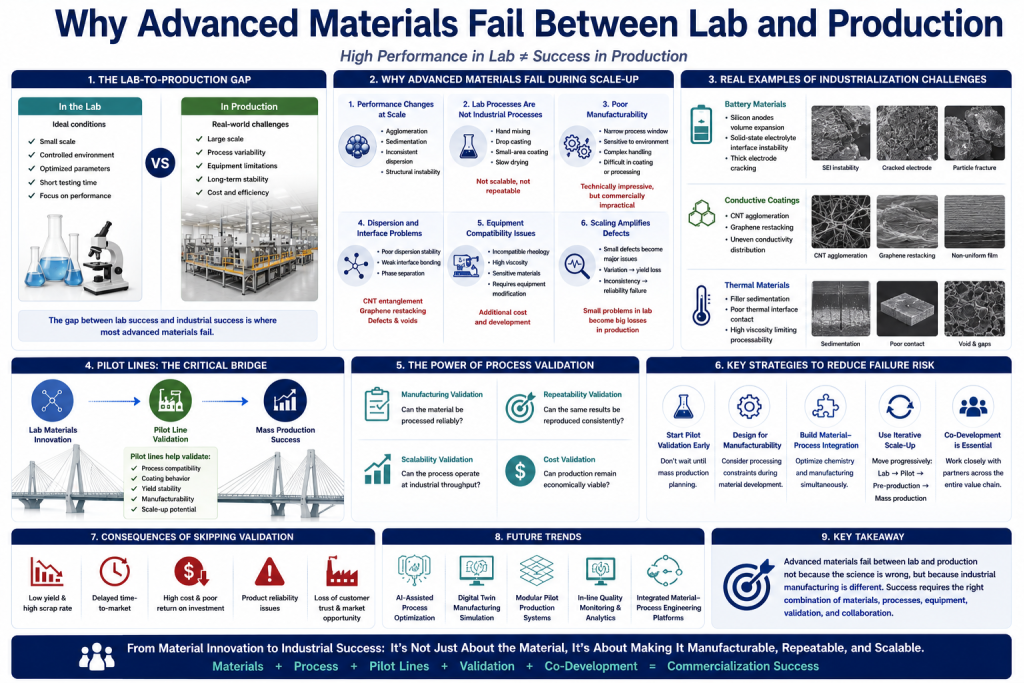
Why Advanced Materials Fail During Scale-Up
1. Material Performance Changes at Scale
A material that performs well at gram-scale may behave differently at kilogram or ton-scale.
Common issues include:
- Agglomeration
- Sedimentation
- Inconsistent particle distribution
- Structural instability
This is especially critical for:
- CNT dispersions
- Graphene systems
- Nano-coatings
- Solid-state materials
2. Laboratory Processes Are Not Industrial Processes
Many lab techniques are difficult to scale:
| Lab Method | Industrial Challenge |
|---|---|
| Hand mixing | Poor batch consistency |
| Drop casting | Not scalable |
| Small-area coating | Uniformity issues |
| Slow drying | Throughput limitations |
Industrial manufacturing requires:
- Continuous processes
- Stable throughput
- Process repeatability
3. Poor Manufacturability
Some advanced materials require:
- Narrow process windows
- Complex handling conditions
- High sensitivity to humidity or temperature
This creates difficulties in:
- Electrode coating
- Composite processing
- Thin film manufacturing
A material may be technically impressive but commercially impractical.
4. Dispersion and Interface Problems
Many advanced carbon materials face:
- Poor dispersion stability
- Weak interface bonding
- Phase separation
For example:
- CNTs may entangle
- Graphene may restack
- Fillers may create defects instead of performance improvements
5. Equipment Compatibility Issues
Existing industrial equipment may not support:
- New slurry rheology
- High-viscosity systems
- Dry electrode architectures
- Sensitive nano-materials
This often requires:
- Equipment redesign
- Process modification
- Additional capital investment
6. Scaling Amplifies Defects
Small defects become major problems at scale:
- Tiny coating inconsistency → yield loss
- Slight thickness variation → cell imbalance
- Minor contamination → reliability failure
Industrial production magnifies process instability.
Why Pilot Lines Matter
Pilot manufacturing is the critical bridge between:
- Material innovation
- Commercial production
Pilot lines help validate:
- Process compatibility
- Coating behavior
- Yield stability
- Manufacturability
before large-scale commercialization.
The Importance of Process Validation
Advanced materials require more than performance testing.
They also require:
Manufacturing Validation
Can the material be processed reliably?
Repeatability Validation
Can the same results be reproduced consistently?
Scalability Validation
Can the process operate at industrial throughput?
Cost Validation
Can production remain economically viable?
Real Examples of Industrialization Challenges
Battery Materials
- Silicon anodes with volume expansion
- Solid-state electrolyte interface instability
- Thick electrode cracking
Conductive Coatings
- CNT agglomeration
- Graphene restacking
- Uneven conductivity distribution
Thermal Materials
- Filler sedimentation
- Poor thermal interface contact
- High viscosity limiting processability
Co-Development Is Becoming Essential
Successful commercialization increasingly requires collaboration between:
- Material suppliers
- Pilot line operators
- Equipment manufacturers
- End users / OEMs
The future is not isolated material development.
It is:
Integrated co-development and industrial validation.
Key Strategies to Reduce Failure Risk
Start Pilot Validation Early
Do not wait until mass production planning.
Design for Manufacturability
Consider processing constraints during material development.
Build Material–Process Integration
Optimize chemistry and manufacturing simultaneously.
Use Iterative Scale-Up
Move progressively:
Lab → Pilot → Pre-production → Mass production
Future Trends
The next generation of industrial materials development will rely on:
- AI-assisted process optimization
- Digital twin manufacturing
- Modular pilot production systems
- Advanced in-line quality monitoring
- Integrated material-process engineering
Advanced materials often fail not because the science is wrong, but because industrial manufacturing is fundamentally different from laboratory research.
The real challenge lies in transforming high-performance materials into:
- Manufacturable
- Repeatable
- Scalable
- Economically viable solutions
Companies that understand the importance of pilot validation, process engineering, and manufacturability will lead the next generation of advanced material commercialization.