
From Lab to Production: Why Pilot-Scale Matters for Graphene
Graphene has attracted global attention due to its exceptional properties, including:
- High electrical conductivity
- Outstanding thermal conductivity
- Mechanical strength
- Lightweight structure
- Barrier performance
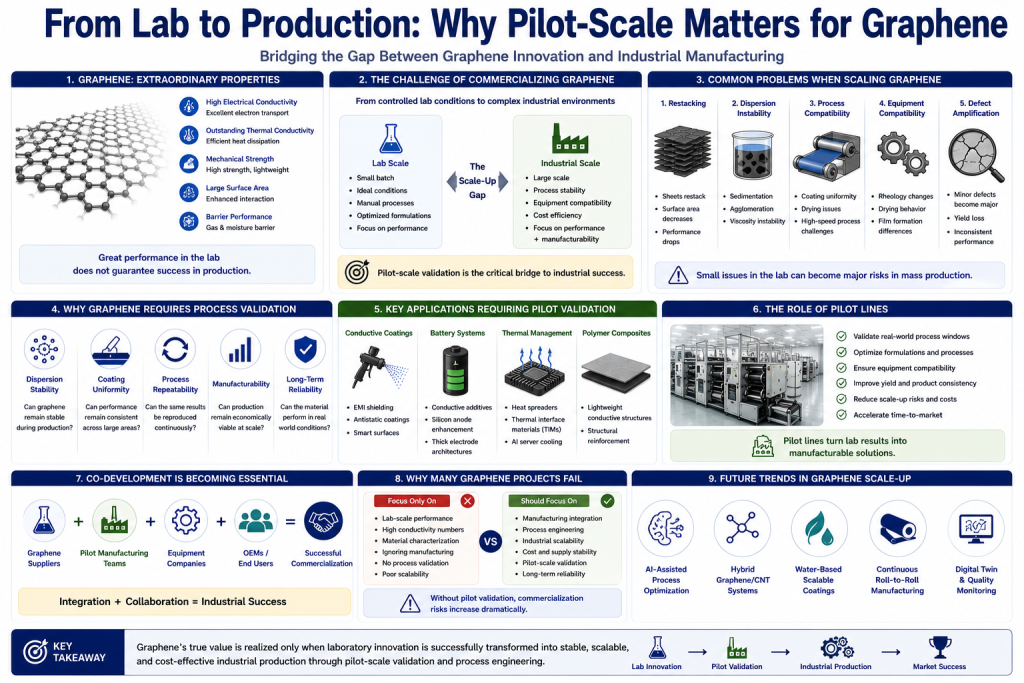
However, despite impressive laboratory results, many graphene projects struggle during commercialization. The challenge is not only graphene itself—it is the transition from laboratory-scale success to industrial-scale manufacturing.
This is why pilot-scale validation has become one of the most critical stages in graphene industrialization.
The Challenge of Commercializing Graphene
In laboratory environments, graphene is often tested under:
- Controlled conditions
- Small batch sizes
- Optimized formulations
Industrial production requires:
- Process stability
- Repeatability
- Cost efficiency
- Large-scale manufacturability
This creates a major gap between:
Graphene research
and
Real industrial deployment
Why Pilot-Scale Matters for Graphene
Pilot-scale production acts as the bridge between:
- Laboratory development
- Mass production
It allows companies to evaluate whether graphene systems can operate reliably under realistic manufacturing conditions.
Common Problems When Scaling Graphene
1. Graphene Restacking
At small scale, graphene sheets may disperse well.
At larger scale:
- Sheets tend to restack
- Surface area decreases
- Conductivity performance drops
This is one of the biggest industrialization challenges.
2. Dispersion Stability Issues
Graphene dispersions often face:
- Sedimentation
- Agglomeration
- Viscosity instability
Especially during:
- Long mixing cycles
- Continuous coating processes
- Large-batch manufacturing
Pilot validation helps identify these problems early.
3. Coating and Process Compatibility
Graphene-based materials must work with industrial processes such as:
- Slot-die coating
- Roll-to-roll coating
- Spray coating
- Composite mixing systems
A formulation that works in the lab may fail during:
- High-speed coating
- Drying
- Continuous production
4. Equipment Compatibility Challenges
Industrial manufacturing equipment may respond differently to graphene systems due to:
- Conductive behavior
- Rheology changes
- Drying characteristics
- Film formation behavior
Pilot-scale testing validates compatibility before large capital investment.
5. Scaling Amplifies Defects
At industrial scale:
- Small dispersion defects become conductivity issues
- Minor coating inconsistency affects yield
- Tiny process instability causes large production losses
Pilot manufacturing helps reduce these risks.
Why Graphene Requires Process Validation
Graphene performance depends not only on material quality, but also on:
- Processing conditions
- Interface engineering
- Manufacturing stability
Industrial success requires validation of:
Dispersion Stability
Can the graphene remain stable during production?
Coating Uniformity
Can conductive performance remain consistent across large areas?
Process Repeatability
Can the same results be reproduced continuously?
Manufacturability
Can production remain economically viable at scale?
Key Applications Requiring Pilot Validation
Conductive Coatings
- EMI shielding
- Antistatic coatings
- Smart conductive surfaces
Battery Systems
- Conductive additives
- Silicon anode enhancement
- Thick electrode architectures
Thermal Management
- Heat spreaders
- Thermal interface materials (TIMs)
- AI server cooling materials
Polymer Composites
- Lightweight conductive structures
- Structural reinforcement systems
The Role of Pilot Lines in Graphene Industrialization
Pilot lines help companies validate:
| Validation Area | Why It Matters |
|---|---|
| Dispersion stability | Maintains consistent performance |
| Coating behavior | Ensures scalable manufacturing |
| Process windows | Defines stable operating conditions |
| Yield performance | Reduces production risk |
| Equipment compatibility | Avoids industrial integration failure |
Co-Development Is Becoming Essential
Successful graphene commercialization increasingly requires collaboration between:
- Graphene suppliers
- Pilot manufacturing teams
- Equipment companies
- OEMs and end users
The future is not simply:
“Selling graphene.”
It is:
“Building manufacturable graphene systems together.”
Why Many Graphene Projects Fail
Many graphene projects focus only on:
- Conductivity numbers
- Lab-scale performance
- Material characterization
But ignore:
- Manufacturing integration
- Process engineering
- Industrial scalability
- Long-term production stability
This is where commercialization often breaks down.
Future Trends in Graphene Scale-Up
The industry is moving toward:
- Pilot-scale process engineering
- AI-assisted formulation optimization
- Hybrid graphene/CNT systems
- Water-based scalable coatings
- Continuous roll-to-roll graphene manufacturing
Graphene commercialization is no longer just a material challenge—it is a manufacturing challenge.
The real value of graphene emerges only when laboratory performance can be transformed into:
- Stable production
- Scalable manufacturing
- Reliable industrial performance
Pilot-scale validation plays a critical role in bridging the gap between innovation and commercialization.
Companies that combine:
- advanced materials
- process engineering
- pilot manufacturing
- industrial validation
will lead the next stage of graphene industrialization.