
Graphene Scale-Up Explained: Lab, Pilot, and Mass Production
Graphene is one of the most promising advanced materials of the modern industrial era. With exceptional:
- Electrical conductivity
- Thermal conductivity
- Mechanical strength
- Barrier performance
graphene has attracted attention across industries including:
- Batteries
- Conductive coatings
- Thermal management
- Composites
- Electronics
However, achieving strong laboratory performance is only the beginning. The real challenge lies in scaling graphene from lab research to industrial mass production.
Understanding the differences between:
- Lab scale
- Pilot scale
- Mass production
is critical for successful graphene commercialization.
The Three Stages of Graphene Scale-Up
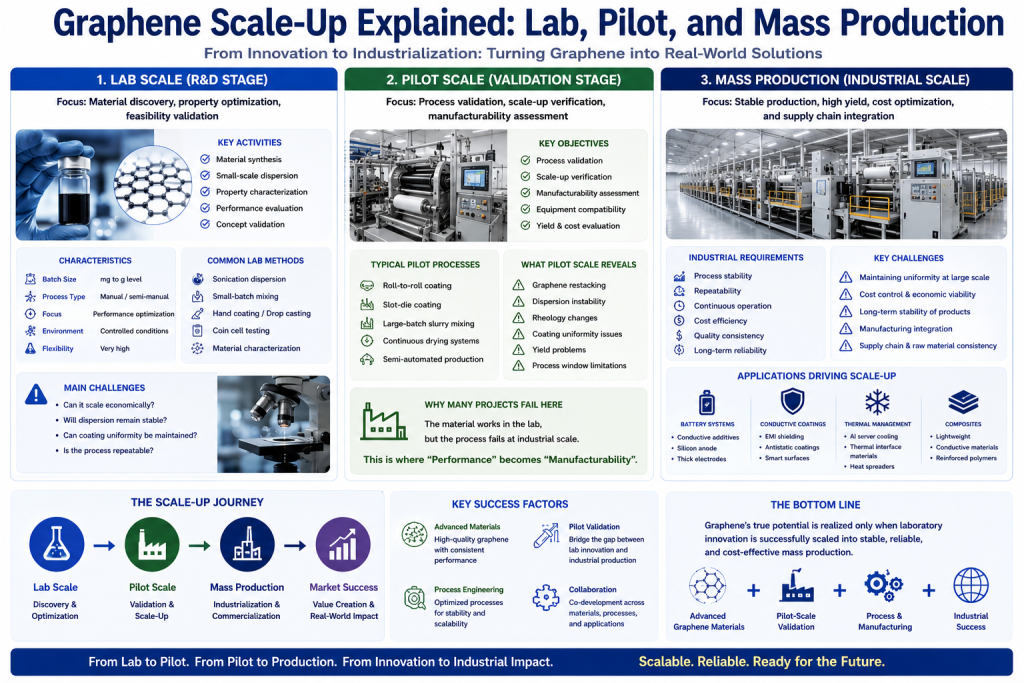
1. Laboratory Scale (R&D Stage)
Purpose
The laboratory stage focuses on:
- Material discovery
- Property optimization
- Small-scale testing
- Feasibility validation
Researchers evaluate:
- Conductivity
- Dispersion behavior
- Thermal performance
- Interface compatibility
Characteristics of Lab-Scale Graphene
| Feature | Lab Scale |
|---|---|
| Batch Size | mg to g level |
| Process Type | Manual / semi-manual |
| Focus | Performance optimization |
| Environment | Controlled conditions |
| Flexibility | Very high |
Common Laboratory Methods
- Sonication dispersion
- Small-batch mixing
- Hand coating
- Drop casting
- Coin cell evaluation
These methods are effective for research, but often difficult to scale industrially.
Main Challenges at Lab Scale
Although graphene may show excellent performance in the lab, key industrial questions remain unanswered:
- Can it scale economically?
- Will dispersion remain stable?
- Can coating uniformity be maintained?
- Is the process repeatable?
This creates the need for pilot validation.
2. Pilot Scale (Validation Stage)
Why Pilot Scale Matters
Pilot production is the critical bridge between:
Laboratory innovation
and
Industrial manufacturing
This stage evaluates whether graphene systems can survive real manufacturing conditions.
Key Objectives of Pilot Scale
Process Validation
Can graphene work reliably in industrial processes?
Scale-Up Verification
Does performance remain stable in larger batches?
Manufacturability Assessment
Can production operate continuously and economically?
Equipment Compatibility
Can existing manufacturing systems handle graphene materials?
Typical Pilot-Scale Processes
- Roll-to-roll coating
- Slot-die coating
- Large-batch slurry mixing
- Continuous drying systems
- Semi-automated production lines
What Pilot Scale Reveals
Pilot-scale validation often exposes problems not visible in the lab:
Graphene Restacking
Sheets collapse together, reducing performance.
Dispersion Instability
Sedimentation and agglomeration increase at larger scale.
Rheology Changes
Industrial mixing changes coating behavior.
Yield Problems
Small process variations create large production losses.
Why Many Graphene Projects Fail Here
This is the stage where many projects struggle because:
- The material works scientifically
- But the process fails industrially
Pilot-scale manufacturing is where:
“Performance” becomes “Manufacturability.”
3. Mass Production (Industrial Scale)
Goal of Industrial Production
At this stage, the focus shifts toward:
- Stable throughput
- High yield
- Cost optimization
- Long-term reliability
- Supply chain integration
Industrial Manufacturing Requirements
Mass production requires:
| Requirement | Importance |
|---|---|
| Process stability | Critical |
| Repeatability | Essential |
| Continuous operation | Required |
| Cost efficiency | Commercial necessity |
| Quality consistency | Mandatory |
Challenges in Graphene Mass Production
Maintaining Uniformity
Large-area coating consistency becomes difficult.
Cost Control
Industrial graphene applications must remain economically viable.
Long-Term Stability
Products must maintain performance over time.
Manufacturing Integration
Graphene systems must integrate with existing industrial processes.
Applications Driving Graphene Scale-Up
Battery Systems
- Conductive additives
- Silicon anode enhancement
- Thick electrodes
Conductive Coatings
- EMI shielding
- Antistatic coatings
- Smart conductive surfaces
Thermal Management
- AI server cooling
- Thermal interface materials
- Heat spreaders
Structural Composites
- Lightweight conductive materials
- Reinforced polymer systems
Why Scale-Up Is More Important Than Lab Performance
Many companies focus heavily on:
- Conductivity values
- Material characterization
- Laboratory data
But industrial success depends more on:
- Process engineering
- Pilot validation
- Manufacturing integration
- Yield stability
The real competitive advantage lies in:
Turning graphene into a manufacturable industrial system.
The Role of Co-Development
Successful graphene industrialization increasingly requires collaboration between:
- Material suppliers
- Pilot line operators
- Equipment manufacturers
- OEMs
Commercialization is no longer isolated material development.
It is:
Integrated scale-up engineering.
Future Trends in Graphene Scale-Up
The industry is moving toward:
- AI-assisted process optimization
- Continuous roll-to-roll manufacturing
- Hybrid graphene/CNT systems
- Water-based scalable formulations
- Digital twin manufacturing systems
Graphene scale-up is a multi-stage industrial journey—not simply a materials challenge.
While laboratory innovation creates potential, pilot validation and manufacturing integration determine commercial success.
The companies that succeed will be those capable of combining:
- advanced materials
- pilot manufacturing
- process engineering
- industrial validation
- scalable production systems
into a complete industrialization strategy.