
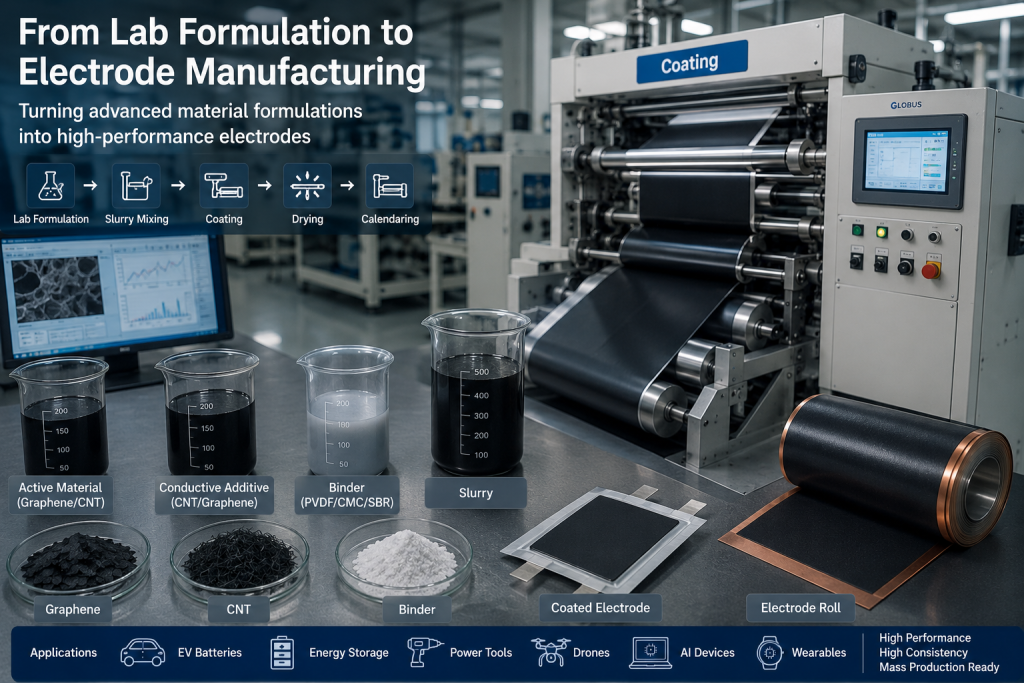
From Lab Formulation to Electrode Manufacturing
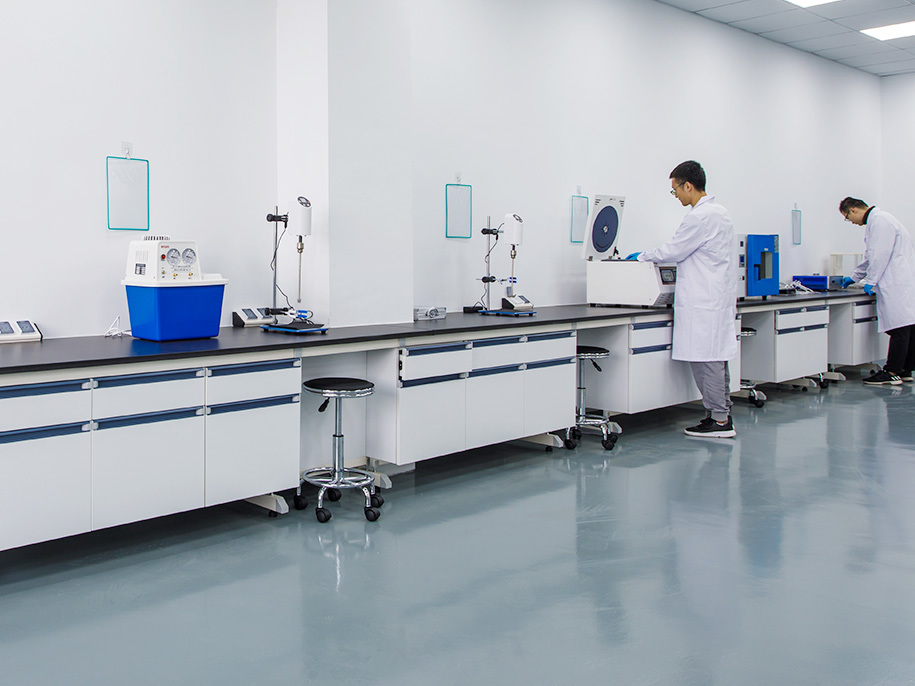
In battery development, creating a promising material formulation in the laboratory is only the first step. The real challenge lies in transforming that formulation into a manufacturable electrode system capable of stable industrial production.
This transition—from lab formulation to electrode manufacturing—is one of the most critical stages in battery commercialization. It determines whether advanced materials can move beyond research and become viable industrial products.
Today, successful battery development increasingly depends on the integration of:
- Material science
- Electrode engineering
- Process validation
- Pilot manufacturing
- Industrial scalability
Why Lab Formulations Often Fail During Manufacturing
Many battery materials demonstrate excellent electrochemical performance in laboratory testing but fail during scale-up due to manufacturing limitations.
The reason is simple:
A good material is not automatically a manufacturable electrode.
Laboratory optimization often focuses on:
- Capacity
- Conductivity
- Initial cycle performance
Industrial manufacturing requires much more:
- Process stability
- Uniform coating
- High yield
- Continuous production compatibility
The Journey from Formulation to Manufacturing
1. Material Formulation Stage
At the laboratory level, researchers design formulations involving:
- Active materials
- Conductive additives
- Binders
- Solvents
The goal is to optimize:
- Energy density
- Conductivity
- Stability
- Electrochemical performance
Common Advanced Material Systems
Conductive Carbon Systems
- CNT conductive networks
- Graphene-enhanced electrodes
- Hybrid carbon systems
Next-Generation Active Materials
- Silicon anodes
- High-nickel cathodes
- Solid-state electrolytes
Laboratory Advantages
Lab-scale development allows:
- Rapid iteration
- Small material consumption
- Flexible experimentation
- Controlled testing conditions
However, these advantages can also hide industrial risks.
The Transition to Electrode Manufacturing
Why Electrode Processing Matters
Battery performance depends not only on material chemistry, but also on how the electrode is manufactured.
Critical manufacturing steps include:
- Slurry preparation
- Mixing and dispersion
- Electrode coating
- Drying
- Calendaring
Each step affects final cell performance.
Key Manufacturing Challenges
1. Slurry Stability and Rheology
A formulation that works in small batches may behave differently at larger scale.
Common problems include:
- Sedimentation
- CNT entanglement
- Graphene restacking
- Viscosity instability
These directly impact coating quality.
2. Dispersion Quality
Uniform dispersion is essential for:
- Conductive network formation
- Consistent electrode performance
- Stable production yield
Poor dispersion can cause:
- Local resistance variation
- Coating defects
- Reduced cycle life
3. Electrode Coating Challenges
Industrial coating requires:
- Uniform thickness
- Stable loading
- High-speed continuous operation
Laboratory coating methods often cannot replicate industrial conditions.
4. Drying and Microstructure Control
Drying influences:
- Porosity
- Binder distribution
- Conductive pathways
- Mechanical integrity
Improper drying may cause:
- Cracks
- Delamination
- Non-uniform electrode structure
5. Calendaring Optimization
Compression affects:
- Electrode density
- Ion transport
- Mechanical stability
Balancing density and diffusion is critical for high-performance batteries.
Why Pilot Manufacturing Is Essential
Pilot lines bridge the gap between:
Laboratory formulation
and
Industrial manufacturing
They validate whether the electrode system can operate reliably under realistic production conditions.
What Pilot Validation Evaluates
| Validation Area | Purpose |
|---|---|
| Slurry stability | Process consistency |
| Coating behavior | Uniform manufacturing |
| Drying performance | Structural integrity |
| Yield stability | Manufacturing economics |
| Equipment compatibility | Industrial scalability |
Manufacturability Is Becoming the Real Bottleneck
As battery technology advances, the key challenge is shifting from:
“Can the material work?”
to:
“Can the material be manufactured reliably at scale?”
This is especially important for:
- High-loading electrodes
- Dry electrode systems
- CNT/graphene conductive networks
- Solid-state battery architectures
Co-Development Is the Future of Battery Manufacturing
Successful commercialization increasingly requires collaboration between:
- Material developers
- Pilot manufacturing teams
- Equipment suppliers
- OEMs
Battery industrialization is becoming a fully integrated process.
Applications Driving Electrode Manufacturing Innovation
EV Batteries
- High energy density electrodes
- Fast-charging architectures
Solid-State Batteries
- Interface engineering
- Dry processing systems
AI and Energy Storage Systems
- Thick electrodes
- Thermal management integration
Advanced Conductive Systems
- Graphene-enhanced electrodes
- CNT conductive networks
Future Trends
The future of electrode manufacturing will focus on:
- AI-assisted process optimization
- Digital twin manufacturing
- Dry electrode technologies
- Continuous roll-to-roll production
- Pilot-scale industrial validation systems
The journey from laboratory formulation to electrode manufacturing is one of the most important stages in battery commercialization.
Success depends not only on advanced materials, but also on:
- Process engineering
- Manufacturability
- Pilot validation
- Industrial scalability
Companies that understand how to integrate materials with manufacturing processes will lead the next generation of battery industrialization.