
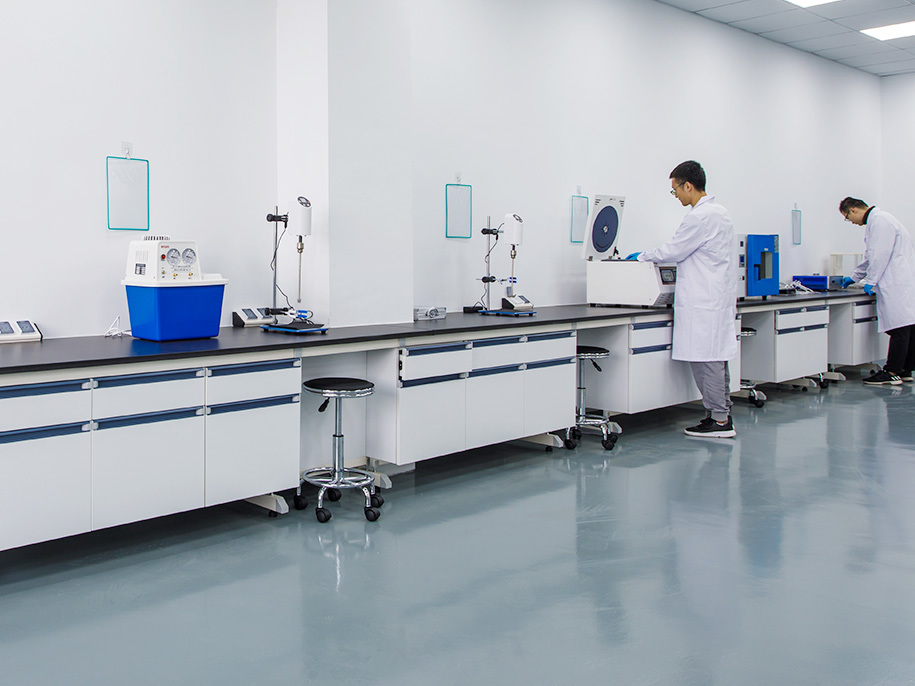
What Happens in a Graphene Pilot Plant?
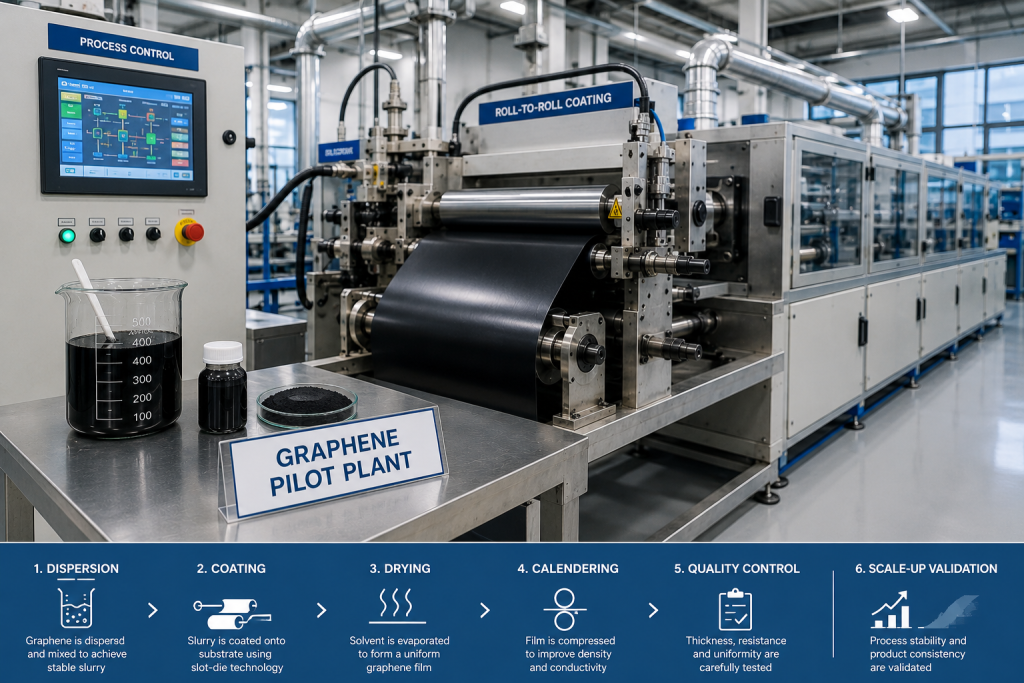
As graphene moves from laboratory research toward industrial commercialization, one stage becomes critically important:
Pilot-scale manufacturing.
A graphene pilot plant is where laboratory concepts are tested under realistic industrial conditions before mass production.
This stage helps determine whether graphene materials can achieve:
- Stable processing
- Scalable production
- Consistent quality
- Commercial viability
Without pilot-scale validation, many graphene projects fail during industrialization.
Today, pilot plants are becoming a key part of graphene commercialization across industries such as:
- Batteries
- Conductive coatings
- Thermal management
- EMI shielding
- Composite materials
What Is a Graphene Pilot Plant?
A graphene pilot plant is a semi-industrial production environment designed to bridge the gap between:
- Laboratory R&D
and - Full-scale manufacturing
Pilot plants simulate industrial production conditions while maintaining enough flexibility for process optimization and validation.
They help companies evaluate:
- Process stability
- Equipment compatibility
- Production scalability
- Manufacturing yield
before investing in large-scale facilities.
Why Pilot Plants Matter for Graphene
Graphene materials often perform well in small laboratory experiments.
However, industrial production introduces challenges such as:
- Dispersion instability
- Restacking
- Coating inconsistency
- Rheology variation
- Drying defects
Pilot plants help identify and solve these issues early.
What Happens Inside a Graphene Pilot Plant?
1. Graphene Dispersion and Slurry Preparation
One of the most critical steps is preparing stable graphene dispersions.
Pilot-scale mixing systems evaluate:
- Dispersion quality
- Viscosity stability
- Agglomeration control
- Process repeatability
At this stage, engineers optimize:
- Mixing speed
- Shear conditions
- Solvent systems
- Additive compatibility
Poor dispersion at pilot scale often predicts industrial manufacturing problems later.
2. Coating Process Validation
Graphene pilot plants frequently test:
- Slot-die coating
- Roll-to-roll coating
- Spray coating
- Gravure coating
These processes determine whether graphene films can maintain:
- Uniform thickness
- Stable conductivity
- Consistent thermal performance
under continuous production conditions.
3. Drying and Film Formation Optimization
Drying is one of the most underestimated parts of graphene manufacturing.
Pilot plants study how drying affects:
- Graphene orientation
- Conductive pathways
- Film density
- Mechanical stability
Improper drying can lead to:
- Cracking
- Delamination
- Uneven conductive networks
4. Roll-to-Roll Manufacturing Simulation
Many industrial graphene products require continuous roll-to-roll production.
Pilot plants simulate:
- Continuous web transport
- Tension control
- Coating speed
- Large-area film formation
This helps validate whether graphene systems can survive real industrial operation.
5. Process Stability Testing
Pilot manufacturing focuses heavily on process stability.
Engineers evaluate whether production remains stable during:
- Long coating runs
- Large-batch mixing
- Continuous drying
- Repeated manufacturing cycles
Stable processes are essential for industrial scalability.
6. Material Scale-Up Validation
Graphene materials often behave differently when production scales from:
- grams
to - kilograms
to - industrial tons
Pilot plants help evaluate:
- Batch consistency
- Quality repeatability
- Manufacturing reliability
before full commercialization.
7. Electrode Manufacturing for Batteries
In battery applications, graphene pilot plants may support:
- Conductive electrode development
- Silicon anode systems
- Thick electrode processing
- Slurry optimization
Pilot-scale electrode coating allows testing under realistic battery manufacturing conditions.
Why Pilot Plants Are Essential for Commercialization
Many graphene projects fail because companies attempt to move directly from:
- Laboratory success
to - Industrial production
without pilot validation.
This creates major risks including:
- Low yield
- Poor repeatability
- Manufacturing instability
- Equipment incompatibility
Pilot plants reduce industrialization risk significantly.
Key Goals of a Graphene Pilot Plant
| Objective | Purpose |
|---|---|
| Process validation | Confirm manufacturability |
| Coating optimization | Improve film quality |
| Scale-up testing | Verify industrial potential |
| Stability analysis | Reduce manufacturing risk |
| Equipment integration | Support commercial production |
Applications Driving Graphene Pilot Manufacturing
Conductive Coatings
- EMI shielding
- Antistatic films
- Smart conductive surfaces
Thermal Management
- AI server cooling
- Heat spreaders
- Thermal interface systems
Battery Systems
- Conductive additives
- Advanced electrode coatings
- Thick electrode architectures
Industrial Protection
- Anticorrosion coatings
- Barrier films
- Chemical-resistant surfaces
Why Process Engineering Is More Important Than Expected
Many companies focus primarily on graphene material properties such as:
- Conductivity
- Surface area
- Layer thickness
But pilot manufacturing often reveals that:
Process engineering determines industrial success more than laboratory material performance alone.
Stable production requires optimization of:
- Rheology
- Coating behavior
- Drying conditions
- Production repeatability
The Shift Toward Manufacturability
The graphene industry is increasingly moving from:
“Can graphene work?”
toward:
“Can graphene be manufactured reliably at scale?”
This shift makes pilot plants one of the most important stages in graphene industrialization.
Co-Development Is Becoming Essential
Successful graphene commercialization increasingly requires collaboration between:
- Material suppliers
- Pilot manufacturing teams
- Coating engineers
- Equipment companies
- OEMs
The future of graphene manufacturing is becoming:
Integrated material + process + manufacturing engineering.
Future Trends in Graphene Pilot Plants
Next-generation pilot facilities are increasingly adopting:
- AI-assisted coating optimization
- Smart in-line monitoring
- Digital twin manufacturing systems
- Automated process analytics
- Continuous roll-to-roll production platforms
These technologies help improve:
- Yield
- Process stability
- Scale-up efficiency
A graphene pilot plant is far more than a small production facility.
It is the critical bridge between laboratory innovation and industrial commercialization.
Pilot manufacturing helps validate whether graphene technologies can achieve:
- Stable processing
- Scalable manufacturing
- Consistent quality
- Commercial viability
As graphene applications continue expanding across batteries, coatings, and thermal systems, pilot plants will play an increasingly important role in successful industrialization.