
Understanding Process Scale-Up Challenges in Graphene Production
Graphene has attracted global attention for its exceptional properties, including:
- High electrical conductivity
- Outstanding thermal conductivity
- Superior mechanical strength
- Large specific surface area
These characteristics make graphene a promising material for applications in batteries, thermal management, conductive coatings, composites, and energy storage systems.
However, producing graphene in a laboratory is very different from manufacturing it at commercial scale.
Many graphene projects achieve excellent results during research and development but encounter significant difficulties during scale-up.
Understanding these challenges is essential for successfully transforming graphene innovation into industrial production.
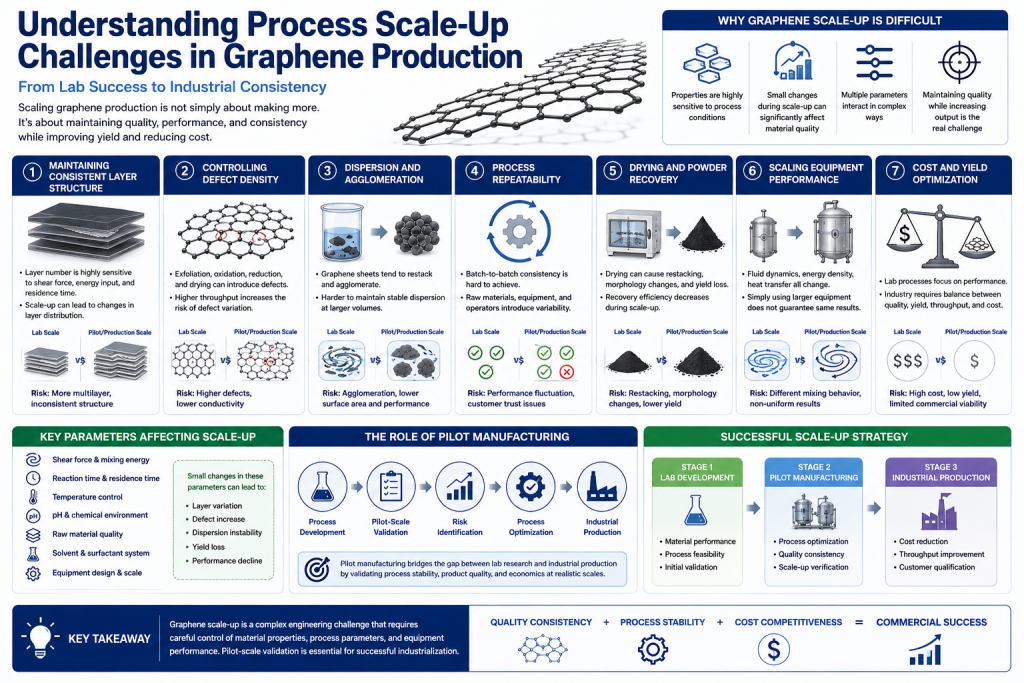
Why Graphene Scale-Up Is Difficult
Unlike conventional bulk materials, graphene is a nanomaterial whose properties are highly sensitive to processing conditions.
Small changes in manufacturing parameters can affect:
- Layer number
- Sheet size
- Surface chemistry
- Defect density
- Conductivity
- Dispersion behavior
As production volume increases, maintaining these properties becomes increasingly challenging.
Scale-up is therefore not simply a matter of producing more material.
It is a process of maintaining quality while increasing output.
Challenge 1: Maintaining Consistent Layer Structure
One of the most important graphene characteristics is layer number.
Applications may require:
- Monolayer graphene
- Few-layer graphene
- Multilayer graphene
During laboratory production, layer control is often achievable.
At larger scales, however:
- Shear forces change
- Residence times vary
- Energy distribution becomes less uniform
These factors can significantly affect final graphene structure.
As a result, material produced at pilot scale may differ substantially from laboratory samples.
Challenge 2: Controlling Defect Density
Graphene performance depends heavily on defect levels.
Excessive defects can reduce:
- Electrical conductivity
- Thermal conductivity
- Mechanical strength
Many production methods introduce defects during:
- Exfoliation
- Oxidation
- Reduction
- Drying
- Milling
When throughput increases, maintaining consistent defect control becomes increasingly difficult.
Pilot testing helps identify acceptable process windows before commercial production begins.
Challenge 3: Dispersion and Agglomeration
Graphene sheets naturally tend to restack and agglomerate.
This challenge becomes more severe as production volumes increase.
Agglomeration can lead to:
- Reduced surface area
- Lower conductivity
- Poor composite performance
- Inconsistent product quality
Maintaining stable dispersion requires careful optimization of:
- Mixing methods
- Solvent systems
- Surfactants
- Process energy
For many industrial applications, dispersion quality is just as important as graphene quality itself.
Challenge 4: Process Repeatability
A laboratory process may work successfully once.
Industrial production requires the process to work hundreds or thousands of times.
Key concerns include:
- Batch-to-batch consistency
- Raw material variability
- Equipment performance
- Operator influence
Customers typically require stable specifications rather than occasional high-performance batches.
Achieving repeatability is often one of the most difficult aspects of graphene commercialization.
Challenge 5: Drying and Powder Recovery
Graphene products are often supplied as:
- Powders
- Pastes
- Dispersions
Drying and recovery processes can significantly affect material quality.
Potential issues include:
Restacking
Graphene sheets may collapse together during drying.
Morphology Changes
Particle structure may change during solvent removal.
Yield Loss
Material recovery efficiency often decreases during scale-up.
Selecting appropriate drying technologies is therefore a critical part of industrial process design.
Challenge 6: Scaling Equipment Performance
Many graphene processes rely on specialized equipment such as:
- High-shear mixers
- Ultrasonic systems
- Ball mills
- Exfoliation reactors
- Continuous flow reactors
A common mistake is assuming that larger equipment will automatically produce identical results.
In reality:
- Fluid dynamics change
- Energy density changes
- Mixing behavior changes
- Heat transfer changes
Successful scale-up requires understanding these engineering differences rather than simply increasing reactor size.
Challenge 7: Cost and Yield Optimization
Laboratory production often prioritizes performance.
Industrial production must balance:
- Product quality
- Manufacturing yield
- Production throughput
- Operating cost
A graphene product may demonstrate outstanding laboratory performance but remain commercially unviable if manufacturing costs are too high.
Pilot production helps identify the optimal balance between performance and economics.
Why Pilot Manufacturing Matters
Pilot manufacturing serves as the bridge between laboratory development and commercial production.
Pilot-scale validation allows manufacturers to evaluate:
- Process stability
- Product consistency
- Equipment suitability
- Manufacturing yield
- Production economics
Most importantly, it helps identify scale-up risks before significant investment is made in full-scale production facilities.
Building a Successful Graphene Industrialization Strategy
Successful graphene commercialization typically follows a structured pathway:
Stage 1: Laboratory Development
Focus on:
- Material performance
- Process feasibility
- Initial application validation
Stage 2: Pilot Manufacturing
Focus on:
- Process optimization
- Quality consistency
- Scale-up verification
Stage 3: Industrial Production
Focus on:
- Cost reduction
- Throughput improvement
- Customer qualification
Companies that skip pilot validation often face unexpected technical and economic challenges during commercialization.
Graphene offers enormous potential across energy storage, thermal management, coatings, composites, and advanced manufacturing.
However, the journey from laboratory innovation to industrial production is rarely straightforward.
Challenges involving layer control, defect management, dispersion, equipment scaling, process repeatability, and cost optimization must all be addressed before successful commercialization can occur.
Pilot manufacturing plays a critical role in overcoming these obstacles by providing a controlled environment for scale-up validation and process development.
For graphene producers, mastering process scale-up is often the difference between a promising material and a successful business.