
Key Challenges in Slurry Mixing and Dispersion for Battery Manufacturing
In lithium-ion battery manufacturing, attention is often focused on active materials, energy density, and cell design.
However, many production challenges begin much earlier—during slurry preparation.
Before coating, drying, and cell assembly can occur, battery materials must first be transformed into a stable and homogeneous slurry.
The quality of this slurry directly influences:
- Electrode uniformity
- Conductive network formation
- Coating performance
- Cell consistency
- Manufacturing yield
For advanced materials such as graphene, carbon nanotubes (CNTs), silicon-based anodes, and high-loading cathodes, slurry mixing and dispersion have become some of the most critical steps in modern battery production.
Why Slurry Quality Matters
A battery electrode is not simply a mixture of powders.
It is a carefully engineered structure composed of:
- Active materials
- Conductive additives
- Binders
- Solvents
These components must be distributed uniformly throughout the electrode.
Poor slurry quality can lead to:
- Capacity variation
- Increased resistance
- Coating defects
- Reduced cycle life
- Production instability
Even the most advanced materials cannot deliver their full performance if dispersion quality is inadequate.
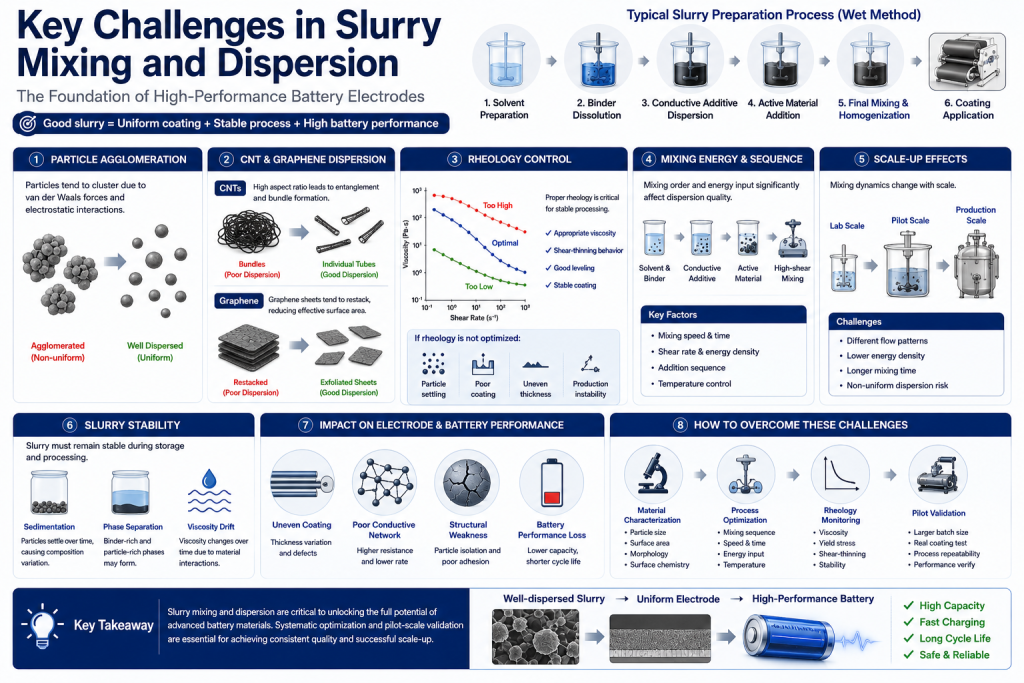
Challenge 1: Particle Agglomeration
One of the most common problems in slurry preparation is agglomeration.
Fine particles naturally tend to cluster together due to:
- Van der Waals forces
- Electrostatic interactions
- Surface energy effects
This challenge is particularly severe for:
- Graphene
- CNTs
- Nano-silicon
- Carbon nanofibers
Agglomerates create localized non-uniformities that can negatively affect both conductivity and electrode structure.
Challenge 2: CNT and Graphene Dispersion
Advanced carbon materials offer exceptional performance benefits.
However, they are also among the most difficult materials to disperse.
Carbon Nanotubes (CNTs)
CNTs possess extremely high aspect ratios.
While this property helps form conductive networks, it also causes:
- Entanglement
- Bundle formation
- Viscosity increase
Improper dispersion often prevents CNTs from forming effective conductive pathways.
Graphene
Graphene sheets tend to restack during processing.
As a result:
- Surface area decreases
- Conductivity advantages diminish
- Composite performance becomes inconsistent
Achieving stable graphene dispersion remains one of the biggest challenges in industrial applications.
Challenge 3: Rheology Control
Dispersion alone is not enough.
The slurry must also exhibit suitable rheological behavior.
Important parameters include:
Viscosity
Too low:
- Particle settling
- Poor coating stability
Too high:
- Difficult pumping
- Coating defects
- Excessive energy consumption
Shear-Thinning Behavior
Battery slurries typically require shear-thinning characteristics.
This allows:
- Easier mixing
- Smooth coating
- Stable wet film formation
Improper rheology often leads to coating problems later in the process.
Challenge 4: Mixing Energy and Sequence
The order in which materials are introduced can significantly affect slurry quality.
A typical process may involve:
- Solvent preparation
- Binder dissolution
- Conductive additive dispersion
- Active material addition
- Final homogenization
Changing this sequence can alter:
- Viscosity
- Particle distribution
- Conductive network formation
The optimal mixing protocol often varies depending on the material system.
Challenge 5: Scale-Up Effects
Many slurry formulations perform well in laboratory mixers but fail during pilot production.
The reason is that mixing dynamics change dramatically with scale.
Factors affected include:
- Shear rate
- Energy density
- Residence time
- Flow pattern
As production volume increases, maintaining equivalent dispersion conditions becomes increasingly difficult.
This is one of the primary reasons why pilot-scale validation is essential.
Challenge 6: Slurry Stability
A good slurry must remain stable not only during mixing but also during storage and processing.
Potential issues include:
Sedimentation
Heavy particles settle over time.
This results in:
- Composition variation
- Coating inconsistency
- Capacity fluctuation
Phase Separation
Binder-rich and particle-rich regions may form.
This negatively affects electrode structure and adhesion.
Viscosity Drift
Slurry properties may change over time due to:
- Particle interactions
- Solvent evaporation
- Polymer behavior
Monitoring slurry stability is critical for production reliability.
How Pilot Manufacturing Helps
Pilot-scale manufacturing provides a bridge between laboratory formulation and industrial production.
Pilot testing enables engineers to evaluate:
- Dispersion effectiveness
- Mixing protocols
- Rheological stability
- Coating behavior
- Process repeatability
Rather than relying solely on laboratory data, manufacturers can observe how materials behave under realistic production conditions.
Best Practices for Slurry Optimization
Successful slurry preparation typically requires:
Material Characterization
Understand:
- Particle size distribution
- Surface area
- Morphology
- Surface chemistry
Process Optimization
Optimize:
- Mixing sequence
- Mixing speed
- Mixing time
- Temperature control
Rheology Monitoring
Measure:
- Viscosity
- Yield stress
- Shear-thinning behavior
- Stability over time
Pilot Validation
Verify performance under:
- Larger batch sizes
- Real coating conditions
- Industrial processing equipment
Conclusion
Slurry mixing and dispersion represent one of the most important—and often underestimated—steps in battery manufacturing.
For advanced materials such as graphene, CNTs, silicon composites, and next-generation battery formulations, achieving uniform dispersion and stable rheology is essential for translating material performance into commercial success.
As battery technologies become more sophisticated, mastering slurry engineering will become increasingly important for manufacturers seeking higher performance, better consistency, and successful industrial scale-up.