

How Coating Uniformity Affects Battery Performance
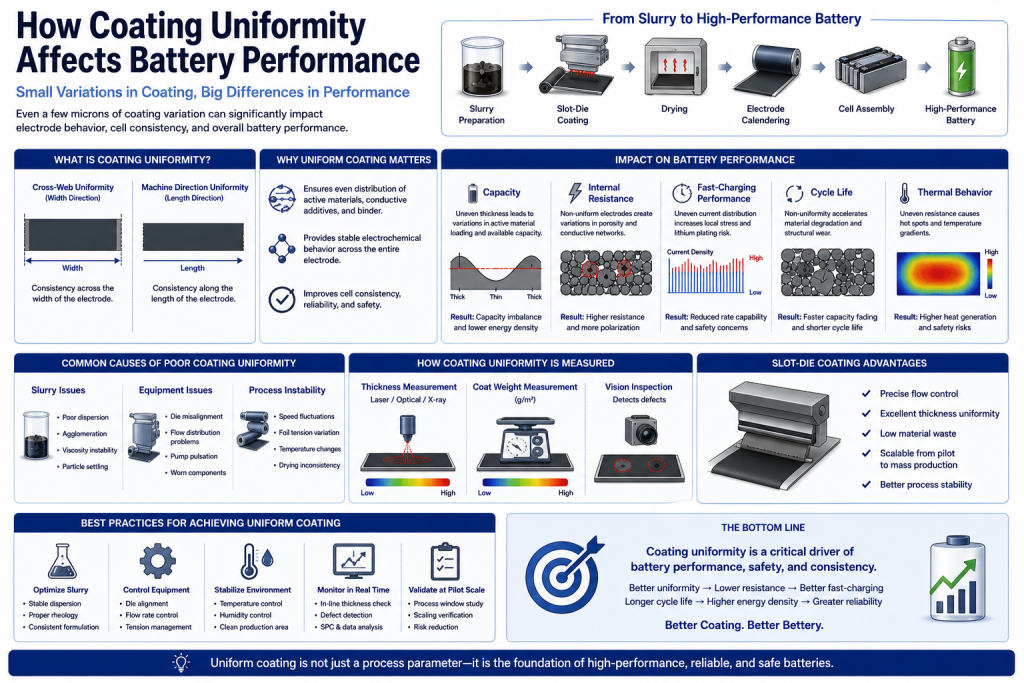
In lithium-ion battery manufacturing, attention is often focused on active materials, cell chemistry, and energy density.
However, one of the most critical factors influencing battery performance is often overlooked:
Coating uniformity.
No matter how advanced the materials are, poor electrode coating can significantly reduce battery performance, consistency, and reliability.
A variation of only a few microns in coating thickness can affect:
- Capacity
- Internal resistance
- Fast-charging behavior
- Cycle life
- Safety performance
This is why coating quality has become one of the most important control points in modern battery production.
What Is Coating Uniformity?
Coating uniformity refers to how consistently electrode slurry is distributed across the current collector.
Uniformity is typically evaluated in two directions:
Cross-Web Uniformity
Thickness consistency across the width of the electrode.
Poor cross-web uniformity creates:
- Edge effects
- Current density variation
- Capacity imbalance
Machine Direction Uniformity
Thickness consistency along the length of the coated electrode.
Variations in this direction can lead to:
- Cell-to-cell inconsistency
- Capacity fluctuation
- Production yield losses
Both forms of uniformity are essential for high-quality battery manufacturing.
Why Uniform Coating Matters
A lithium-ion battery electrode functions as an electrochemical reaction platform.
For optimal performance:
- Active materials
- Conductive additives
- Binders
must be distributed evenly throughout the electrode.
When coating thickness varies, electrochemical behavior becomes uneven.
The result is inconsistent battery performance.
Impact on Battery Capacity
The amount of active material coated onto the electrode directly determines available capacity.
Thick Areas
May contain:
- More active material
- Higher local capacity
Thin Areas
May contain:
- Less active material
- Lower local capacity
As a result, different regions of the electrode contribute unevenly during charge and discharge.
This reduces overall cell efficiency and consistency.
Impact on Internal Resistance
Non-uniform coating often creates differences in:
- Porosity
- Conductive network structure
- Electrode density
These variations affect electron and ion transport pathways.
Consequences include:
- Higher impedance
- Increased polarization
- Reduced power capability
The effect becomes particularly significant during high-rate charging and discharging.
Impact on Fast-Charging Performance
Fast charging places extreme demands on electrode uniformity.
Current distribution must remain balanced throughout the electrode.
When coating thickness varies:
- Some regions receive higher current density
- Localized heating may occur
- Lithium plating risk increases
These effects can accelerate degradation and reduce battery lifespan.
For EV applications, maintaining coating uniformity is essential for achieving reliable fast-charging performance.
Impact on Cycle Life
Over hundreds or thousands of charge-discharge cycles, small coating variations become amplified.
Non-uniform electrodes often experience:
- Uneven expansion and contraction
- Local stress concentration
- Microcrack formation
- Accelerated active material degradation
This leads to faster capacity fading and reduced cycle life.
Impact on Thermal Behavior
Battery heat generation is closely related to current distribution.
When coating is inconsistent:
- Resistance varies locally
- Heat generation becomes uneven
- Hot spots may develop
Temperature differences across the cell can contribute to:
- Faster aging
- Reduced efficiency
- Increased safety risks
This is especially important for large-format EV and ESS batteries.
Common Causes of Poor Coating Uniformity
Several process factors can contribute to coating defects.
Slurry Issues
- Poor dispersion
- Agglomeration
- Viscosity instability
- Particle settling
Coating Equipment Issues
- Die misalignment
- Flow distribution problems
- Pump pulsation
- Worn coating components
Process Instability
- Speed fluctuations
- Foil tension variation
- Temperature changes
- Drying inconsistencies
Each factor can influence final electrode quality.
Measuring Coating Uniformity
Modern battery manufacturing uses multiple inspection techniques.
Thickness Measurement
Evaluates coating thickness across the electrode.
Common tools include:
- Laser sensors
- Optical scanners
- X-ray systems
Coat Weight Measurement
Measures deposited material mass per unit area.
Provides direct information about active material loading consistency.
Vision Inspection
Detects:
- Streaks
- Voids
- Edge defects
- Surface irregularities
These systems help identify issues before cells are assembled.
The Role of Slot-Die Coating
Among modern coating technologies, slot-die coating offers excellent uniformity control.
Advantages include:
- Precise flow regulation
- Consistent wet film formation
- Reduced material waste
- Scalability from pilot lines to mass production
However, achieving optimal results still requires careful control of:
- Slurry rheology
- Flow rate
- Coating speed
- Die gap
- Environmental conditions
Why Pilot Lines Are Essential
Many coating issues do not appear during laboratory testing.
Pilot lines provide a realistic manufacturing environment where engineers can evaluate:
- Coating stability
- Wet film behavior
- Drying characteristics
- Equipment compatibility
- Process repeatability
Pilot-scale validation helps identify problems before large-scale production begins.
This significantly reduces technical and financial risk.
Best Practices for Improving Coating Uniformity
Successful battery manufacturers typically focus on:
Optimized Slurry Preparation
- Stable dispersion
- Controlled viscosity
- Consistent formulation
Equipment Calibration
- Die alignment verification
- Flow rate monitoring
- Tension control
Environmental Control
- Temperature stability
- Humidity control
- Consistent drying conditions
In-Line Inspection
- Real-time thickness measurement
- Defect monitoring
- Statistical process control
Together, these measures improve both product quality and manufacturing yield.
Conclusion
Coating uniformity is one of the most important factors influencing lithium-ion battery performance.
It affects:
- Capacity
- Internal resistance
- Fast-charging capability
- Thermal behavior
- Cycle life
- Manufacturing consistency
As battery technologies continue to advance, achieving highly uniform electrode coatings will remain essential for producing safe, reliable, and high-performance energy storage systems.
For manufacturers developing next-generation batteries, coating uniformity is not simply a process parameter—it is a critical driver of product quality and commercial success.