
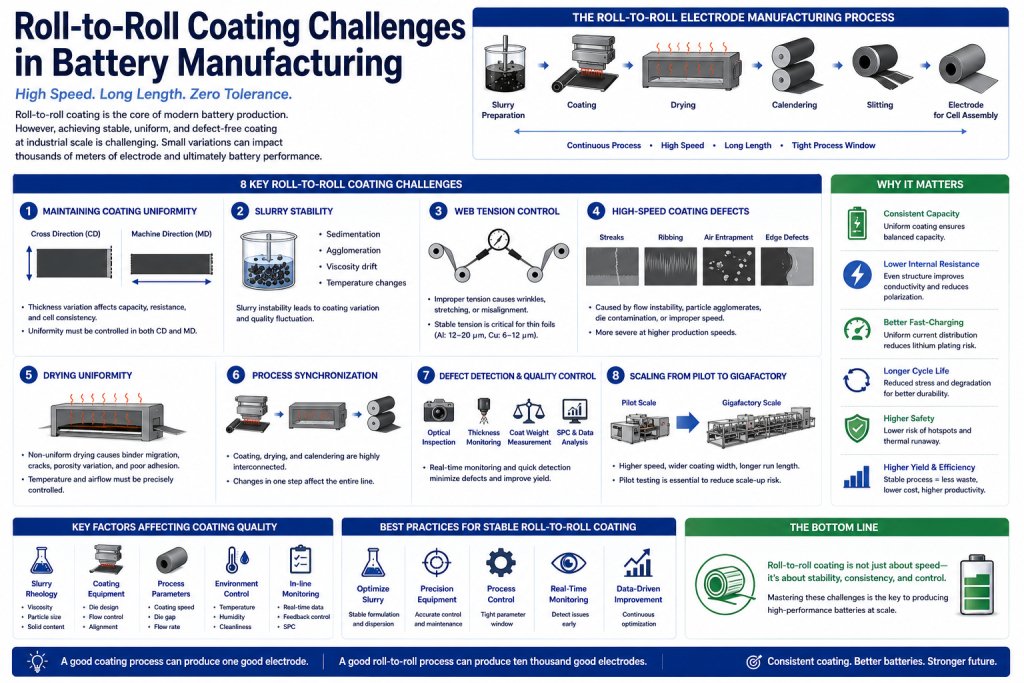
Roll-to-Roll Coating Challenges in Battery Manufacturing
Modern lithium-ion battery production relies heavily on roll-to-roll (R2R) coating technology.
From electric vehicle batteries to large-scale energy storage systems, millions of square meters of electrode materials are coated every year using continuous manufacturing processes.
Roll-to-roll coating offers significant advantages:
- High throughput
- Consistent quality
- Reduced production costs
- Scalability for mass manufacturing
However, achieving stable and uniform coating at industrial speeds is far more challenging than laboratory-scale coating.
Even small process variations can lead to defects that affect battery performance, yield, and production efficiency.
Understanding these challenges is essential for successful battery manufacturing and scale-up.
What Is Roll-to-Roll Coating?
Roll-to-roll coating is a continuous manufacturing process where electrode slurry is applied onto a moving current collector foil.
The coated foil then passes through:
- Wet film formation
- Drying
- Calendering
- Slitting
- Cell assembly
Because the substrate moves continuously through the production line, process stability becomes critically important.
A small disturbance can affect hundreds or even thousands of meters of electrode material.
Why Roll-to-Roll Coating Is More Difficult Than Laboratory Coating
Laboratory coating systems typically operate:
- At low speeds
- Over short lengths
- Under controlled conditions
Industrial roll-to-roll production introduces additional complexity:
- Long production runs
- Continuous operation
- High coating speeds
- Large material volumes
As a result, new challenges emerge that are rarely visible in laboratory environments.
Challenge 1: Maintaining Coating Uniformity
One of the biggest challenges in roll-to-roll coating is achieving consistent coating thickness.
Variations may occur across:
Machine Direction (MD)
Along the length of the electrode.
Cross Direction (CD)
Across the width of the electrode.
Even small thickness variations can result in:
- Capacity differences
- Resistance variation
- Cell imbalance
- Reduced yield
Maintaining uniform coating over thousands of meters requires precise control of both equipment and process conditions.
Challenge 2: Slurry Stability During Long Production Runs
Battery slurries are complex mixtures containing:
- Active materials
- Conductive additives
- Binders
- Solvents
During long production campaigns, slurries may experience:
- Sedimentation
- Agglomeration
- Viscosity drift
- Temperature changes
These effects can gradually alter coating behavior and product quality.
Continuous monitoring and proper slurry management are therefore essential.
Challenge 3: Web Tension Control
Current collector foils are extremely thin.
Typical thicknesses include:
- Aluminum foil: 12–20 μm
- Copper foil: 6–12 μm
During roll-to-roll processing, improper tension can cause:
- Wrinkles
- Stretching
- Misalignment
- Coating defects
Maintaining stable web tension throughout the entire production line is critical for coating accuracy and process stability.
Challenge 4: High-Speed Coating Defects
As coating speed increases, process sensitivity also increases.
Common defects include:
Streaks
Often caused by:
- Particle agglomerates
- Die contamination
- Flow disturbances
Ribbing
Periodic thickness variations caused by unstable coating flow.
Air Entrapment
Occurs when coating speed exceeds stable operating conditions.
Edge Defects
Uneven coating behavior near foil edges.
These issues become increasingly difficult to control at commercial production speeds.
Challenge 5: Drying Uniformity
After coating, the wet electrode enters the drying section.
Drying appears simple but is actually one of the most complex stages in electrode manufacturing.
Improper drying may cause:
- Binder migration
- Crack formation
- Porosity variation
- Adhesion problems
Temperature distribution, airflow design, and solvent evaporation rates must be carefully optimized.
Challenge 6: Process Synchronization
Roll-to-roll manufacturing is an interconnected process.
Changes in one section affect the entire line.
Examples include:
- Coating speed changes affecting drying performance
- Tension adjustments influencing coating quality
- Drying conditions affecting calendering behavior
Successful production requires synchronization between all processing stages.
Challenge 7: Defect Detection and Quality Control
Because production is continuous, defects must be identified quickly.
Modern battery manufacturing increasingly relies on:
Optical Inspection Systems
Used to detect:
- Streaks
- Voids
- Surface defects
Thickness Monitoring
Provides real-time coating measurements.
Coat Weight Measurement
Ensures consistent active material loading.
Statistical Process Control (SPC)
Tracks process stability over time.
Early defect detection minimizes scrap and improves manufacturing efficiency.
Challenge 8: Scaling from Pilot Lines to Gigafactories
A coating process that works on a pilot line may not automatically succeed at gigafactory scale.
Challenges include:
- Higher production speeds
- Wider coating widths
- Longer production runs
- Increased throughput requirements
Pilot manufacturing helps identify these scale-up issues before major investments are made.
This is one reason why pilot lines remain a critical step in battery industrialization.
How Pilot Lines Help Solve Roll-to-Roll Challenges
Pilot-scale manufacturing allows engineers to evaluate:
- Slurry behavior
- Coating stability
- Drying performance
- Tension control
- Process repeatability
Pilot testing also provides valuable data for:
- Equipment selection
- Process optimization
- Customer qualification
- Scale-up planning
By identifying problems early, pilot lines reduce both technical and financial risk.
Best Practices for Stable Roll-to-Roll Coating
Successful battery manufacturers typically focus on:
Stable Slurry Formulation
- Consistent dispersion
- Controlled rheology
- Reduced agglomeration
Precision Coating Equipment
- Accurate flow control
- Die alignment
- Uniform pressure distribution
Environmental Control
- Temperature stability
- Humidity control
- Cleanroom operation
Real-Time Monitoring
- Thickness inspection
- Defect detection
- Process analytics
Together, these practices improve product consistency and manufacturing efficiency.
Roll-to-roll coating is the foundation of modern battery electrode manufacturing.
While the process enables large-scale production, it also introduces significant technical challenges involving coating uniformity, slurry stability, web handling, drying, and process control.
Successfully managing these variables is essential for producing high-performance batteries with consistent quality and competitive manufacturing costs.
As battery production continues to scale globally, mastering roll-to-roll coating technology will remain one of the most important capabilities in advanced battery manufacturing.