
Graphene Anticorrosion Coatings for Metal Protection
Corrosion remains one of the most costly challenges facing modern industry.
Metal degradation affects:
- Infrastructure
- Marine equipment
- Oil and gas facilities
- Energy storage systems
- Transportation equipment
- Industrial machinery
According to industry estimates, corrosion-related damage costs the global economy hundreds of billions of dollars each year through maintenance, repairs, downtime, and equipment replacement.
As industries seek longer-lasting and more sustainable protection solutions, graphene-enhanced anticorrosion coatings have emerged as a promising technology.
By combining exceptional barrier properties with advanced coating systems, graphene offers new opportunities to improve metal durability and extend service life in demanding environments.
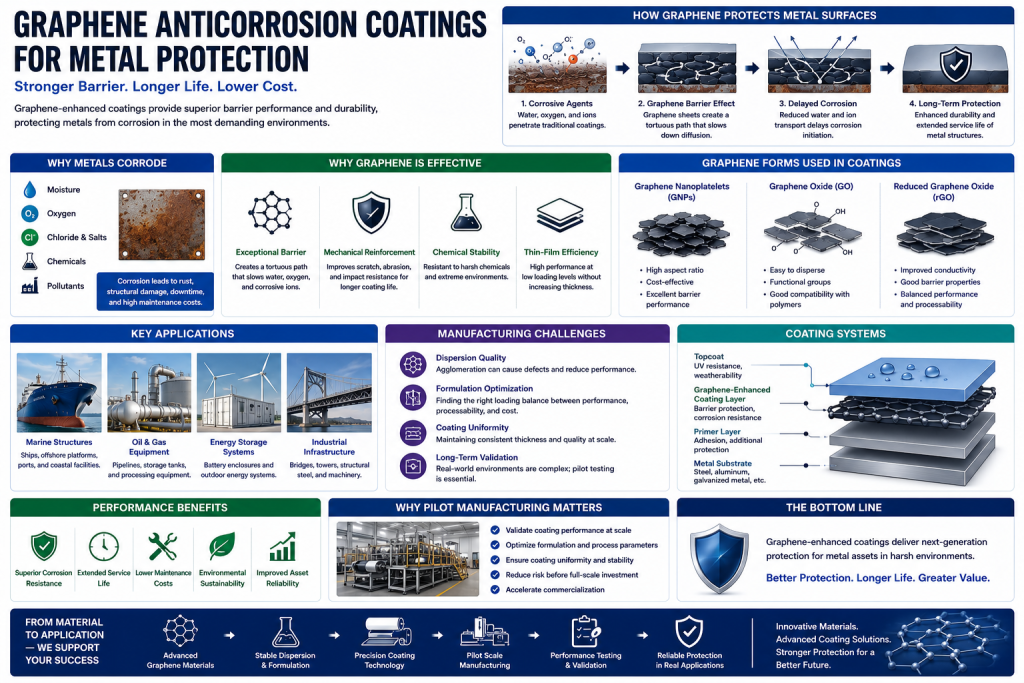
Why Metals Corrode
Corrosion is an electrochemical process that occurs when metals react with their surrounding environment.
Common causes include:
- Moisture
- Oxygen
- Salt exposure
- Chemicals
- Industrial pollutants
Over time, these reactions can result in:
- Rust formation
- Structural weakening
- Surface degradation
- Reduced equipment lifespan
Protective coatings serve as the first line of defense against these corrosive environments.
The Role of Anticorrosion Coatings
Traditional protective coatings work by creating a barrier between the metal surface and the surrounding environment.
Common coating technologies include:
- Epoxy coatings
- Polyurethane coatings
- Zinc-rich primers
- Ceramic coatings
While these systems can provide effective protection, long-term performance may be limited by:
- Microcracks
- Water penetration
- Mechanical damage
- Coating degradation
This is where graphene can offer significant advantages.
Why Graphene Is Attractive for Corrosion Protection
Graphene possesses several properties that make it an interesting additive for protective coatings.
Exceptional Barrier Performance
Graphene sheets create a highly tortuous path that slows the penetration of:
- Water
- Oxygen
- Corrosive ions
As a result, moisture and corrosive species require significantly longer pathways to reach the metal substrate.
Mechanical Reinforcement
Graphene can improve:
- Scratch resistance
- Abrasion resistance
- Coating durability
This helps maintain coating integrity under harsh operating conditions.
Chemical Stability
Graphene exhibits excellent chemical resistance, making it suitable for demanding industrial environments.
Thin-Film Efficiency
Because graphene is extremely thin, relatively low loading levels can influence coating performance without significantly increasing coating thickness.
How Graphene Works Inside a Coating
Graphene is rarely used as a standalone protective layer.
Instead, it is incorporated into coating systems such as:
- Epoxy coatings
- Polyurethane coatings
- Acrylic coatings
- Hybrid composite coatings
Within these systems, graphene acts as a barrier-enhancing component.
The coating structure becomes more difficult for corrosive agents to penetrate.
This mechanism is often referred to as the tortuous path effect.
As a result:
- Water diffusion slows
- Oxygen transport decreases
- Corrosion initiation is delayed
Common Graphene Forms Used in Protective Coatings
Several graphene-related materials are used in anticorrosion applications.
Graphene Nanoplatelets (GNPs)
Widely used due to:
- Good scalability
- Cost-effectiveness
- Barrier performance
Graphene Oxide (GO)
Provides:
- Easier dispersion
- Functional surface chemistry
- Improved compatibility with certain polymers
Reduced Graphene Oxide (rGO)
Offers a balance between:
- Conductivity
- Barrier properties
- Processability
Selection depends on coating formulation and performance requirements.
Key Applications
Graphene anticorrosion coatings are being evaluated across multiple industries.
Marine Structures
Used for:
- Ships
- Offshore platforms
- Port infrastructure
where saltwater exposure creates severe corrosion challenges.
Oil and Gas Equipment
Potential applications include:
- Pipelines
- Storage tanks
- Processing equipment
requiring long-term corrosion resistance.
Energy Storage Systems
Battery enclosures and outdoor energy storage equipment benefit from enhanced environmental protection.
Industrial Infrastructure
Applications include:
- Bridges
- Towers
- Structural steel
- Manufacturing equipment
where maintenance costs can be significant.
Manufacturing Challenges
Although graphene offers substantial potential, successful implementation requires overcoming several technical challenges.
Dispersion Quality
Poor dispersion can create:
- Agglomerates
- Coating defects
- Performance inconsistencies
Uniform distribution is critical.
Formulation Optimization
Graphene loading levels must be carefully balanced.
Excessive loading may increase:
- Viscosity
- Processing difficulty
- Manufacturing cost
Coating Uniformity
Consistent film formation is essential for reliable protection.
Scale-up often requires:
- Controlled rheology
- Precision coating methods
- Process optimization
Long-Term Validation
Accelerated laboratory testing is useful but may not fully predict field performance.
Pilot-scale and field evaluations remain important for commercial adoption.
Why Pilot Manufacturing Matters
Many graphene coating formulations perform well in laboratory testing.
However, industrial success depends on more than laboratory results.
Pilot-scale coating validation helps evaluate:
- Dispersion stability
- Coating quality
- Production repeatability
- Application performance
- Manufacturing economics
Pilot manufacturing provides the bridge between material innovation and commercial deployment.
Future Trends
Several factors are expected to drive growth in graphene-based anticorrosion technologies:
Longer Asset Lifetimes
Industries increasingly seek coatings that reduce maintenance frequency.
Sustainable Protection Systems
Improved durability can reduce material consumption and environmental impact.
Advanced Composite Coatings
Hybrid systems combining graphene with traditional coating technologies are gaining attention.
Infrastructure Modernization
Aging infrastructure creates ongoing demand for improved corrosion protection solutions.
Graphene-enhanced anticorrosion coatings represent a promising approach to protecting metal assets in demanding environments.
By improving barrier performance, enhancing durability, and extending service life, graphene can help address some of the most significant challenges associated with corrosion.
However, successful commercialization depends not only on graphene quality but also on formulation development, coating process optimization, pilot-scale validation, and real-world performance testing.
As coating technologies continue to evolve, graphene is expected to play an increasingly important role in next-generation corrosion protection systems.