Key Process Challenges in Graphene Coating Scale-Up
Graphene has attracted significant interest across industries due to its exceptional electrical, thermal, and mechanical properties.
Applications continue to expand in:
- Thermal management films
- Conductive coatings
- Battery electrodes
- EMI shielding materials
- Corrosion-resistant coatings
- Flexible electronics
While many graphene coatings demonstrate impressive laboratory performance, scaling these coatings from research to industrial production remains a major challenge.
A coating process that works successfully on a small laboratory substrate may behave very differently when applied continuously on a pilot or commercial manufacturing line.
Understanding these scale-up challenges is essential for successful graphene commercialization.
Why Coating Scale-Up Is Different from Material Scale-Up
Producing graphene at larger volumes is only one part of industrialization.
The next challenge is applying graphene consistently onto a substrate.
At laboratory scale:
- Small samples are coated
- Process conditions are tightly controlled
- Coating speeds are low
- Material consumption is limited
Industrial manufacturing introduces:
- Continuous production
- Larger substrate widths
- Higher coating speeds
- Long production runs
- Tight quality requirements
As production scales, coating behavior becomes increasingly sensitive to process variation.
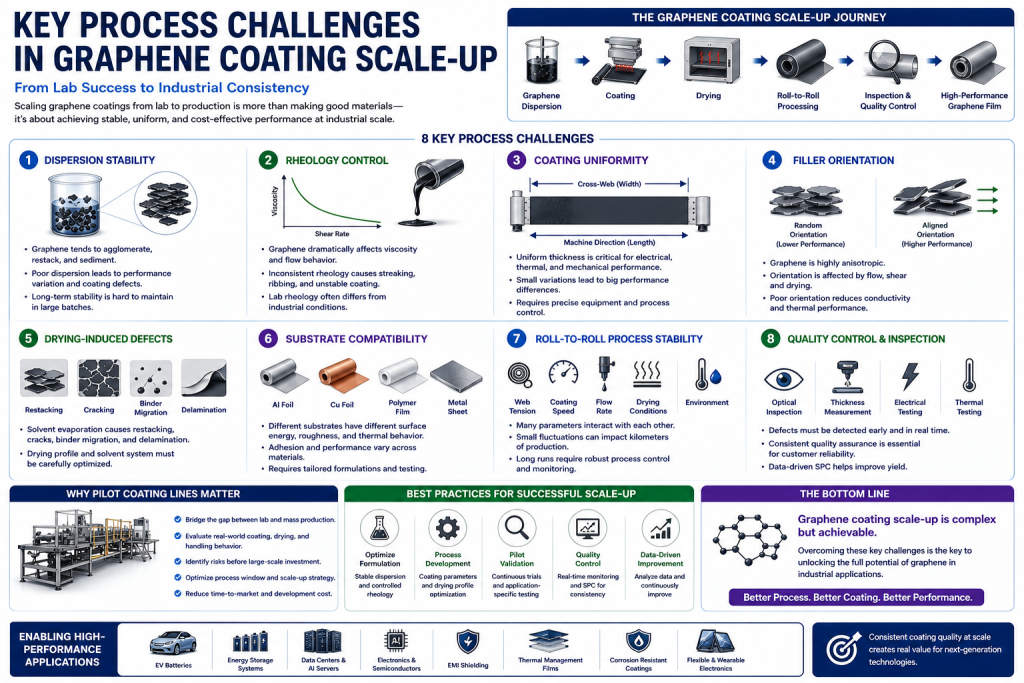
Challenge 1: Graphene Dispersion Stability
One of the most significant obstacles in graphene coating is maintaining stable dispersion.
Graphene sheets naturally tend to:
- Agglomerate
- Restack
- Sediment
Poor dispersion can lead to:
- Conductivity variation
- Surface defects
- Uneven coating thickness
- Reduced thermal performance
At larger production volumes, maintaining consistent dispersion over extended coating runs becomes particularly difficult.
Continuous agitation and optimized formulation design are often required.
Challenge 2: Rheology Control
Graphene significantly affects slurry rheology.
Even small loading levels may alter:
- Viscosity
- Yield stress
- Flow behavior
- Shear-thinning characteristics
Laboratory formulations may behave differently under industrial coating conditions.
If rheology is not properly controlled, manufacturers may encounter:
- Streaking
- Ribbing
- Edge defects
- Coating instability
Optimizing rheology is therefore one of the most important aspects of graphene coating scale-up.
Challenge 3: Coating Uniformity
Uniform coating thickness is critical for product performance.
In applications such as thermal management films or conductive coatings, small thickness variations can cause significant differences in:
- Electrical conductivity
- Thermal conductivity
- Surface resistance
- Mechanical properties
Manufacturers must control:
- Wet film thickness
- Coat weight
- Cross-web uniformity
- Longitudinal uniformity
Achieving this level of consistency often requires precision coating equipment and robust process control.
Challenge 4: Filler Orientation and Functional Performance
Unlike many conventional fillers, graphene exhibits highly directional properties.
Performance often depends on how graphene sheets align within the coating.
Improper orientation may reduce:
- Thermal conductivity
- Electrical conductivity
- Barrier performance
Scale-up introduces changes in:
- Flow fields
- Shear forces
- Drying dynamics
These changes can significantly influence filler orientation and final product performance.
Challenge 5: Drying-Induced Defects
Drying is one of the most underestimated steps in graphene coating manufacturing.
As solvents evaporate, several issues may occur:
Graphene Restacking
Sheets may collapse together, reducing effective surface area.
Binder Migration
Non-uniform binder distribution can affect adhesion and conductivity.
Crack Formation
Stress development during drying may create surface defects.
Coating Delamination
Poor adhesion can result in film failure.
Optimized drying profiles are often required to preserve coating quality.
Challenge 6: Substrate Compatibility
Graphene coatings are applied to many different substrates, including:
- Aluminum foil
- Copper foil
- Polymer films
- Flexible electronics substrates
- Metal sheets
Each substrate presents unique challenges related to:
- Surface energy
- Roughness
- Thermal expansion
- Adhesion
A formulation that works well on one substrate may perform poorly on another.
Pilot-scale testing is essential for validating compatibility.
Challenge 7: Roll-to-Roll Process Stability
Most commercial graphene coatings are manufactured using roll-to-roll processes.
Maintaining stable operation requires control of:
- Web tension
- Coating speed
- Flow rate
- Drying conditions
- Environmental factors
Small process fluctuations can affect large quantities of product.
Long production runs therefore place significant demands on process consistency.
Challenge 8: Quality Control and Inspection
As production scales, quality assurance becomes increasingly important.
Manufacturers often implement:
Optical Inspection
Detects:
- Surface defects
- Streaks
- Pinholes
- Coating irregularities
Thickness Measurement
Monitors coating consistency in real time.
Electrical Testing
Evaluates conductive performance.
Thermal Performance Testing
Verifies heat dissipation characteristics.
Real-time monitoring helps reduce scrap and improve manufacturing yield.
Why Pilot Coating Lines Matter
Pilot coating lines provide an essential bridge between laboratory development and full-scale manufacturing.
Pilot-scale validation allows engineers to evaluate:
- Dispersion stability
- Coating uniformity
- Drying behavior
- Equipment compatibility
- Production economics
Most importantly, pilot testing identifies process risks before commercial-scale investments are made.
Best Practices for Successful Graphene Coating Scale-Up
Companies that successfully industrialize graphene coatings typically focus on:
Formulation Optimization
- Stable dispersions
- Controlled rheology
- Long-term storage stability
Process Development
- Coating parameter optimization
- Drying profile development
- Quality control procedures
Pilot Validation
- Continuous production trials
- Application-specific testing
- Customer qualification samples
Data-Driven Manufacturing
- Process monitoring
- Statistical process control
- Continuous improvement
These strategies improve scalability while maintaining product performance.
Graphene coatings offer significant opportunities in thermal management, energy storage, electronics, conductive coatings, and advanced manufacturing.
However, achieving consistent performance at industrial scale requires much more than producing high-quality graphene.
Successful commercialization depends on overcoming challenges related to dispersion, rheology, coating uniformity, drying, substrate compatibility, and roll-to-roll manufacturing stability.
Pilot-scale coating validation remains one of the most effective tools for reducing risk and accelerating graphene product commercialization.
As graphene applications continue to expand, mastering coating scale-up will become increasingly important for companies seeking long-term competitive advantage.