
How to Maintain Consistency in Graphene Dispersion at Scale
Graphene dispersion is one of the most important steps in transforming graphene from a laboratory material into a commercially viable product.
Whether the final application involves:
- Conductive coatings
- Thermal management films
- Battery electrodes
- Composite materials
- Functional inks
- EMI shielding solutions
the quality of graphene dispersion directly influences product performance.
In laboratory environments, achieving a stable graphene dispersion may appear relatively straightforward.
However, maintaining the same level of dispersion quality during pilot-scale and industrial-scale production presents a significantly greater challenge.
Many graphene commercialization projects encounter difficulties not because of graphene itself, but because dispersion consistency becomes increasingly difficult to control as production volumes grow.
Why Dispersion Matters
Graphene delivers value through its unique structure.
To fully utilize its properties, graphene sheets must be distributed uniformly throughout the formulation.
Poor dispersion can lead to:
- Agglomeration
- Restacking
- Sedimentation
- Non-uniform coating performance
- Reduced conductivity
- Lower thermal performance
Even small variations in dispersion quality can significantly affect the final product.
As a result, dispersion consistency becomes a critical factor in industrial manufacturing.
The Scale-Up Challenge
A formulation that performs well in a laboratory beaker may behave very differently in a 500-liter or 1000-liter production tank.
Several factors change during scale-up:
Mixing Energy Distribution
Large vessels rarely provide the same shear conditions as laboratory mixers.
Residence Time Variations
Material experiences different mixing histories throughout larger systems.
Heat Generation
Long mixing cycles can introduce temperature changes that affect dispersion stability.
Equipment Geometry
Impeller design and vessel dimensions influence flow patterns.
These factors make scale-up considerably more complex than simply increasing batch size.
Understanding Graphene Agglomeration
Graphene sheets naturally tend to attract each other.
Strong intermolecular forces can cause:
- Sheet restacking
- Particle clustering
- Reduced effective surface area
As agglomeration increases, many of graphene’s desirable properties become less accessible.
Consequences may include:
- Lower conductivity
- Reduced thermal performance
- Poor coating quality
- Inconsistent product behavior
Preventing agglomeration is therefore one of the primary goals of dispersion engineering.
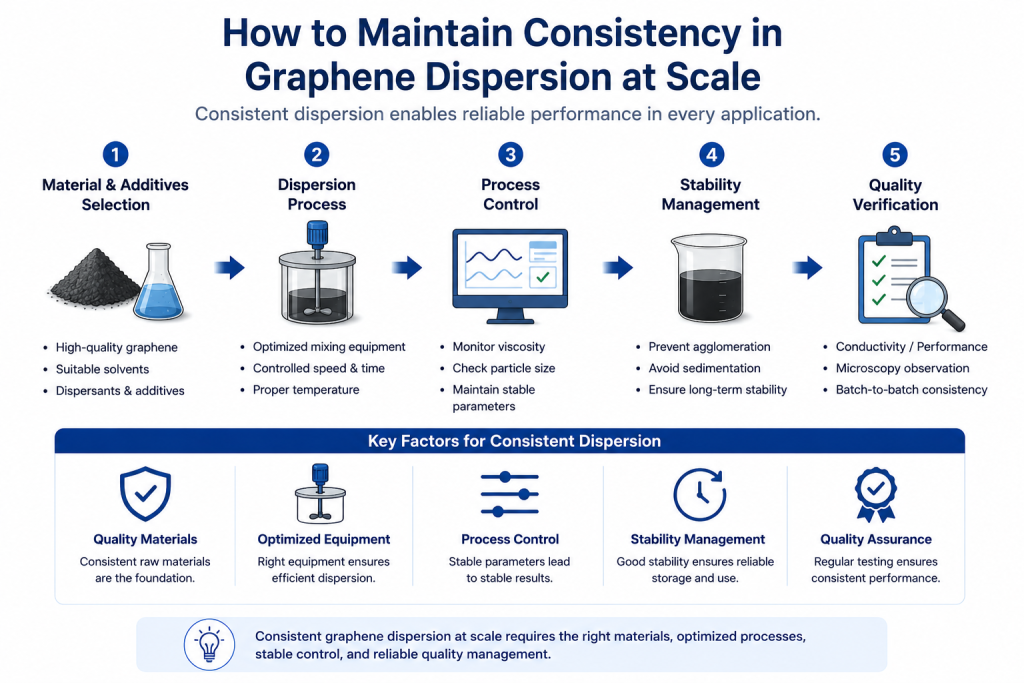
Selecting the Right Graphene Material
Consistency begins with raw material quality.
Important parameters include:
Layer Number
Variations in layer count can affect dispersion behavior.
Particle Size Distribution
Uniform particle size often improves process stability.
Surface Chemistry
Functional groups influence interactions with solvents and additives.
Purity
Impurities can alter rheology and performance.
Consistent raw materials provide the foundation for consistent dispersion.
Optimizing Dispersion Equipment
Equipment selection plays a major role in scale-up success.
Common dispersion technologies include:
High-Shear Mixers
Widely used for large-volume processing.
Rotor-Stator Systems
Providing controlled shear environments.
Ultrasonic Processing
Effective at laboratory scale but often challenging to scale economically.
Media Milling
Used when aggressive particle deagglomeration is required.
The optimal solution depends on formulation requirements and production scale.
Controlling Process Parameters
Successful graphene dispersion requires careful control of multiple variables.
Mixing Speed
Insufficient shear may leave agglomerates intact.
Excessive shear may damage graphene structures.
Mixing Time
Longer processing does not always improve dispersion.
Overprocessing can sometimes reduce performance.
Temperature
Temperature influences viscosity and dispersion stability.
Maintaining controlled conditions improves repeatability.
Solids Content
Higher concentrations often increase processing difficulty.
Optimizing solids loading helps balance productivity and quality.
The Importance of Rheology Control
Graphene significantly affects slurry rheology.
Changes in viscosity influence:
- Mixing efficiency
- Pumpability
- Coating behavior
- Storage stability
Monitoring rheological properties helps identify potential scale-up issues before they impact production.
Stable rheology often serves as an indicator of stable dispersion quality.
Preventing Sedimentation During Production
Even well-dispersed formulations may experience settling over time.
Industrial production often involves:
- Material storage
- Transfer operations
- Extended processing periods
Strategies for minimizing sedimentation include:
- Optimized particle stabilization
- Controlled viscosity
- Continuous agitation
- Proper formulation design
Maintaining homogeneity throughout production is essential for consistent product performance.
Quality Control Methods
Dispersion quality should be measured rather than assumed.
Common evaluation methods include:
Particle Size Analysis
Monitoring agglomeration levels.
Microscopy
Visualizing dispersion quality.
Electrical Conductivity Testing
Assessing conductive network formation.
Thermal Performance Testing
Evaluating heat transfer capability.
Rheological Characterization
Tracking process stability.
These tools help identify variability before it affects customers.
The Role of Pilot Production
Pilot-scale validation is one of the most effective ways to evaluate graphene dispersion consistency.
Pilot production helps engineers understand:
- Mixing scalability
- Equipment interactions
- Long-run stability
- Batch-to-batch variation
- Manufacturing repeatability
Many issues that remain hidden during laboratory development become visible during pilot-scale operation.
Addressing these challenges early reduces commercialization risk.
Common Mistakes During Scale-Up
Several mistakes frequently occur during graphene manufacturing scale-up.
Assuming Laboratory Parameters Will Scale Directly
Mixing conditions rarely scale linearly.
Focusing Only on Initial Dispersion
Long-term stability is equally important.
Ignoring Rheology Changes
Viscosity often changes significantly with batch size.
Limited Process Monitoring
Insufficient quality control increases variability risk.
Avoiding these mistakes improves production reliability.
Future Trends
As graphene commercialization continues to expand, dispersion technology is evolving.
Key developments include:
Automated Process Monitoring
Improving consistency and reducing operator dependence.
AI-Assisted Process Optimization
Supporting real-time control of dispersion parameters.
Continuous Manufacturing
Reducing batch-to-batch variation.
Advanced Characterization Tools
Providing faster assessment of dispersion quality.
These technologies are expected to improve large-scale graphene manufacturing in the coming years.
Conclusion
Maintaining consistency in graphene dispersion at scale is one of the most important challenges in graphene industrialization.
Successful scale-up requires more than increasing batch size. It demands careful control of raw materials, mixing technology, rheology, process conditions, and quality assurance.
By combining robust formulation development with pilot-scale validation and process optimization, manufacturers can achieve the consistency needed for reliable commercial production.
Ultimately, the companies that succeed in graphene commercialization will not simply be those that produce graphene—they will be those that consistently deliver stable, scalable, and repeatable graphene dispersions that perform reliably in real-world applications.