Critical Parameters for Graphene-Based Coating Pilot Trials
Graphene-based coatings are increasingly used in industrial applications such as:
- Conductive coatings
- EMI shielding films
- Thermal management layers
- Anticorrosion coatings
- Flexible electronic surfaces
While laboratory-scale coating experiments often demonstrate excellent performance, transitioning to pilot-scale production introduces significant process variability.
The success of graphene coating scale-up depends not only on material quality, but also on controlling a set of critical process parameters (CPPs) during pilot trials.
These parameters determine whether a coating system can move from laboratory validation to stable industrial manufacturing.
Why Pilot Trials Are Essential
Laboratory coating methods typically use small substrates, manual control, and highly optimized conditions.
In contrast, pilot trials introduce:
- Continuous coating processes
- Larger substrate widths
- Higher throughput requirements
- Real industrial drying conditions
- Mechanical tension and web handling
These differences often expose hidden instability in:
- Dispersion systems
- Coating uniformity
- Drying behavior
- Conductive network formation
Pilot trials are therefore essential for identifying and controlling process-sensitive parameters.
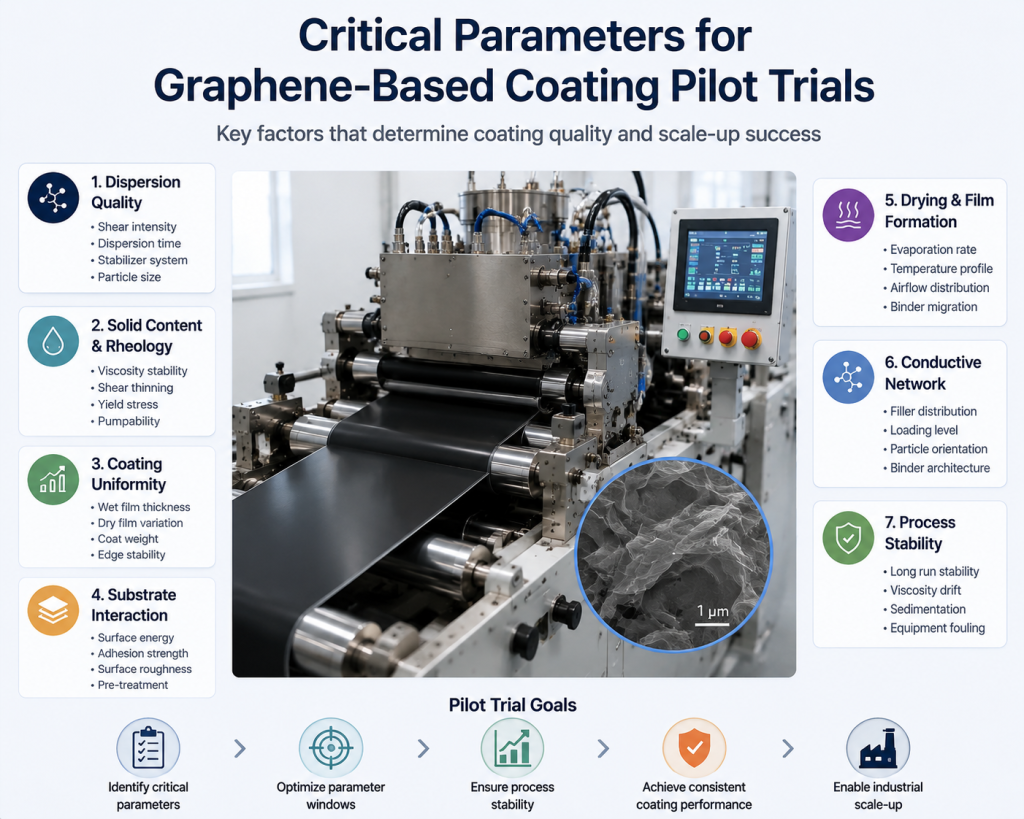
Critical Parameter 1: Graphene Dispersion Quality
Dispersion quality is the foundation of coating performance.
Poor dispersion leads to:
- Agglomeration
- Non-uniform conductivity
- Surface defects
- Weak mechanical properties
Key factors include:
- Shear intensity during mixing
- Dispersion time
- Stabilizer system selection
- Particle size distribution
- Solvent compatibility
At pilot scale, maintaining dispersion stability over long production runs becomes significantly more challenging.
Critical Parameter 2: Solid Content and Rheology
Graphene strongly affects slurry rheology.
Important parameters include:
- Viscosity stability
- Shear thinning behavior
- Yield stress control
- Pumpability
If rheology is not stable:
- Coating thickness fluctuates
- Flow instability occurs
- Edge defects increase
Rheology control is one of the most sensitive scale-up variables.
Critical Parameter 3: Coating Uniformity
Uniform coating is essential for functional performance.
Key indicators include:
- Wet film thickness consistency
- Dry film thickness variation
- Coat weight distribution
- Edge stability
Even minor variations can significantly affect:
- Electrical conductivity
- EMI shielding performance
- Thermal conductivity
Uniformity becomes harder to control as coating width increases in pilot lines.
Critical Parameter 4: Substrate Interaction
Graphene coatings interact strongly with substrates such as:
- Metals
- Polymers
- Composite films
Important factors include:
- Surface energy compatibility
- Adhesion strength
- Surface roughness
- Pre-treatment conditions
Poor substrate interaction can lead to delamination or inconsistent film formation.
Critical Parameter 5: Drying and Film Formation
Drying is often where coating defects are generated.
Key variables include:
- Evaporation rate
- Temperature gradient
- Airflow distribution
- Binder migration behavior
Improper drying can cause:
- Cracking
- Wrinkling
- Non-uniform conductive networks
Drying behavior is especially sensitive in graphene systems due to high surface area interactions.
Critical Parameter 6: Conductive Network Formation
Graphene coatings rely on percolation networks for conductivity.
Key factors include:
- Filler distribution
- Loading level
- Particle orientation
- Binder architecture
If network formation is inconsistent:
- Electrical resistance varies
- Performance becomes unstable
- Batch-to-batch variation increases
This parameter is critical for industrial acceptance.
Critical Parameter 7: Process Stability Over Time
Pilot trials are not short experiments—they are continuous processes.
Stability must be evaluated across:
- Long coating runs
- Multiple batches
- Equipment cycles
Key risks include:
- Slurry sedimentation
- Viscosity drift
- Equipment fouling
- Temperature variation
Long-term stability is often the deciding factor for scale-up success.
Role of Pilot Manufacturing in Parameter Optimization
Pilot lines provide a realistic environment to:
- Identify process bottlenecks
- Validate coating repeatability
- Optimize parameter windows
- Evaluate industrial feasibility
Unlike laboratory testing, pilot trials reveal how multiple parameters interact under real manufacturing conditions.
This interaction is often where unexpected scale-up issues emerge.
Common Scale-Up Failures
Many graphene coating projects fail at pilot stage due to:
- Over-optimized laboratory conditions that cannot scale
- Underestimated rheology sensitivity
- Poor dispersion stability over time
- Inconsistent drying profiles
- Weak process control strategy
These issues are rarely visible in small-scale experiments.
How to Improve Pilot Trial Success
Successful scale-up requires:
- Robust dispersion engineering
- Controlled rheology design
- Process parameter mapping
- Real-time monitoring
- Iterative pilot optimization
A systematic approach significantly improves the probability of successful commercialization.
Graphene-based coating pilot trials are highly sensitive to multiple interacting process parameters.
Among them, dispersion quality, rheology control, coating uniformity, drying behavior, and conductive network formation are the most critical factors.
Pilot manufacturing provides the only realistic environment to understand and optimize these variables under industrial conditions.
Successful commercialization of graphene coatings depends not only on material performance, but on the ability to control these critical parameters consistently at scale.