
Challenges in Dry Electrode Scaling and Manufacturing
Dry electrode technology has attracted significant attention as battery manufacturers seek more efficient, sustainable, and cost-effective production methods.
By reducing or eliminating the need for solvents, drying ovens, and solvent recovery systems, dry electrode processing has the potential to simplify battery manufacturing while lowering energy consumption and factory operating costs.
Despite these advantages, large-scale adoption remains a complex engineering challenge.
Producing high-quality dry electrodes consistently requires more than new materials—it demands careful process development, specialized equipment, and extensive pilot-scale validation.
Understanding these challenges is essential for companies evaluating dry electrode technologies for future battery production.
From Laboratory Success to Industrial Reality
Many dry electrode concepts demonstrate promising results in laboratory environments.
Small-scale testing can successfully produce electrodes with good electrochemical performance.
However, industrial manufacturing introduces additional requirements, including:
- Continuous production
- High throughput
- Stable product quality
- Repeatable processing
- Cost-effective operation
A process that performs well in the laboratory must also remain stable during long production runs under commercial manufacturing conditions.
Achieving Uniform Material Distribution
Unlike wet electrode manufacturing, dry processing does not use a liquid slurry to help distribute particles.
Instead, active materials, conductive additives, and binders must be blended and distributed uniformly in their dry state.
Maintaining homogeneous particle distribution becomes increasingly difficult as production volume increases.
Poor distribution may result in:
- Local conductivity variations
- Density inconsistencies
- Reduced electrode performance
- Product variability
Uniform material distribution remains one of the most important technical challenges in dry electrode manufacturing.
Binder Processing Challenges
Binder behavior differs significantly between wet and dry processes.
In wet coating, solvents help distribute binder throughout the electrode.
In dry processing, binder activation and particle bonding depend primarily on mechanical processing and process conditions.
Manufacturers must carefully optimize:
- Binder selection
- Mixing conditions
- Process temperature
- Pressure
- Material interactions
Proper binder performance is essential for achieving mechanical strength and long-term electrode stability.
Maintaining Conductive Networks
Efficient electron transport depends on well-connected conductive pathways.
Carbon nanotubes (CNTs), conductive carbon black, and other conductive additives are commonly used to establish these networks.
During dry processing, maintaining consistent conductive architectures can be challenging because particle movement differs from slurry-based systems.
Successful manufacturing requires careful control of:
- Conductive additive distribution
- Particle contact
- Compression behavior
- Electrode microstructure
Stable conductive networks are critical for battery performance.
Equipment Design and Process Control
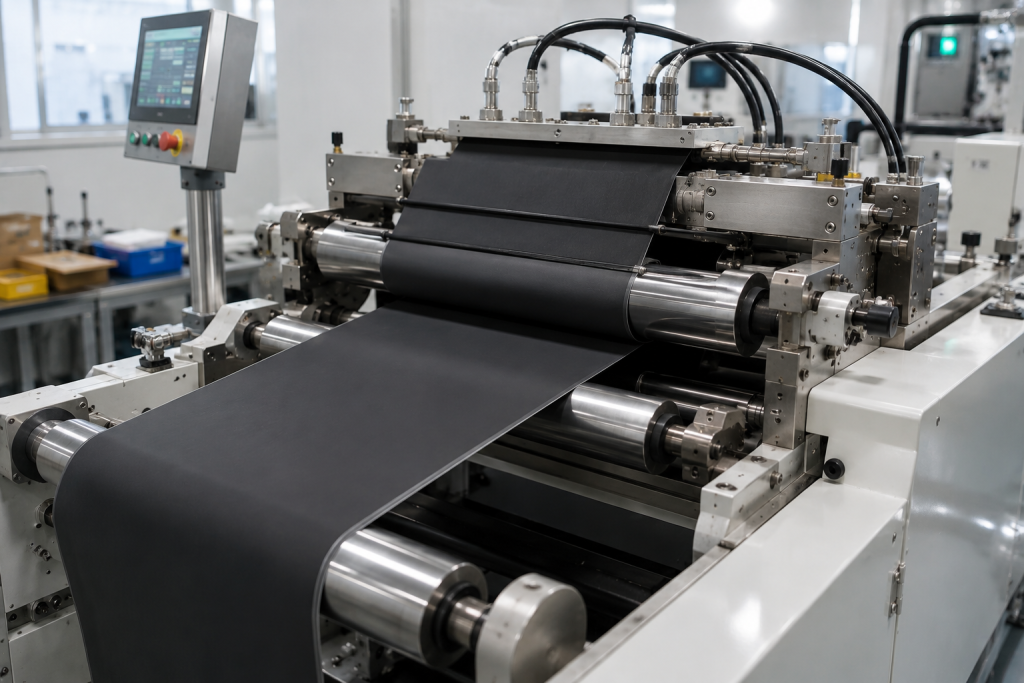
Dry electrode manufacturing often requires equipment specifically designed for powder handling and electrode formation.
Important considerations include:
Powder Feeding
Consistent material feeding helps prevent composition fluctuations.
Mixing Systems
Uniform blending is essential for product consistency.
Web Handling
Continuous transport must avoid cracking or material loss.
Compression and Lamination
Proper pressure control influences density, adhesion, and electrode integrity.
Equipment optimization is a major focus during pilot-scale development.
Controlling Electrode Structure
Electrode microstructure directly affects battery performance.
Manufacturers must carefully control:
- Thickness
- Density
- Porosity
- Surface quality
- Mechanical integrity
Small variations can influence ionic transport, electrical conductivity, and long-term cycle performance.
Achieving consistent electrode architecture at industrial scale remains an active area of process optimization.
Manufacturing Consistency
Commercial battery production requires more than high performance—it requires repeatability.
Manufacturers must consistently produce electrodes with minimal variation from batch to batch.
Key quality objectives include:
- Stable material composition
- Uniform electrode dimensions
- Consistent electrical properties
- Predictable mechanical performance
Maintaining this level of consistency becomes increasingly challenging as production capacity increases.
Quality Inspection and Process Monitoring
Reliable quality control is essential for dry electrode manufacturing.
Typical monitoring activities include:
- Thickness measurement
- Density evaluation
- Surface inspection
- Electrical resistance testing
- Mechanical strength assessment
Advanced process monitoring helps detect variations before they affect finished products.
Continuous quality verification supports higher manufacturing reliability.
Scaling Equipment from Pilot to Production
Pilot-scale equipment provides valuable insight into manufacturing behavior before full-scale investment.
Pilot production helps evaluate:
- Process stability
- Equipment compatibility
- Material handling
- Production repeatability
- Product consistency
Many scale-up issues become apparent only during extended pilot production.
Addressing these challenges early helps reduce technical and financial risks.
The Importance of Advanced Carbon Materials
Advanced carbon materials continue to play an important role in dry electrode technology.
Examples include:
Carbon Nanotubes (CNTs)
Helping establish conductive pathways throughout the electrode.
Graphene
Providing opportunities to enhance electrical conductivity and mechanical reinforcement.
Hybrid Conductive Networks
Combining multiple conductive materials to optimize performance.
As dry electrode technology advances, the integration of advanced carbon materials is expected to become increasingly important.
Future Outlook
Dry electrode manufacturing continues to evolve rapidly.
Industry trends include:
Higher Energy Density Batteries
Driving demand for improved electrode architectures.
Sustainable Manufacturing
Encouraging lower-energy production methods.
Intelligent Manufacturing
Using automation and process monitoring to improve consistency.
Pilot Manufacturing Expansion
Supporting faster validation of emerging production technologies.
Although wet electrode processing remains the dominant manufacturing approach today, dry electrode technology is expected to play an increasingly important role in future battery production.
Dry electrode technology offers significant opportunities to improve battery manufacturing efficiency, reduce energy consumption, and simplify production processes.
However, successful industrial implementation requires overcoming several scale-up challenges, including material distribution, binder processing, conductive network formation, equipment optimization, and manufacturing consistency.
Pilot-scale validation provides an essential pathway for addressing these challenges before commercial deployment.
As battery technologies continue to evolve, companies that successfully combine advanced materials with robust manufacturing processes will be best positioned to accelerate the commercialization of dry electrode production.