
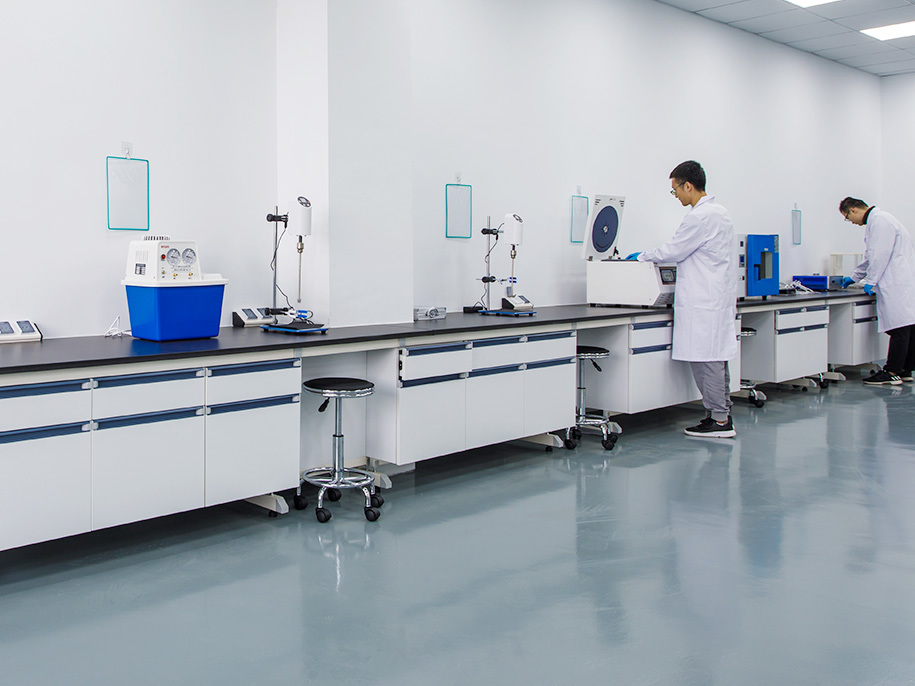
Graphene Coating Scale-Up: From Laboratory Formulation to Industrial Production
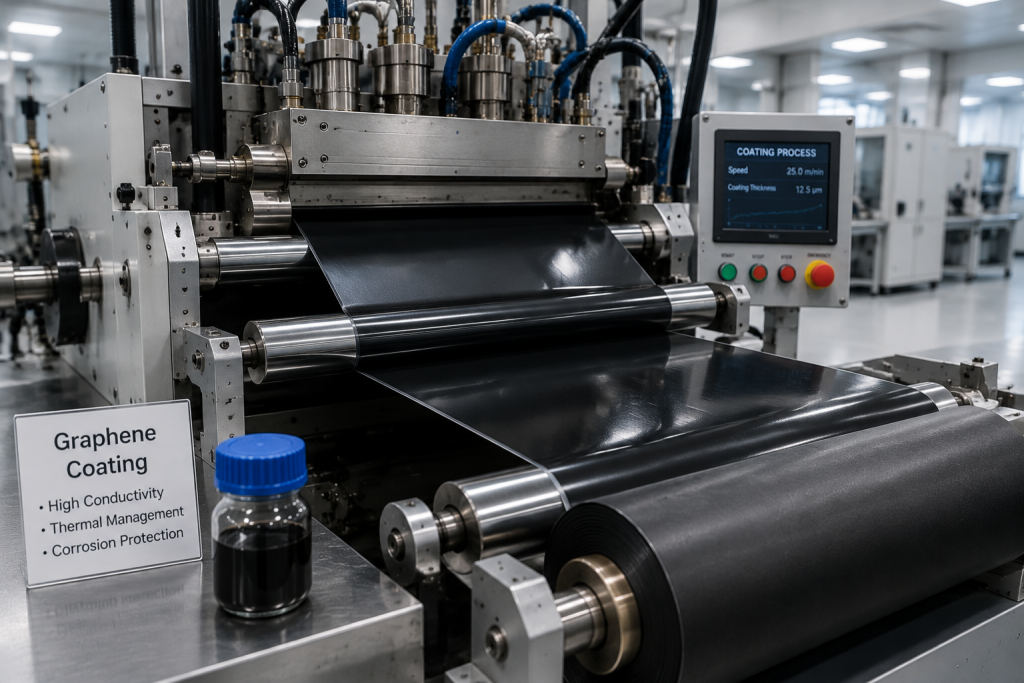
Graphene coatings have demonstrated outstanding potential in:
- Thermal management
- Conductive applications
- EMI shielding
- Anticorrosion protection
- Energy storage systems
However, moving from laboratory formulation to industrial production remains one of the biggest challenges in graphene commercialization.
A coating that performs well on a small experimental sample does not automatically translate into a stable manufacturing process.
Industrial success requires not only excellent material properties but also reliable production capability.
The Scale-Up Gap in Graphene Coatings
Laboratory development usually focuses on:
- Material selection
- Performance testing
- Small-area coating experiments
Industrial manufacturing requires additional considerations:
- Large batch preparation
- Continuous coating
- Process stability
- Quality consistency
- Cost control
The challenge is transforming a successful formula into a repeatable production system.
Challenge 1: Scaling Graphene Dispersion
The first challenge is maintaining dispersion quality.
At laboratory scale:
- Small volume
- High mixing control
- Short processing time
At industrial scale:
- Larger tanks
- Different shear distribution
- Longer storage periods
Potential issues:
- Agglomeration
- Sedimentation
- Viscosity variation
- Conductivity fluctuation
Industrial graphene coatings require robust dispersion engineering.
Challenge 2: Maintaining Rheology Control
Coating performance depends strongly on rheology.
Important parameters include:
- Viscosity
- Flow behavior
- Shear response
- Storage stability
Incorrect rheology can cause:
- Uneven coating thickness
- Surface defects
- Poor film formation
A formulation suitable for laboratory testing may require significant optimization before entering pilot production.
Challenge 3: Coating Process Adaptation
Industrial coating requires compatibility with manufacturing equipment.
Common processes include:
- Slot-die coating
- Roll-to-roll coating
- Spray coating
- Blade coating
Each process requires optimization of:
- Coating speed
- Wet thickness
- Drying conditions
- Substrate handling
The coating method becomes part of the product design.
Challenge 4: Drying and Film Formation
Drying is often underestimated during scale-up.
Industrial drying conditions affect:
- Solvent evaporation
- Binder distribution
- Graphene network formation
- Film adhesion
Poor drying control may lead to:
- Cracking
- Shrinkage
- Performance variation
Pilot trials help identify the optimal drying window.
Challenge 5: Balancing Performance and Cost
A high-performance graphene coating must also be commercially viable.
Industrial customers consider:
- Raw material cost
- Coating efficiency
- Production speed
- Equipment investment
- Product lifetime
The best solution is not always the highest graphene loading, but the most optimized system.
The Role of Pilot Manufacturing
Pilot manufacturing provides the bridge between formulation development and commercial production.
Pilot trials allow engineers to validate:
- Mixing scalability
- Coating stability
- Long-term operation
- Product consistency
- Manufacturing cost
This stage significantly reduces commercialization risk.
Quality Control in Industrial Graphene Coatings
Successful production requires measurable quality standards.
Typical evaluations include:
Material Level
- Particle size
- Dispersion stability
- Concentration control
Coating Level
- Thickness uniformity
- Surface morphology
- Adhesion
Performance Level
- Electrical conductivity
- Thermal conductivity
- Durability
Quality control transforms graphene coating from a research material into an industrial product.
Future Outlook
The future of graphene coatings depends on improving:
- Scalable dispersion technologies
- Automated coating systems
- Continuous manufacturing
- Process monitoring
- Cost-efficient formulations
As industries demand better thermal management, conductivity, and protection solutions, graphene coatings will increasingly move from laboratory research toward industrial applications.
Graphene coating commercialization is not only a materials challenge—it is a manufacturing challenge.
The transition from laboratory formulation to industrial production requires control of dispersion, rheology, coating processes, drying behavior, and quality systems.
Pilot-scale manufacturing plays a critical role in reducing uncertainty and proving that graphene coating technologies can achieve reliable, repeatable, and scalable production.
The future winners in graphene commercialization will not simply develop better graphene materials—they will build better manufacturing systems around them.