

Graphene vs CNT: Choosing the Right Carbon Material for Industrial Applications
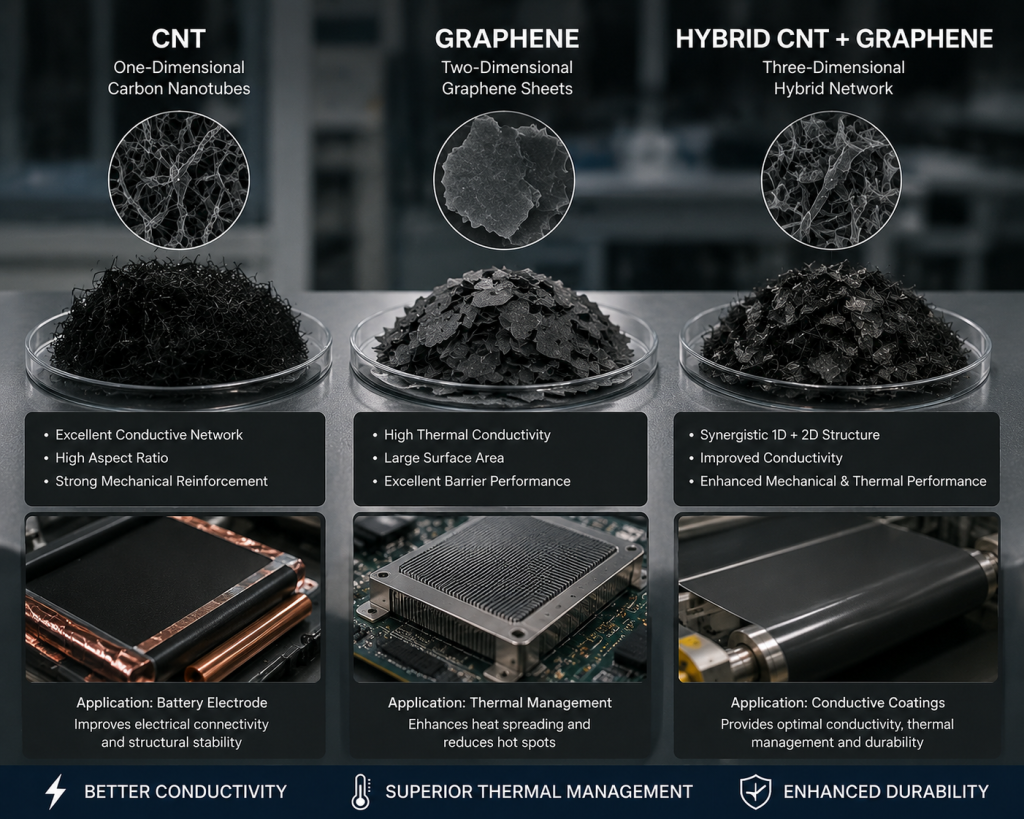
Graphene and carbon nanotubes (CNTs) are two of the most important advanced carbon materials developed in recent decades.
Both materials offer exceptional electrical conductivity, thermal performance, mechanical strength, and chemical stability.
As industries search for higher-performance materials, graphene and CNTs are increasingly being used in:
- Battery technologies
- Conductive coatings
- Thermal management systems
- Electronics
- Composite materials
- Energy applications
However, selecting between graphene and CNT is not simply a question of which material has better properties.
The right choice depends on:
- Application requirements
- Manufacturing processes
- Performance targets
- Cost considerations
- Scale-up feasibility
In many industrial applications, the best solution may not be a single material, but a carefully engineered combination of graphene and CNT.
Understanding the Structural Difference
The fundamental difference between graphene and CNT comes from their structure.
Graphene: Two-Dimensional Carbon Network
Graphene consists of a single or multiple layers of carbon atoms arranged in a two-dimensional honeycomb structure.
This structure provides:
- Large surface area
- Excellent in-plane conductivity
- Strong mechanical properties
- Outstanding thermal spreading capability
Graphene behaves like a large conductive sheet.
It is particularly effective for:
- Heat spreading
- Barrier protection
- Surface modification
- Composite reinforcement
CNT: One-Dimensional Carbon Network
Carbon nanotubes are cylindrical carbon structures with extremely high aspect ratios.
Their unique structure provides:
- Efficient conductive pathways
- Excellent mechanical reinforcement
- Network formation capability
CNTs behave like nanoscale conductive wires.
They are especially effective for:
- Electrical connection
- Percolation networks
- Conductive additives
Electrical Conductivity: Network Formation vs Surface Conductivity
Electrical performance is one of the most important reasons industries use graphene and CNT.
CNT Advantages
CNTs are highly effective at creating interconnected conductive networks.
Because of their high aspect ratio, a small amount of CNT can connect separated particles.
Applications include:
- Battery electrode conductive additives
- Polymer conductive composites
- Anti-static coatings
CNTs are particularly valuable when electrical connectivity between particles is required.
Graphene Advantages
Graphene provides large-area conductive pathways.
Its advantages include:
- Surface conductivity
- Charge transport across large areas
- Thin conductive layers
Applications include:
- Conductive coatings
- Flexible electronics
- Transparent conductive systems
Industrial Consideration
The question is not:
“Which one is more conductive?”
The better question is:
“How does the application require conductivity to be delivered?”
For particle-to-particle connection:
→ CNT often provides advantages.
For surface-level conductivity:
→ Graphene may be more suitable.
Thermal Management: Heat Transfer and Heat Spreading
Thermal management is becoming increasingly important in:
- AI servers
- Data centers
- Electric vehicles
- Power electronics
Graphene for Heat Spreading
Graphene has excellent thermal conductivity within its plane.
It can help:
- Spread heat across surfaces
- Reduce hot spots
- Improve thermal uniformity
Typical applications:
- Thermal coatings
- Heat spreading films
- Electronic components
CNT for Thermal Networks
CNTs can create interconnected thermal pathways.
Their advantages include:
- Three-dimensional network formation
- Interface enhancement
- Composite reinforcement
CNTs can support thermal transport when integrated into composite systems.
Hybrid Thermal Systems
In many cases:
Graphene provides:
Large-area heat spreading
CNT provides:
Three-dimensional connection pathways
Combining both can create more complete thermal networks.
Mechanical Reinforcement Comparison
Mechanical properties are important in:
- Composite materials
- Flexible electronics
- Protective coatings
Graphene
Graphene can improve:
- Stiffness
- Barrier properties
- Surface durability
It is useful for reinforcing thin coatings and composite structures.
CNT
CNTs provide:
- High tensile strength
- Flexible reinforcement
- Crack resistance
They are effective in improving mechanical durability.
Applications Where Graphene Has Advantages
Thermal Management Coatings
Graphene is suitable for:
- Heat dissipation coatings
- Thermal interface layers
- Electronic cooling systems
Barrier and Anticorrosion Coatings
Graphene can create protective pathways against:
- Moisture
- Oxygen
- Chemical penetration
Flexible Electronics
Its thin and flexible structure makes graphene attractive for:
- Sensors
- Conductive films
- Flexible devices
Applications Where CNT Has Advantages
Battery Conductive Additives
CNTs are widely studied for:
- Lithium-ion batteries
- Silicon anodes
- High-loading electrodes
They improve conductive network formation.
Polymer Composites
CNTs enhance:
- Electrical conductivity
- Mechanical strength
- Structural performance
Conductive Coatings
CNTs are effective where:
- Low loading is required
- Network conductivity is important
When Hybrid Graphene + CNT Systems Are Better
Many advanced industrial systems do not rely on only one carbon material.
Hybrid systems combine different structural advantages.
CNT Provides:
- Conductive bridges
- Network connectivity
- Mechanical reinforcement
Graphene Provides:
- Surface pathways
- Thermal spreading
- Barrier effects
Together they create:
- Better conductivity
- Improved thermal performance
- Enhanced mechanical stability
Manufacturing Considerations
Material performance alone does not determine industrial success.
Manufacturing compatibility is equally important.
Key factors include:
Dispersion
Both graphene and CNT tend to aggregate.
Stable dispersion technology is critical.
Formulation Design
Performance depends on:
- Material ratio
- Binder system
- Solvent selection
- Processing conditions
Coating Compatibility
Different materials may require:
- Slot-die coating
- Roll-to-roll processing
- Spray coating
- Printing technologies
The Importance of Pilot Validation
Laboratory results cannot fully represent industrial manufacturing.
Pilot trials help evaluate:
- Dispersion stability
- Coating uniformity
- Process repeatability
- Production feasibility
A material that performs well in research may fail during scale-up.
Pilot manufacturing reduces this risk.
How to Choose Between Graphene and CNT
A practical selection approach should consider:
1. Application Objective
Do you need:
- Conductivity?
- Thermal management?
- Mechanical reinforcement?
- Barrier protection?
2. Manufacturing Process
Consider:
- Mixing method
- Coating technology
- Production speed
- Equipment compatibility
3. Performance-Cost Balance
The highest-performing material is not always the best commercial solution.
Industrial products require:
- Stable supply
- Consistent quality
- Competitive cost
Future Development: Beyond Single Materials
The future of advanced carbon materials will likely move toward engineered systems.
Instead of asking:
“Graphene or CNT?”
Industrial engineers may increasingly ask:
“How can different carbon materials work together to solve specific engineering challenges?”
Future solutions will combine:
- Material science
- Process engineering
- Manufacturing optimization
- Application knowledge
Graphene and CNT are both powerful advanced carbon materials, but they solve different engineering problems.
Graphene provides:
- Large-area conductivity
- Thermal spreading
- Barrier performance
CNT provides:
- Conductive networks
- Mechanical reinforcement
- Particle connectivity
The best material choice depends on the application, manufacturing process, and commercial requirements.
For industrial applications, success comes not only from selecting advanced materials but from integrating them into reliable manufacturing systems.
The future of carbon materials will not be defined by one superior material, but by intelligently designed material systems that combine performance, scalability, and industrial practicality.