
From Pilot Line to Customer Qualification: The Road to Commercial Carbon Materials
Developing an advanced carbon material is only the beginning of the commercialization journey.
Whether the product is graphene, carbon nanotubes (CNTs), conductive additives, or functional coatings, laboratory success does not automatically lead to market adoption.
Before a new material becomes part of a customer’s production process, it must pass a series of technical and manufacturing evaluations that demonstrate consistent quality, reliable performance, and scalable production capability.
This transition—from pilot manufacturing to customer qualification—is often the most critical stage in commercializing advanced materials.
Why Customer Qualification Matters
Industrial customers are not simply purchasing a material specification.
They are investing in a manufacturing solution that must perform reliably over thousands of production hours.
Before approving a new material, customers typically evaluate:
- Product consistency
- Manufacturing stability
- Batch-to-batch repeatability
- Application performance
- Supply capability
- Technical support
Qualification reduces technical and supply-chain risks before full-scale adoption.
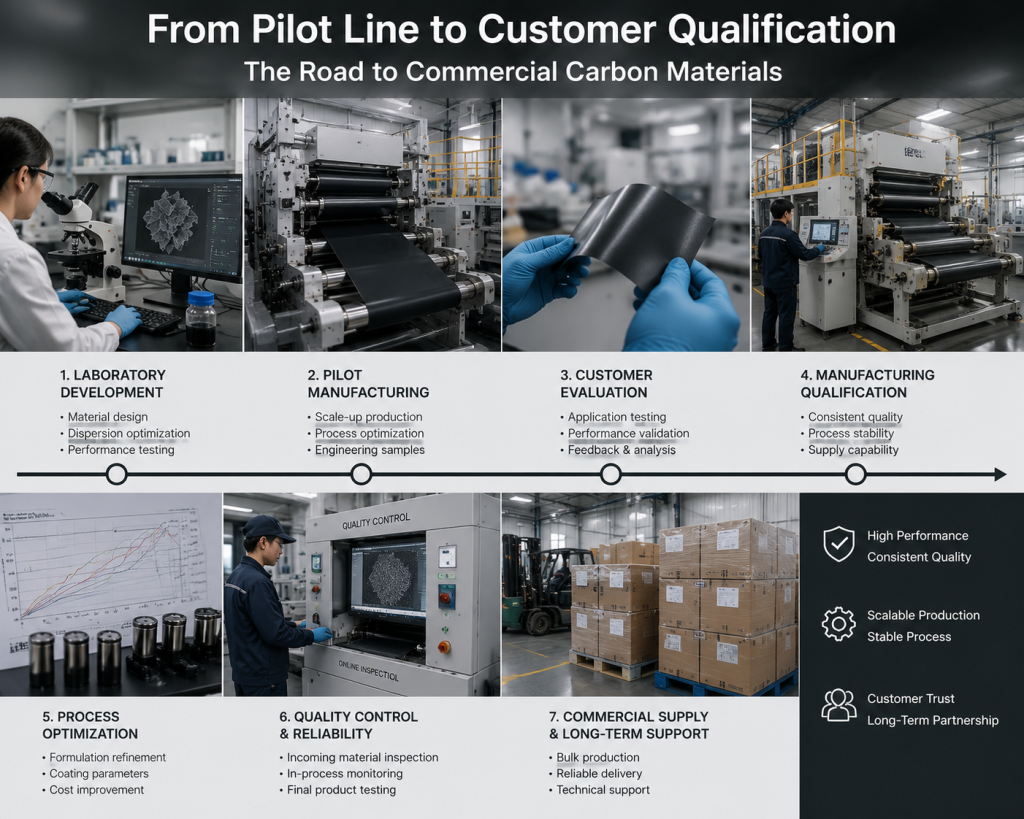
Step 1: Laboratory Validation
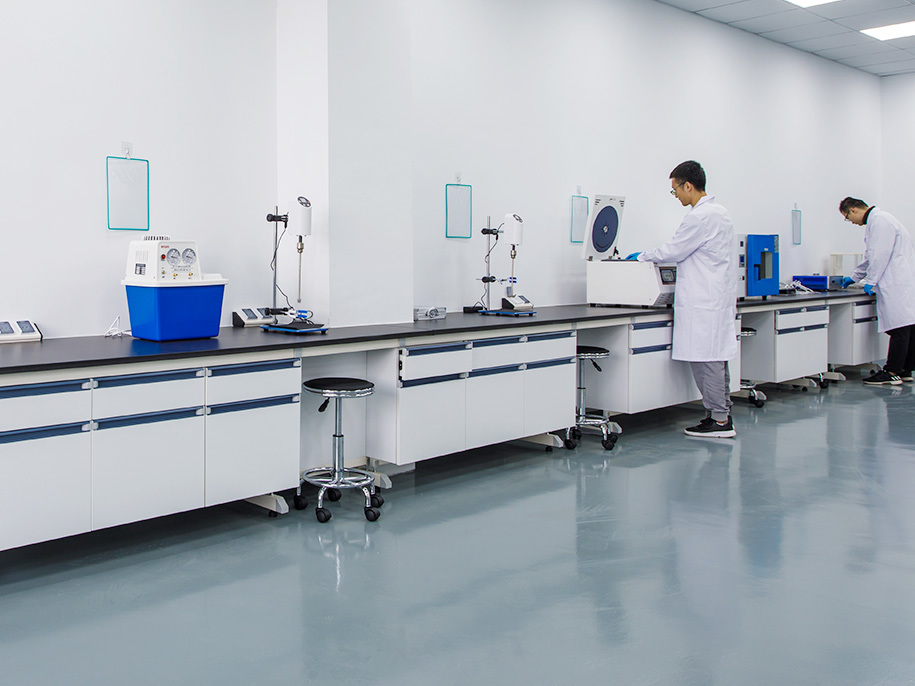
Every project begins with laboratory-scale development.
Typical activities include:
- Material characterization
- Dispersion optimization
- Initial performance testing
- Compatibility studies
- Proof-of-concept experiments
At this stage, the objective is to confirm that the material has the desired functional properties.
However, laboratory validation alone cannot predict industrial performance.
Step 2: Pilot Manufacturing
Pilot production bridges research and industrial manufacturing.
Pilot trials verify whether the material can be produced consistently under realistic process conditions.
Typical objectives include:
- Scaling dispersion processes
- Optimizing coating parameters
- Verifying production repeatability
- Producing engineering samples
- Evaluating process stability
Pilot manufacturing transforms a research material into a manufacturable product.
Step 3: Customer Sample Evaluation
Once pilot samples are available, customers begin application-specific testing.
Depending on the industry, evaluation may include:
Battery Applications
- Cycle life
- Rate capability
- Electrode processing
- Conductivity
Thermal Management
- Thermal conductivity
- Heat spreading efficiency
- Reliability
Conductive Coatings
- Surface resistance
- Adhesion
- Environmental durability
At this stage, close collaboration between supplier and customer becomes essential.
Step 4: Manufacturing Qualification
Successful technical performance is only one part of qualification.
Customers also evaluate manufacturing capability.
Typical considerations include:
- Production capacity
- Process control
- Quality management
- Raw material traceability
- Delivery reliability
A material with excellent laboratory performance may still fail qualification if manufacturing cannot meet industrial requirements.
Step 5: Process Optimization
Customer feedback often leads to further optimization.
Typical improvements include:
- Formulation refinement
- Dispersion adjustment
- Coating optimization
- Process window expansion
- Cost optimization
Commercialization is usually an iterative engineering process rather than a single validation event.
Common Challenges During Qualification
Many advanced material projects encounter obstacles such as:
- Inconsistent pilot batches
- Differences between laboratory and production performance
- Narrow process windows
- Equipment compatibility issues
- Supply-chain scalability
Addressing these challenges early improves the probability of successful adoption.
The Importance of Cross-Functional Collaboration
Commercial qualification requires cooperation between multiple teams:
- Material scientists
- Process engineers
- Manufacturing specialists
- Quality engineers
- Customer R&D teams
- Procurement departments
Successful projects balance material performance with manufacturability and commercial practicality.
Building Long-Term Customer Confidence
Industrial customers value more than technical specifications.
They also expect:
- Consistent quality over time
- Reliable production schedules
- Responsive technical support
- Continuous process improvement
- Stable long-term partnerships
Trust is established through proven manufacturing capability as much as through material performance.
Future Trends in Advanced Material Qualification
As industries adopt increasingly complex materials, qualification processes are becoming more data-driven.
Future developments may include:
- Digital quality monitoring
- AI-assisted process optimization
- Real-time manufacturing analytics
- Predictive quality control
- Integrated pilot-to-production data management
These technologies will help accelerate commercialization while maintaining product reliability.
Commercializing advanced carbon materials involves much more than developing excellent laboratory performance.
The journey from pilot production to customer qualification requires consistent manufacturing, rigorous quality control, application validation, and close collaboration with end users.
Companies that successfully integrate material innovation with scalable production and customer-focused qualification processes will be best positioned to bring advanced carbon technologies into real industrial applications.