
The Future of Solvent-Free Battery Manufacturing
Battery manufacturing has entered a new stage of development as demand for higher energy density, lower production costs, and more sustainable processes continues to grow.
Traditional lithium-ion battery production relies heavily on wet electrode processing, where active materials, conductive additives, and binders are mixed with solvents to create slurries.
Although this approach is mature and widely used, it also introduces several challenges:
- High energy consumption during drying
- Large-scale solvent recovery requirements
- Complex manufacturing systems
- Environmental and operational costs
Solvent-free battery manufacturing, particularly through dry electrode technology, is emerging as a potential pathway toward more efficient and sustainable battery production.
However, the transition from laboratory concepts to industrial manufacturing requires significant engineering innovation.
Understanding Solvent-Free Battery Manufacturing
Solvent-free manufacturing eliminates or greatly reduces the use of liquid solvents during electrode production.
Instead of preparing a slurry, dry processes typically rely on:
- Dry powder mixing
- Solid-state material blending
- Powder forming
- Dry coating
- Direct electrode fabrication
The goal is to simplify production while maintaining or improving electrode performance.
Why the Industry Is Exploring Solvent-Free Processes
1. Reducing Energy Consumption
In conventional wet electrode manufacturing, large drying ovens are required to remove solvents after coating.
These drying systems consume significant energy.
Removing solvent evaporation can potentially reduce:
- Factory energy demand
- Equipment footprint
- Production complexity
2. Simplifying Manufacturing Lines
Wet electrode production requires multiple steps:
- Slurry mixing
- Coating
- Drying
- Solvent recovery
- Electrode conditioning
Solvent-free approaches may reduce process complexity by eliminating several solvent-related operations.
3. Improving Environmental Sustainability
Solvent-free manufacturing can reduce:
- Solvent emissions
- Chemical handling requirements
- Waste generation
This supports the battery industry’s transition toward more sustainable production methods.
The Role of Dry Electrode Technology
Dry electrode manufacturing is currently one of the most promising approaches for solvent-free battery production.
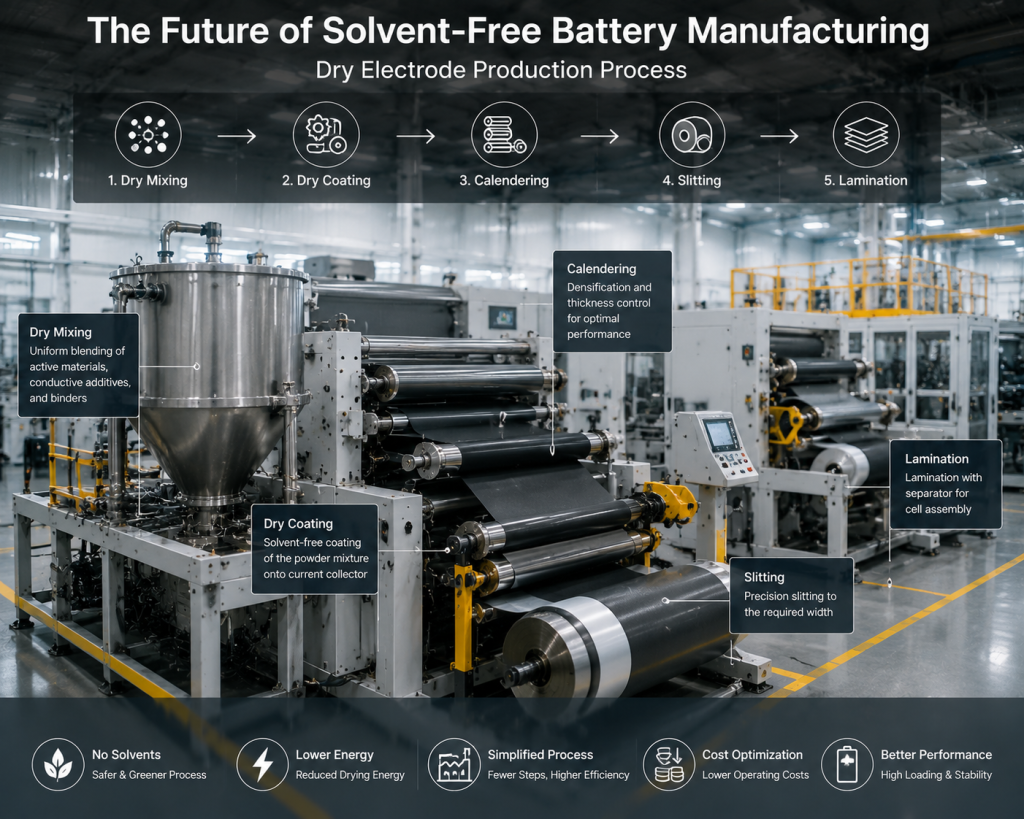
A typical dry electrode process includes:
- Powder mixing
- Conductive network formation
- Dry film creation
- Lamination onto current collectors
The technology aims to achieve high-performance electrodes without traditional slurry processing.
Advanced Carbon Materials in Solvent-Free Electrodes
Advanced carbon materials play an important role in enabling dry electrode technologies.
Carbon Nanotubes (CNT)
CNTs provide:
- Strong conductive networks
- Mechanical reinforcement
- Improved particle connectivity
Their high aspect ratio allows efficient conductivity at relatively low loading levels.
Graphene
Graphene contributes:
- Large-area conductive pathways
- Mechanical strength
- Structural support
It can improve electrode architecture when integrated properly.
Hybrid Carbon Networks
Combining CNT and graphene can create:
- Three-dimensional conductive structures
- Improved mechanical stability
- Better electrical performance
Hybrid carbon systems are increasingly explored for next-generation dry electrode designs.
Manufacturing Challenges of Solvent-Free Processes
Despite the advantages, industrial adoption faces several challenges.
Powder Mixing Control
Without solvents, achieving uniform distribution becomes more difficult.
Critical factors include:
- Particle dispersion
- Material interaction
- Mixing energy
- Powder flow behavior
Electrode Density Control
Dry processes must achieve the right balance between:
- High active material loading
- Mechanical stability
- Ion transport pathways
Incorrect density can negatively affect battery performance.
Mechanical Integrity
Without traditional slurry binders, maintaining electrode strength becomes challenging.
Manufacturers must control:
- Binder distribution
- Fiber formation
- Particle bonding
Equipment Development
Existing battery production lines are mainly designed for wet processing.
Dry manufacturing may require:
- New mixing systems
- Specialized coating equipment
- Modified compression processes
- Advanced quality monitoring
The Importance of Pilot Manufacturing
Pilot validation is essential before large-scale adoption.
Pilot lines allow engineers to evaluate:
- Material processability
- Continuous production stability
- Electrode quality
- Equipment compatibility
- Manufacturing yield
A successful laboratory experiment does not guarantee industrial success.
Pilot manufacturing provides the bridge between innovation and commercial production.
Solvent-Free Manufacturing and Battery Scale-Up
Future gigafactories require manufacturing systems that are:
- More energy efficient
- More sustainable
- More compact
- More cost competitive
Solvent-free technologies could help achieve these goals by reducing:
- Factory footprint
- Energy consumption
- Process complexity
However, scalability remains the key challenge.
Future Development Trends
1. Higher Energy Density Electrodes
Dry processes may enable:
- Thicker electrodes
- Higher active material loading
- Improved cell-level energy density
2. Integration with New Battery Chemistries
Solvent-free methods may support:
- Silicon anodes
- Solid-state batteries
- Advanced lithium systems
3. Intelligent Manufacturing Control
Future production will increasingly use:
- Real-time monitoring
- AI-based process optimization
- Automated quality control
4. Expansion of Pilot Production Platforms
Pilot manufacturing facilities will become increasingly important for:
- Technology validation
- Customer qualification
- Industrial scale-up
From Technology Concept to Industrial Reality
The future of solvent-free battery manufacturing depends on more than eliminating solvents.
Successful commercialization requires integration of:
- Material engineering
- Process development
- Equipment innovation
- Quality control
- Manufacturing expertise
The companies that successfully combine these elements will be better positioned to lead the next generation of battery manufacturing.
Solvent-free battery manufacturing represents a significant opportunity to transform the future of battery production.
By reducing energy consumption, simplifying manufacturing processes, and improving sustainability, dry electrode technologies could reshape how lithium-ion batteries are produced.
However, industrial adoption requires solving complex challenges in materials, equipment, and process control.
Pilot manufacturing will remain a critical step in proving that solvent-free technologies can achieve the reliability, consistency, and scalability required for commercial battery production.
The future of batteries will not only depend on better materials—it will depend on better manufacturing systems.