

CNT vs Graphene: Which Conductive Material Is Better?
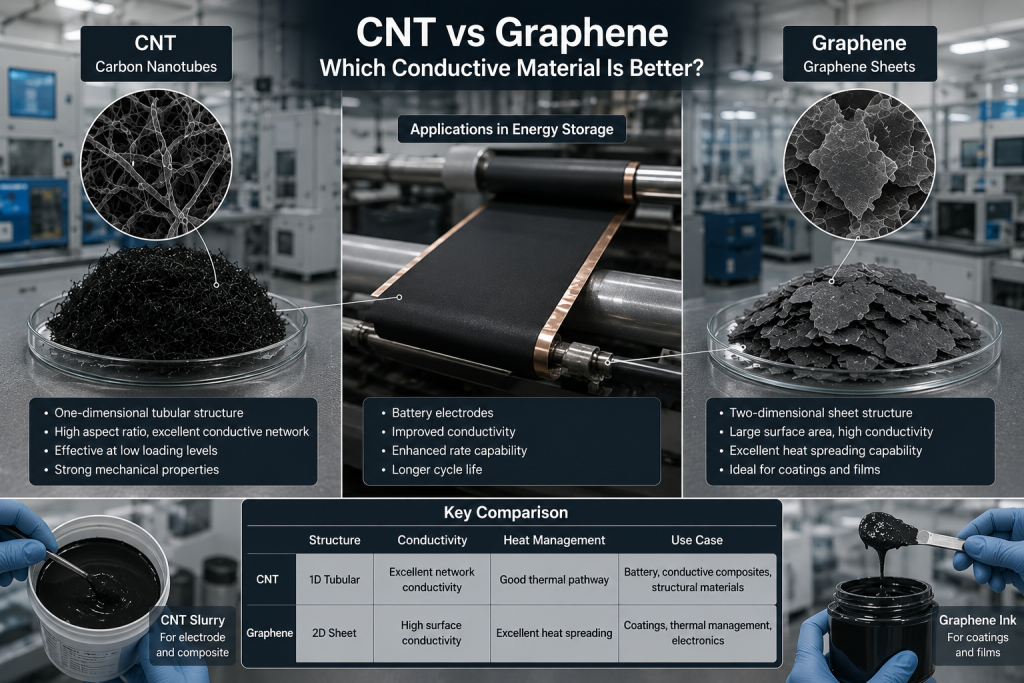
Carbon nanotubes (CNTs) and graphene are among the most widely studied advanced carbon materials in modern materials science.
Both offer exceptional electrical conductivity, mechanical strength, and chemical stability, making them attractive for applications ranging from lithium-ion batteries to conductive coatings and thermal management systems.
As these materials become increasingly available for industrial use, one question is frequently asked:
Which conductive material is better—CNT or graphene?
The answer is not straightforward.
Rather than competing technologies, CNTs and graphene provide different structural advantages that suit different engineering requirements.
Choosing the right material depends on the desired function, manufacturing process, and commercial objectives.
Understanding the Structural Difference
Although both materials are composed entirely of carbon atoms, their structures are fundamentally different.
Carbon Nanotubes (CNTs)
CNTs are cylindrical nanostructures formed by rolling graphene sheets into tubes.
Their one-dimensional geometry creates long conductive pathways that efficiently connect particles throughout a material.
This makes CNTs highly effective for building conductive networks inside composites and battery electrodes.
Graphene
Graphene is a two-dimensional sheet of carbon atoms arranged in a hexagonal lattice.
Its broad surface area provides excellent in-plane conductivity and efficient heat spreading across large surfaces.
Graphene is particularly attractive for applications involving coatings, films, and thermal management.
Electrical Conductivity: Different Ways to Conduct
Both materials are highly conductive, but they achieve conductivity differently.
CNT: Building Conductive Networks
CNTs excel at forming interconnected conductive bridges between particles.
Their extremely high aspect ratio allows them to establish electrical pathways even at relatively low loading levels.
Typical applications include:
- Battery conductive additives
- Conductive polymer composites
- Anti-static materials
- EMI shielding compounds
Graphene: Creating Conductive Surfaces
Graphene provides continuous conductive sheets over large areas.
Its structure is well suited for:
- Conductive coatings
- Flexible electronic films
- Transparent conductive layers
- Printed electronics
Rather than connecting particles, graphene primarily enhances surface conductivity and electron transport across thin films.
Thermal Performance Comparison
Heat management is becoming increasingly important in modern electronic systems.
Graphene Advantages
Graphene possesses outstanding in-plane thermal conductivity.
It is often explored for:
- Heat spreading layers
- Thermal interface coatings
- Electronic cooling systems
- AI server thermal management
Its large surface area helps distribute heat efficiently.
CNT Advantages
CNTs also contribute to thermal transport by forming interconnected pathways within composite materials.
They are commonly used to improve thermal conductivity in:
- Polymer composites
- Structural materials
- Functional fillers
Mechanical Reinforcement
Mechanical performance is another important consideration.
Graphene
Graphene can improve:
- Surface hardness
- Barrier properties
- Coating durability
- Structural stiffness
Its sheet-like structure reinforces thin films and layered composites.
CNT
CNTs are well known for:
- High tensile strength
- Excellent flexibility
- Crack resistance
- Reinforcement of polymer matrices
Their fibrous structure helps distribute mechanical stress throughout a material.
Manufacturing Considerations
Industrial success depends not only on material properties but also on process compatibility.
Several manufacturing factors influence material selection.
Dispersion Stability
Both CNTs and graphene tend to aggregate because of strong interactions between carbon particles.
Achieving stable dispersion requires careful formulation, appropriate mixing methods, and optimized processing conditions.
Process Compatibility
The preferred material may depend on the manufacturing process.
Graphene is commonly used in:
- Thin-film coatings
- Slot-die coating
- Roll-to-roll manufacturing
- Spray coating
CNTs are widely used in:
- Electrode formulations
- Composite compounding
- Conductive plastics
Cost and Loading
Performance is not determined solely by conductivity.
Engineers also evaluate:
- Material loading
- Processing efficiency
- Manufacturing cost
- Product consistency
The most economical solution is often the one that delivers sufficient performance with stable production.
Typical Industrial Applications
Carbon Nanotubes (CNTs)
CNTs are frequently selected for:
- Lithium-ion battery electrodes
- Silicon-rich anodes
- Conductive polymers
- Structural composites
- Electrostatic discharge protection
Graphene
Graphene is commonly explored for:
- Thermal management coatings
- Conductive films
- Corrosion-resistant coatings
- Flexible electronics
- EMI shielding surfaces
When Hybrid Systems Offer the Best Solution
Many commercial products no longer rely on a single conductive material.
Instead, engineers combine CNTs and graphene to create hybrid carbon networks.
In these systems:
- CNTs provide three-dimensional conductive bridges.
- Graphene creates two-dimensional conductive and thermal pathways.
The combination can improve:
- Electrical conductivity
- Heat dissipation
- Mechanical stability
- Overall material efficiency
Hybrid formulations are becoming increasingly important in batteries, coatings, and advanced electronic materials.
The Role of Pilot Manufacturing
Selecting a conductive material is only the first step.
Industrial adoption requires pilot-scale validation to verify:
- Dispersion stability
- Process repeatability
- Coating uniformity
- Electrical consistency
- Manufacturing scalability
Pilot production helps identify process limitations before full-scale commercialization.
How to Choose the Right Conductive Material
Instead of asking:
“Which material is better?”
A more practical engineering question is:
“Which material best fits my application and manufacturing process?”
Selection should consider:
- Electrical performance requirements
- Thermal management needs
- Mechanical properties
- Processing method
- Production cost
- Scale-up feasibility
The optimal choice is often application-specific rather than universally superior.
Future Outlook
As advanced manufacturing continues to evolve, material systems will become increasingly sophisticated.
Future developments are expected to focus on:
- Hybrid CNT–graphene architectures
- Multifunctional conductive materials
- Sustainable manufacturing processes
- AI-assisted material optimization
- Pilot-scale validation for rapid commercialization
The future of conductive materials will be driven not only by material innovation but also by manufacturing capability and application engineering.
CNTs and graphene are both exceptional conductive materials, but they address different engineering challenges.
CNTs are highly effective at building interconnected conductive networks within composite materials, while graphene provides outstanding surface conductivity and heat-spreading capability.
Rather than viewing them as competing technologies, engineers should evaluate them based on application requirements, manufacturing compatibility, and long-term commercial objectives.
In many advanced applications, the most effective solution is not choosing one over the other, but combining both materials into an optimized hybrid carbon system that balances performance, scalability, and cost.